
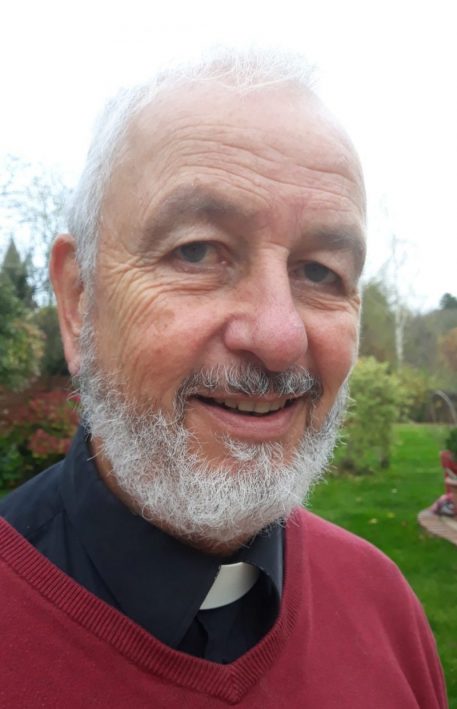
Father Doug

Click on the link for the live stream:

Sermons:
Easter 2026
Have you been following the space ship Artemis to the moon? Not literally, obviously, but on the television. It’s been terrific. A great bit for me was the very start – the ignition when the rocket fuel exploded into flame and energy. It’s a great image as the rocket comes to life. Actually, there’s a lot of similar images around Easter as we celebrate the dead, broken body of Jesus coming to life. At the beginning of the vigil (*) we lowered the candle into the fire and the wick burst into flame with a fizz, just as life returned to the corpse of Jesus. A great cosmic moment to be celebrated in human kind, because Jesus showed us the way we all must go. And there are so many other symbols besides the Easter Candle: our wonderful Easter Garden, with its empty tomb, the newly blessed baptismal water, the sacred oils, our beautiful statues unveiled, images of those who live in heaven, the beautiful flowers representing nature’s celebration of life, all shouting aloud – The Lord is risen!
On Good Friday we recalled how Jesus died for a cause, namely that no one can be excluded from God’s love for any reason. But he claimed that in future he would give us himself as the way to reach God. But only when he rose from the dead did we begin to see exactly what he was giving us. In the garden of Gethsemane Jesus surrendered his life to the Father, gave it up as a sacrifice. He hoped that his Father would bring him through and for sure, he did. It is the same hope we have when we surrender or entrust our lives to God and so we can also trust that God will bring us through. We can go anywhere he leads us and we will be safe or saved, even if it it’s not where we might choose to go. Hope in God enables us to endure anything in life.
We live in hope – in him, and that is different from living with optimism or wishful thinking. If we are optimistic, we expect the right result, and live with disappointment if we don’t get it. If we surrender our lives to God’s will, making that act of faith and trust in him, we get to live in hope. Getting the outcome, we wish for doesn’t matter because God is with us, and we together will always end up in a better place.
It is also how we give witness to Christ’s risen presence in our lives. With a little reflection we can all recall times when we have had to endure something we didn’t fancy and yet have reached a better place. When people share their blessings, especially when these blessings are found in the midst of difficulty they give witness to God’s presence and his ability to redeem matters – to the resurrection, in other words. To see the light amidst the darkness, freedom beyond any suffering, new life beyond death – This is what it is to be a Christian.
So, don’t be too terrified to carry your own personal cross, Jesus says, because joys lie ahead. If we place our hand in his like a child does with a parent, we will be safe, we need fear nothing. He will even lead us through death when that time comes. He knows the way, he has shown us the way, indeed, he is the way, in life and in death.
Fifth Sunday of Lent. Year A, 2026
What an amazing moment we’ve just heard about; Jesus called Lazarus out of the tomb. Imagine him shuffling out, wrapped up in his burial cloths. Jesus ordered: Unbind him. Let him go free.
This was the last of the 7 great signs of Jesus recorded in John’s gospel. It showed His power even over death. Jesus taught: “I am the resurrection and the life; whoever lives in me will never die.” He meant this in a spiritual way, but this physical demonstration had an impact. All Jerusalem was talking about it. His followers were amazed. His enemies were terrified. In fact, it was the last straw for them. He had to be got rid of!
What did Jesus mean: “unbind him, let him go free?” He wasn’t just asking for the burial cloths to be removed. Nor was he saying that Lazarus would never die. He was saying that Lazarus could now live life free from the fear of death. And that’s what our hope in Jesus means. God wants us to live our lives free from fear, full of hope instead. We know that we are not on our own in life. Jesus is with us. But death is another matter. We may still fear death, but Jesus will be with us, and if we turn our lives over to Him, we need fear nothing. We can live with a freedom that only He can give – like the peace that only he can give, a peace the world cannot give.
We may recognise this freedom and peace. I have seen it in several people. For instance, in a wartime bomb disposal officer I used to know. Back in January I took a mid-week break in Malta and while I was there I made a pilgrimage to Mosta Basilica. Famously in April 1942 during an air raid, there were 300 people in the church in prayer. A 500kg bomb came through the domed roof and landed in the nave, but it didn’t explode and the people inside emerged unscathed. A British army team, led by George Patrick Carroll defused the bomb, and I saw the plaque celebrating him and his team there next to the unexploded bomb. Now this Pat Carroll, as I knew him, was a golfing partner of mine from Rainham parish. He’s died since, but I was proud to visit Mosta and pay tribute to him. He was an amazing man. He told me that each time he had to disarm a bomb he prepared by offering – giving up – his life to God and each time he survived, he thanked God for giving him his life back. Well he lived life with a real freedom. He was fearless, not reckless, well except near bunkers! He didn’t fear death and stayed close to God. Others who’ve been close to death can live this way too, but it is what God wants for all of us.
The promise of God’s presence in our lives was given in our baptism, and our response should be to offer our lives back to God – as we try to do in the Offertory Procession at mass along with the other gifts that are brought forward. We ask that these gifts be joined to the sacrifice that Jesus made at Easter, when he gave his life to us all – for eternity. Eternal life does not begin when we die; it began with our baptism. We can live in this freedom right now, if we truly believe in who Jesus is, and how much he cares, and if we place our hope in him. Like we did as children, we can put our hand along with our hope in the hand of another and fear nothing, we can be totally free.
So, as Lazarus was, we can be: free from worldly cares, from fear of death even; free instead for life with God, in friendship with him through his Son. We can have life and have it to the full. And that is precisely what God wants for us all. It has been his plan all along.
Fourth Sunday of Lent, Year A, 2026
Lent is about transformation. The Sunday gospels are selected to illustrate this. On the first Sunday we heard about the temptations of Jesus. He lived as we all do with temptations, limitations of being human. In his 40 days he faced, overcame and got past them and was transformed. On the second Sunday we heard about his Transfiguration. He appeared transformed into a life beyond suffering and death. Last week we heard about the women at the well and how she was transformed in faith. And this week we hear about the man who was born blind and how his life was transformed.
Like with the woman at the well, his transformation was gradual, in stages. On his first encounter with Jesus he experienced compassion. Jesus met him and loved him. The expression of love was in giving the man sight. The man’s life was transformed from darkness to light. And he gave witness. To anyone who asked, he responded: “Yes I am the one.” He reflected on his experience, and realised that he’d had a special encounter, that he’d experienced at least a prophet!
But by chance, his cure was a little bit awkward, embarrassing to the authorities because it occurred on the Sabbath. They figured it couldn’t be right, that something dodgy was going on. Jesus must be coming from the dark side. But even under interrogation the man was adamant and told the authorities: “yes it was me, I was cured, a great prophet was responsible, I will not deny it.” A brave and defiant witness. The mighty temple authorities drove him away but he took it on the chin.
Jesus chased after him to engage in a further encounter.
Do you believe in the Messiah?
Tell me who he is.
I who am speaking to you, I am He.
Well then, I do believe that you are the Christ, the Messiah who has done great things for me.
The man first received sight but he later went on to receive insight into the presence of Jesus in his life and in his world – A bit like Mary perhaps, when she recognized the good news and, in her response, prayed: “The Almighty has done great things for me. Holy is His name.” The man came to complete faith, he was transformed through two encounters with Jesus.
But how many encounters have you and I had? Many more! The transformation in us must continue. We must give witness, just as the man did, to the marvelous things that God has done and continues to do for us, transforming us during this time of Lent – and we let him, hopefully. So, it is good to allow him a few moments of silence often, so that he can reassure us: “Yes I am the one,” He will say, “I am the one with you. I am He.”
With the Samaritan woman the transformation took place in the course of the conversation. With the man today, just two steps have been picked out, but for us there are many more steps. Like them both, we can be witnesses in many ways but a great opportunity will present itself to us in a few weeks with the opportunity to actively participate in the Easter liturgy. First, we can give witness and support to each other by coming to church. We can literally be here for each other. But we can give witness to others as well. And it is a good thing to do:
On Holy Thursday at the Mass of the Lord’s Supper we can hear and experience Jesus wedding us, promising his life to us both in service and in death. On Good Friday we remember his passion and we hear him marrying us, actually giving his life for us, in sacrifice. And on Easter Saturday we celebrate the Day of Glory and Liberation for us all. The worst darkness of humanity is made light, enlightened.
So yes, let everyone know. Let your families know. Let your friends know. Tell them that you’ll say a prayer for them when you are here. Or better still bring them too. Say as Jesus said, “Come and see.”
Third Sunday of Lent, Year A, 2026
The week before last I was on the diocesan clergy conference. It was up near Nottingham so I went by train. In days gone by people would start talking to each other, and my carriage was full but both ways, but it was nearly silent. On buses it’s slightly different. I was on a bus up to Bexleyheath with 2 supermarket shopping bags. The person next to me began a conversation; “You going shopping?” “Yes, I am.” “In Bexleyheath?” “Yes”. Well the conversation didn’t go much deeper than that, and nor did our newly made friendship. But things can go deeper and relationships can develop, if we want them to, if we are deliberate in conversation, listening and speaking. Look at what happened in today’s gospel.
At the sixth hour, which is 12 noon, Jesus stops at Jacob’s well. Just then a woman also comes to the well, to fetch water. Now there is a reason why she is coming to the well at that time of day. The rest of her townswomen would have collected water at the beginning of the day before the burning midday sun. The fact that she came at midday in the heat, on her own, tells us that she was for some reason isolated from everyone else. We find out why, later: she has been ill-used by a number of men and has a bad reputation. Now water is vital of course. We know a straightforward thirst for a drink but we are also aware of other thirsts, perhaps more deep-down thirsts. And it is both kinds of thirst that are given attention in this humorous narrative of Jesus at the well with the Samaritan woman.
Jesus, a Jewish man asks her for a drink of water. Well, a decent Jewish chap just wouldn’t do that, humbly express a need to such a woman, a Samaritan at that. Jesus has taken a risk to enter this conversation and instigate a relationship. She offers a sarcastic reply. But Jesus takes it deeper and says that he could offer her living water, and the two of them have a bit of a banter. This living water that he says he can offer, can go deep and satisfy a much deeper thirst in the woman. We see the conversation go deeper and the relationship go deeper. He brings her to Faith. Actually, this is why we are hearing this gospel today in the middle of Lent, a time when hundreds of people in our own diocese and hundreds of thousands around the world are preparing to join the church on Easter night. Several will do in our parish, in fact, and our prayer is that they will deepen that conversation with the Lord and grow deeper into friendship with him.
It is sad to note the lack of conversation going on in our world. I think that social media encourages people to simply express opinions and not necessarily listen to others or enter conversation. The world is not better when world leaders do the same. Opinions are expressed, little is actually discussed.
God does want to enter conversation with us. He wants to listen to our needs and share with us his living waters to satisfy our thirsts. If we allow ourselves to enter this conversation, his love, his grace will penetrate or permeate deeper into our souls just as it did with the woman at the well. God’s Spirit found a way deep into her being and brought her alive. She recognised what had happened and went back to tell the whole village of her new Faith in Jesus. On her testimony they were convinced and they came to meet Jesus, themselves, and then came to Faith.
Jesus and the woman shared a sacred space in conversation. In Lent we are invited to enter this same sacred space and allow that Living Water, God’s Spirit to flow down through the cracks that are our needs and reach right down into our souls.
Second Sunday of Lent, Year A, 2026
Did you watch any of the Winter Olympics? I did, and I won’t pretend that I didn’t wish I could have been there, although if I was I would probably have been complaining about the snow. It just kept on coming down by the bucketful, didn’t it? It disrupted the events and it even stopped athletes and others from getting to them. From my own experience, it really isn’t good to be skiing when it is snowing that hard, you just can’t see anything. It is frightening and quite dangerous. You just hope and pray for a bit of a break in the snow and a glimpse of the way ahead.
Well that glimpse of the way ahead is what we are hearing about in today’s gospel, the transfiguration. The disciples had been following Jesus on a long but very strange and mysterious path. They must have been having doubts and difficulties, conflicts and confusion. And Jesus must have been having his own doubts too. He had much to ask his Father about. Anyway, he took Peter, James and John up the mountain with him to be with him as he prayed about these things. We might talk of there being a ‘cloud of unknowing’ surrounding Jesus and his mission. But there on the mountain, Mount Tabor, we’re told, the cloud of unknowing lifts for a short time and then everything is clear. The disciples could see Jesus for who he was AND for who he was to be … in glory. The way ahead would lead to a good place. It was enough to reassure them. They could carry on with a bit more confidence and hope in where it was all leading. Their glimpse of the way ahead was enough.
Now there are plenty of times when we have questions about where things are going, doubts perhaps about matters of faith, about whether we’re on the right track. There are times when nothing seems at all clear, times when we are baffled, like when we glimpse the pain and suffering that people sometimes experience.
There are such dreadful things happening in Gaza and Palestine, in Ukraine, in Sudan and now in Iran – many other places too. At such times we need to remember those moments when the veil has lifted, when there has been a clearing in the cloud, when everything has been transfigured so that we’ve glimpsed God truly present in the midst of it all, even in suffering. We need to remember these times when things seem to make sense. We do have such moments. So, the narrative should not be that once it seemed clear but now it doesn’t. It should be that I have had moments of clarity and so now I trust that if I keep going in the same direction I will get to the place I am meant to reach. The glimpse of the way ahead is enough to keep me going.
And it is reasonable that we should pray for these occasional epiphanies and revelations and when we do receive them to treasure them and store them up for the moments we will need them. Our life journeys to the heart of God are made in faith and hope. For the most part, we have to carry on trusting and hoping, living in and with Faith. Much of the time we may feel we are in the dark but every now then there will be a rich and glorious moment of clarity. God knows what each of us needs and he will provide the insights we require to travel safely. The transfiguration on Mount Tabor was a wonderful gift granted by the Father to encourage Jesus and his disciples and show them the way home. We have reason to believe that God will be able to guide us home as well.
First Sunday of Lent, Year A, 2026
Why is it, that on Wednesday, I was so hungry when normally I am not bothered at all? Well, it was Ash Wednesday of course, a day of fasting and abstinence. When I can’t have it, that’s when I want it most. It’s a funny thing being human, isn’t it, living with temptation? Very inconvenient! But the Gospel happily, gives us great hope as we hear Jesus dealing with it. He doesn’t duck the issue.
The Book of Genesis takes us back to when we were created. We hear the story of the Garden of Eden, and Adam and Eve. In the garden was the tree of good and evil, but no one was supposed to eat its fruit. So, every day, Adam and Eve resisted, but they couldn’t help but wonder what it was like, so inevitably one day, they gave in. Eve ate and Adam tried it too. Theirs was the original sin but the same tendency is in our lives as well. We are subject to that original sin. We inevitably turn away from God, eventually, even if it’s only to just see what it’s like.
In our psalm we prayed for God’s mercy, humbly admitting that we do sin, ‘our offences, truly we know them’, the psalmist says, and we responded with a prayer: ‘have mercy on us O Lord’. In the letter to the Romans, St. Paul observed that sin leads to death, by which we understand the death or destruction of relationships, of trust, of freedom and so on. By contrast, Jesus offers us the gift of life, with relationships restored and trust and freedom re- established.
Jesus experienced those times of temptation and got through them. He doesn’t wait for us on the other side. He is right there with us in our mess, supporting us. He went into the wilderness to reflect upon his mission and destiny as a human being and to face all that would hold him back. He took on 40 days of prayer and fasting to get on top of being truly human including dealing with temptations, classic ones, that we may recognise:
The first is to satisfy every need and desire, to ‘scratch every itch’. He resisted the temptation to turn the stones into bread: “man does not live on bread alone”, he says. To be human is bigger than that. He can do without it. But nowadays the instant gratification of desire is possibly the norm.
Next, he faced up humbly to the limitations of the human being that he was. He resisted the temptation to jump off a parapet and wait for God to rescue him. He would have fallen to the ground and died, unless…, well, he did not put God to the test. He accepted who he was. We too can be tempted to want to be someone we are not. We should accept who we are with gratitude to our Creator. Each of us is the person God wants us to be with the body he designed and gave to us.
Finally, Jesus overcame the lust for power. We need to be wary of self-interest and when we are tempted, we should say with Jesus, ‘Be off, Satan’.
So, the 40 days of Lent lie ahead for us to work on ourselves. We can step into the wilderness, as Jesus did, and find the space to consider our mission and our lives, to see more clearly what is going on for us. And like Jesus did, we can seek to develop through our acts of penance, the strength we need to further our mission, in seeking a deeper union with God AND with each other. And thus, we draw alongside Jesus in his journey through life, into death and beyond, to eternity. That’s what Lent is about.
Sixth Sunday, Year A, 2026
A few Sundays ago, someone said to me “I’ve got it sussed, I’d been trying to figure out some link between the readings and the eucharistic prayer that we use, but then I realised that you simply use prayer 2 on even-numbered weeks and prayer 3 on odd-numbered weeks”. And it is as trivial as that, but I did give credit for TRYING to look deeper! More importantly, I saw someone this week who is normally quite mild mannered and deferential, but who was quite angry, and inappropriately so. There was no need to get so up tight about the trivial issues that were at stake. Later though, in conversation I found out that a dear friend of hers had recently died. She said that this had nothing to do with it, but it did. Anger is often part of the grieving process, as we know. Families can even fall out with each other, when a parent dies, for instance. But it is one thing spotting something going on at a deeper level in someone else. The trick is to have the wisdom to see it in ourselves, to spot the connection or motivation deep down that prompts our behaviour. Then the challenge is not just to see it but to find the moral strength to change things deep down if necessary.
Wisdom enables us to read beneath the surface or face value, deeper into a situation so that we can judge what is going on, and then we can then choose the better path. It is this wisdom that Jesus is speaking of in the Gospel. He tells us that it is good to abide by the law, but we must also look deeper. It’s clearly a good thing not to go about murdering people. But Jesus challenges us to look deeper and address any anger that might be provoking such a violent intention. This involves knowing and understanding ourselves, our feelings and our instincts. It is Wisdom. We must know ourselves, literally inside out, to notice what is going on in our hearts before deciding what to do. Because deep down in our hearts we will find a sacred presence of God – whom we should both fear and revere.
But the wise person will also reverence that same real presence of God in other people and so any anger will have to be dealt with in this context. The anger may then subside, and be replaced with understanding, or even reconciliation. Forgiveness is perhaps the most challenging form of love there is. Jesus hardly ever missed an opportunity to talk about it.
So it is important to see both ourselves and other people, as children of God, each one sacred to God, loveable even when doing wrong. Once this is acknowledged, much else will follow. The wise person does not objectify anyone, for any reason, and is the one who avoids labelling others through gender, colour, faith tradition, nationality – whatever. When we label people, we give ourselves permission to not treat them as individuals, as children of God. That’s how we hurt people, who are sacred to God. In wisdom we genuinely want everyone to enjoy dignity, happiness, and justice. It is the Way that Jesus lived his life as a human and he tells us that we would be wise to do the same.
‘Yes, obey the rules’, Jesus says, but go deeper into their purpose and act out of the depth or centre of your being with love and then all your thoughts, words and actions will be clearly wise and will help make the world a better place. See, judge, act! What could be wiser than that?
Fifth Sunday, Year A, 2026
Around here we are blessed with places to walk – so many within easy reach. Occasionally, I drive up onto Blackheath and then walk down through Greenwich Park, then through the tunnel under the Thames to the Isle of Dogs, through Millwall Park into City Farm, then to emerge in Docklands. Recently, I wanted to stop at the Farm because I’d heard about some magnificent giant pigs that were there, Snuffles and Ruffles. There was a prominent sign saying “To the Pigs”. But in actual fact… it wasn’t really necessary… You didn’t need a signpost… There was a much better sign – in the air as it were! The smell was unmistakeable.
“Essence of Pigs”, I’d call it. The whiff of pigs was really part of the pigs. To smell the smell was to be in the proximity of pigs. The sign contained something of that which it signified. Now, you and I are meant to signify the presence of the Church. We are meant to be “Essence of Church”, to have the whiff of Church about us! The Church has a whiff of Jesus. Where the Church is, there you’ll find God. Jesus promised us that. It may be the job of Church leaders to make sure that Jesus is easily identified in the Church but it is definitely our job to ensure that our lives pass that on. In other words, the Light of Christ must be in plain view, not hidden under a lampstand.
Jesus offered us a challenge: “Seeing all your good works”, he said, “people will give praise to your Father in heaven”. Seeing you they will see the Church, seeing the Church they will see Him and seeing Him they will see His Father. This is what we mean by sacrament, ‘an outward sign of an inner reality or grace’, as the catechism used to tell us! And this is how our lives, the Way that we live, plays a crucial role in the Coming of the Kingdom, the Mission of Christ. If people see our good works, then with a little reflection they will see God’s hand behind it all. If people see the Church as Jesus wants the Church to be, they will see him. That’s what he’s telling us.
To see the church being what the church is meant to be, and doing what it is meant to do, is to see Jesus continuing to be as he was, and to be doing what he did. And we see this in the seven sacraments of the Church. In baptism we see Jesus continuing to call disciples or followers. In Reconciliation he offers forgiveness. In Holy Communion he feeds his people. In Confirmation he inspires, through his spirit, a mission to the world. In marriage he reveals himself in the love that the couple show each other. Through Holy Orders he continues to preach and teach. In the Sacrament of the Sick he heals.
These liturgical sacraments are celebrated in bad taste though, if they do not match a lived-out reality. We shouldn’t for instance receive Holy Communion with someone who we then give a good thumping to. We just heard the prophet Isaiah saying this from way back when. So, on the lampstand, the world should see real love, in our mission, in our actions.
It is crucial for us to take our mission out the door of the church. Our lives need to reveal the presence of God as obviously as does, in particular this altar, the centre and visible focus of our church, a stone slab made for the offering of sacrifice. That sacrifice of Jesus, giving his very life to us all is at the heart of our faith. He asks us to follow and do likewise. That’s what Jesus means by putting the light on a lampstand, for everyone to see. We, individually AND together are called to be the light of the world that illuminates both the world and its creator.
Second Sunday, Year A, 2026
We celebrated the baptism of Jesus last week and heard St. Matthew’s account of it, so we are quite familiar with it. AND so were the readers of John’s gospel which comes along decades later. It’s just that John wants to share his reflections on it. He sets it up quite theatrically and has John the Baptist, like a compere, calling Jesus to the stage: “Please welcome the Lamb of God who takes away the Sin of the World”. Now this is an important saying that we repeat at mass each week, as we prepare for Holy Communion. So, what does it mean?
Well, the Lamb of God is a lamb given up in sacrifice to God, so that God can share its life-giving nourishment with others. It’s not destroyed, it’s given up in order to be shared. Jesus sacrificed his life completely but only to share it with all of us. And not just in death, also in the generous way he lived his life. His was a life of self-sacrifice. Years ago, I was visiting some nuns in Tyburn Convent. They spoke about the many Catholic martyrs who were executed there. But one of the sisters said: We have given up our lives as well, only more slowly!
St. John remembers Jesus saying that his followers would have to walk in his footsteps, follow his way and carry their crosses too. So, the Sin of the World is really selfishness, whereby we are tempted to give nothing away, to share nothing of what we are or of what we have. There are many excuses for holding back. The confidence we have in our world has taken a few knocks in recent times. The world and to a degree our lives are controlled by just a few very powerful or very rich individuals. We don’t seem to have much say in things. We are tempted to take a step back from our engagement with life, to disengage, to avoid taking part in life, in community, or in any relationships, to turn away and pull back from making a contribution, to keep our heads down and be sure not to volunteer anything. Well, I think today’s gospel challenges us not to disengage, not to turn away from the world.
St. John recalls Jesus saying ‘I have come so that you may have life and have it to the full’. The quality of our lives seems to be important to Jesus. He does not want our lives to be empty, or to be disengaged from the world in which we live, our society, our community and so on. That’s at the very heart of the ‘Sin of the world’ that the Lamb of God takes away. Lamb of God, you take away the sin of the world, have mercy on us.
Much of Jesus’s mission was about restoring life to those who seemed exiled from it, the sinners, the sick, the disabled and many others. He wanted everyone to have life in its fullness, to receive his ‘Bread of Life’, to know and engage in intimacy with him, and with others as well. We must accept the responsibility of being stewards of our own lives. If God offers us health and relative wealth we can’t just return it, like some unwanted Christmas present. We must accept with gratitude every opportunity God offers us to take part in the life of community and to celebrate his gifts of life by using these gifts to make a difference. Cynicism, laziness, indifference, turning away, and above all fearfulness – these are the enemies, the devil’s work, the sin of the world. Lamb of God, take these away from us.
May we see 2026 as being full of hope and potential and may we be kept free from fear and safe from all anxiety.
Baptism of the Lord, Year, A 2026
You’ll not be surprised to hear me say that I find it slightly irksome to be told by people of different faiths or even no faith that it’s unlucky for me to celebrate Christmas beyond New Year’s Day or even 12th night. The fact is that for Christians, today’s feast of Christ’s Baptism is the finale of our Christmas season. We began Christmas, not with the October special offers nor even with the start of Advent but with the birth of Jesus in a stable in Bethlehem. So, the start of our story is quite simply Mary and Joseph gazing at their baby, whom they call Jesus. It is a beautiful scene replicated with any parents and their baby, parents gazing at their baby and a baby gazing back at its parents. It is a picture of awe and wonder. But in this instance in Bethlehem, an especially deep mystery was opened up, whereby humanity gazed at divinity and divinity gazed back at humanity, it was the mystery of God being joined to our world as a human. It’s a mystery that deepens and deepens.
In that gaze Mary and Joseph committed to Jesus and he committed to them. The mystery deepened, at least symbolically, with the arrival of the shepherds. They gazed at the Christ-child, and he back at them. In that gaze the Chosen Race committed to Jesus, and he committed to them. That’s why St. Luke wrote them into the story. But as we heard St. Peter saying in our reading from the Acts of the Apostles, ‘It’s true, God sent his word to the People of Israel, but the truth I have now come to realise is that God does not have favourites and anybody of any nationality is acceptable to him’. Hence St. Matthew tells us about a visit from the magi, the dignitaries from beyond Israel. These ambassadors did Jesus homage. They gazed at him and he at them. In that gaze Jesus committed to people of all nations and they to him.
But that was there and then, a few thousand miles away and a few thousand years ago, so how does it reach us? Well, that’s what today’s feast is about. Jesus, by now an adult, plunged into the waters of baptism. He went right up to his neck in them. In doing so he committed totally to all of us. He immersed himself into the whole of humanity and took it all on his shoulders. When we were baptised, we met him there in the waters. He gazed at us and we at him. In that gaze we see his commitment to us, and he sees our commitment to him. Our commitment was expressed by the baptismal promises that we made or more likely that were made on our behalf. His baptism was the final step of his Christmas journey and that’s why it’s the appropriate ending to the Christian season of Christmas.
So, in a moment I shall invite you to undertake the last significant action of this Christmas which is to renew your baptismal promises (and then accept a blessing with baptismal waters.) Let it be a reminder of your meeting Christ in his baptism, and of your engaging in a mutual commitment with him that we call a relationship or a spiritual life, so whatever new year resolutions that you may have made last week, consider a challenge from today’s feast:
Now is the time to renew or deepen commitments to the Way of the Lord, maybe:
An area of your life to improve
An area of faith to look at
A relationship to work on and improve
A quality or virtue to nurture
A fault to correct
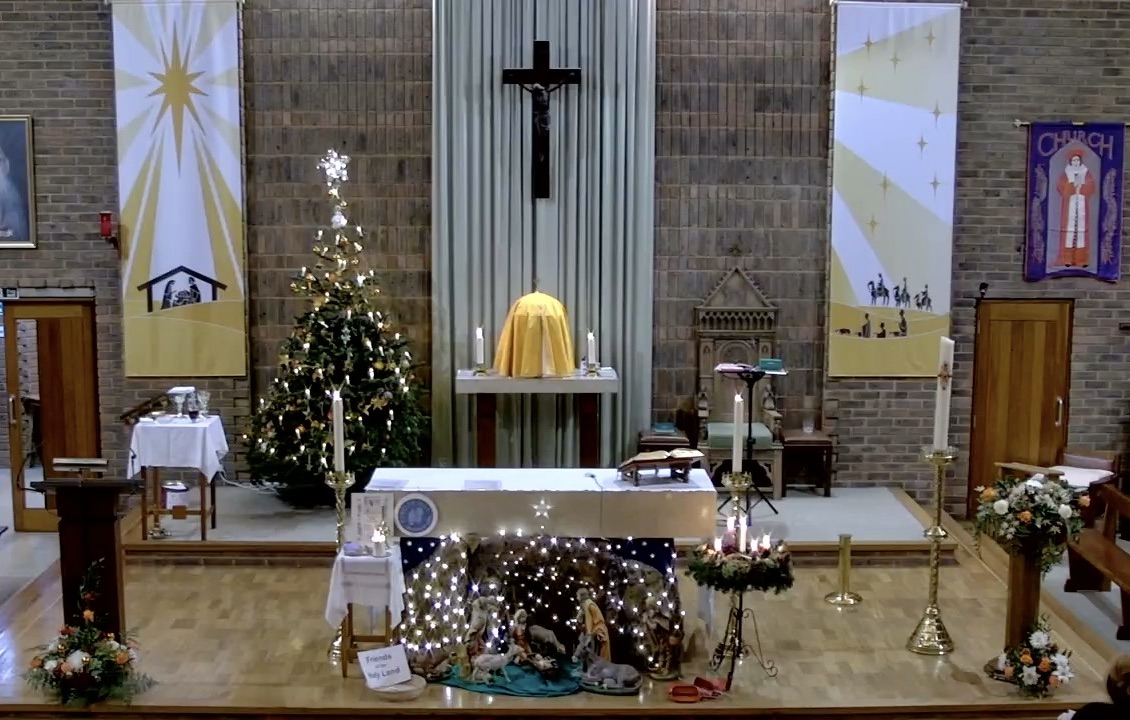
Anyway, our crib goes, as of today and our decorations are packed away. We get on with the year ahead.
2nd Sunday of Christmas 2028 (A)
One cold Thursday in November, I met some friends in Whitstable and we took shelter in its museum where to my surprise, there was a steam engine – The Invicta. It was used on the Canterbury and Whitstable Railway which claims to be the first railway in England. It opened in May 1830. The engine pulled passengers and freight between the two towns, but there is a 200 ft hill amid the 6 miles of track so stationary engines were also involved in tugging the wagons by ropes and cables up and over. The world’s first ever season tickets enabled Canterbury residents to visit Whitstable’s beaches every day during the summer. Anyway, I found it fascinating. I climbed all over the engine and we subsequently walked the route of the line. We really felt joined to those people of long ago, imagining how they felt, getting wrapped up in their excitement and their lives. A sense of history, which has a bearing on who we are.
Again, there’s a television programme called “Who Do You Think You Are?”, where celebrities are given information about their ancestry which always gives them a deeper understanding of who they are now. Knowing where we’ve come from helps us know who we are and perhaps, who or what we might become. There is something of this in today’s gospel, repeated from the mass of Christmas Day, for us to look into more deeply:
The Word was God but then the Word became Flesh, God became Man. There is something about God that is human and there is something about humanity that is divine. So, at the very beginning of time, God joined my history to His own. He made a declaration about me, that He and I would be related. I am part of his history and more importantly, he is part of mine. That gives me dignity and so I, and we, can demand respect. It is our right. God always wanted to get wrapped up in humanity. It was, from the beginning of creation, God’s plan to do it. His life and our lives are entwined: A marvellous revelation at the heart of what we celebrate at Christmas. History counts!
So, it is good to respect all that has occurred in the past. We recognise that it has much to tell us about what our lives mean. It gives us insight too, into the future. Because as a Christian I now know that an important thing about me is what I will become or what I am in the process of becoming. “We are already Children of God”, St John writes, “What we are to be in the future hasn’t been completely revealed yet, but we do know that we shall be like him”, he says. In other words, as God has become man, man will become God. My future lies in living with God wrapped up in his life as he is in mine. It is our ‘calling’ or ‘destiny’ and it is written in our history, tied up in God
So all this is good news. Jesus’s birth of helps us understand much about God, his love, his passion, but also a great deal about ourselves and our destiny. It’s important for us to know about this. This is why St. John wrote this gospel, for us to understand the importance of the Word becoming flesh, of God becoming Man. God communicates himself totally to us in His Word, made flesh. We receive and accept his gift and we open our eyes to the future it brings!
Fourth Sunday of Advent, Year A, 2025
For better or worse, I read a lot of detective stories. Detectives often say “I don’t believe in coincidences” and in connecting two events they go on to solve the crime. Well I don’t believe in coincidences either and I go on to detect the hand of God but unlike detectives I can’t usually prove it.
We were recently gifted two spanking new candle stands, one of which you can see, but what to do with the two stands we had and the 10,000 candles we still had in stock? It would take years! Just a few days later I met a friend in Canterbury who asked if I knew anyone with a 2 ft candle stand to spare. We gave him the stand and sold him the 10,000 candles. I don’t believe in coincidences. God does mess about in our world, not usually in extraordinary ways – unless that’s what it takes.
Now we just heard how Jesus came to be born. It isn’t the beginning of Matthew’s Gospel, though. Just before the words we’ve just heard, Matthew presents a genealogy of Jesus, tracing his parentage back through JOSEPH, all the way to Abraham. There are a lot of people in that line of descent, many who we are quite uncertain about, and some controversial and dare I say dodgy characters as well. All part of Jesus’s lineage. St Matthew wants us to know that the gospel will not be full of superheroes. Instead, it will be crowded with ordinary people trying to do their best – people like Joseph.
He was in a fix, wasn’t he? He had found out that his fiancée, Mary, was pregnant but not with his child. He considered this carefully and decided that for her sake he would separate from her quietly. Then he had a weird dream in which he learned that God was responsible for the pregnancy and he then agrees to go through with the marriage, by ‘taking her to his home’ in Bethlehem. In doing so he became the legal father of Jesus. Joseph said ’yes’ to it all, God’s activity in the world.
Mary heard a similar message from God and her response was the same. She said ‘yes, let it be done to me.’ This is important. She didn’t say, ‘yes, I’ll do it.’ She said, ‘let it be done to me’. Joseph and Mary are humble but willing – ordinary people willing to give their lives up to God’s plan. They didn’t put this together. It was crafted by God to fulfil all the promise of scripture, the entry of the Creator into creation. The messiah would be the Son of God, conceived by the Holy Spirit. He would be Jewish, born of Mary and He would be a Son of David, because Joseph, of the House of David would marry Mary and thereby give Davidic status to Jesus. God crafted this, not Mary and Joseph. How would it all work out? They didn’t need to know or understand. It was probably better that they didn’t. God would do it and take responsibility for it. They simply and humbly accepted their roles in what God was up to.
We can all follow suit, and present ourselves, our time, our talent and our treasure, all for God’s use. What is achieved, even here in the parish is achieved through us by God, not by us. I said down in Canterbury: ‘Well done God, because what just happened is not what I planned; it’s you that’s pulled it off’.
So, the challenge of all our Advent themes, is to admit to the activity of God in our lives and in our world. Our calling, like Mary and Joseph’s is to humbly let God do His thing through us and for us. The same with Christmas. You can pull your hair out and work your socks off trying to construct the perfect Christmas. But why not offer up all our best meant preparations to God, so that we are not doing Christmas, He is. Let Christmas be done to us, as it was to Mary and Joseph.
Third Sunday of Advent, Year A, 2025
Today we have lit our 3rd Advent candle, the pink one. Today is Gaudete Sunday and our Advent theme this week is, like our candle, a little bit lighter than those of the last 2 Sundays. Today the challenge is to be awake to, and to celebrate the presence of Jesus in our midst and hence to rejoice – Gaudete! But it is a challenge. What did John the Baptist ask: ‘Are you the one, or have we got to wait for someone else?’
Surely, John was the one who did know Jesus. He was the one who directed people to him. Is there some doubt in his mind? Well, look where he was when he asked the question. In a bad place, in prison in fact, somewhere he never expected to be. He wasn’t the criminal type and nor was he a rebel. He was a prophet, working well outside Jerusalem, with no aspirations to power, so a threat to no one. “Are you the one?” I don’t think it is doubt; more an expression of surprise, and maybe a touch of anger. He didn’t expect things to have turned out this way. The arrival or advent of the Messiah was not as he thought it would be, and he was the one proclaiming it, for goodness sake! So, what’s going on? How come the Messiah has not brought peace and established a joyful new empire? And how come I have ended up in prison?! “So Jesus, are you sure you are the one? Please explain things to me!”
Jesus did answer John’s question: Tell him what you hear and see. The blind see, the deaf hear, the lame walk, lepers are cured, the dead are raised to new life and the Good News is proclaimed to the poor, so don’t lose faith. It is all there, just not as you may have been expecting it.
But aren’t we in the same position, living in a bad place? I sometimes get challenged by people asking: How can you believe in God when there are all these terrible wars, famines, poverty, and mad leaders out of control? And they surely have a point. I never thought I would live through a time where governments are having to defend themselves against charges of genocide, where mass starvation is being used as a weapon of war, where untethered powers are overseeing the decay of our very planet in global warming. It isn’t what I’d expect life to be like after the coming of the Messiah. I have not been put in prison for my Faith like John, but many Christians have. Jesus answers us as he answered John.
Look around you, He says. Can you see my presence? Can we see it in his Church as it continues his mission? Well we can see all that if we look carefully, even just in Bexley. Our support of international and national organisations doing great charitable work is outstanding, our elderly and housebound are served by visitors and Eucharistic ministers, the eyes of faith are opened by our catechists and by teachers in our schools, Holy scripture is proclaimed, and the sacraments of our church and the prayer of our community give life and hope to us all.
So, let me end by reading from a Christmas Card sent from one community whom we have supported – In Ghana, as it happens: Thank you for remembering us, our work and our needs. Thank you for helping us to feed the hungry, cloth the naked, bring comfort to the sick and dying, hope to the discouraged and the light of faith to those who are searching. We thank God that he has allowed us to be his hands and you to be the arms that support us in prayer, sacrifice and charity.
So, Rejoice. Jesus is indeed the one, he is here with us and in us. He acts through us for others and through others for us.
Second Sunday of Advent, Year A, 2025
Round about this time some years ago, I was due to go on a pilgrimage to India. I’d booked to go, back in the June of that year. I’d sent off my visa application along with my passport to the Indian Embassy. In due course I should have received it back and been set to go. But, with only a week or so to go it had not arrived and a phone call to the embassy revealed that it might still take weeks but that I should not give up hope! It might arrive any day. Every morning I’d be on the pavement waiting for the postman. I actually got quite sick with anxiety. The waiting was hard work. The passport came the day before I was due to go. I am reminded of it all when I occasionally see some children who just can’t understand why Christmas won’t come sooner, but at least they’re not in much doubt that it will be there. But there are many anxious waits in life.
The Jewish world went through great anguish waiting for their Messiah. His arrival would shake the world upside down, Isaiah was saying, some 740 years before the event. Calves and lions would feed together, cattle and bears would be friends, he said; nothing would be the same. There was always a place in history for the Son of God to be born into this world, to take his place in the midst of mankind. From the moment of creation, it was inevitable. It would be an event that would affect the entire history of the human race and reveal to it, its meaning and purpose. Children often decorate a Jesse Tree, as it is called, with all the great characters of the Old Testament who took a role in the carefully orchestrated prelude to the Coming of the Messiah, the greatest event in earth’s history. Creation had always cried out for its Creator to fully reveal himself.
There were frequent disappointments until…
“In due course”, the waiting was over. In due course, John the Baptist appeared heralding the mission of Jesus who like John, had been born 30 years ago, a specific event on a specific day – maybe a Thursday, no-one wrote it down sadly so 25th December is as good a day to celebrate as any other. But it was a huge moment in our history. John the Baptist called on everyone to react, to ‘Get ready’, and turn away from anything that would stop them embracing a life with: Christ in their midst. And let’s be fair, people responded in great numbers. Crowds from Jerusalem and all Judea and all over, made their way to him out in the Jordan Valley and they were baptised. They all heard John telling them to wake up to what was about to happen. And we know how in the next three brief years there was an engagement between the Son of God and his people, an expression of the divine in humanity. And we know that this engagement was transformed into a communion between God and his people in which we all participate, especially in mass.
The world would not be the same again. And we would do well to recognise that what John the Baptist said then, applies to us as well. We should wake up and not miss the main event. We should repent and figure out what holds us back as humans so that we can leave it behind and reach forward to embrace the marvellous life that God offers us. The Church puts on offer the sacrament of Reconciliation. It is here on Saturdays and we will be holding a special reconciliation service here with other priests from the deanery on Monday 22nd at 7.00.
So we are challenged today to pause and reflect a little and call on others to wake up to the Advent of Christ. At least let’s reflect enough to find joy at what happened all those years ago and as Pope Francis used to say, if you find joy, then don’t forget to tell your face about it!!
First Sunday of Advent, Year A, 2025
In these days of Advent, we are invited to reflect on the arrival of Christ in majesty, in history, in mystery, and of course in the final week, in Mary. There is a looking forward, a looking back, and a looking around us, to see where Christ will be, has been and is now. Be awake, Jesus says in the gospel. So, we have more to do in the next 25 days than get ready for the Feast of Christmas Day, as if that weren’t enough! This great and holy season of Advent is about more than Christmas and it deserves serious consideration. It is full of important ideas.
This first Sunday picks out Christ’s advent in majesty, at the end of days or at least the end of our days, and we are invited to accept the challenge to look ahead to that moment of death and prepare to celebrate it well. In actual fact, there are plenty of adverts from undertakers around at the moment encouraging us to think about our funeral – and of course to pay for it now! This is quite a new thing in our society, at least. And it isn’t a bad thing to put together some instruction as to what you want to happen. I have known plenty of instances where someone wasn’t given a funeral mass in church because relatives didn’t know how important it was to their loved one, to have a such a proper funeral. Relatives can’t be blamed if they don’t know, I suppose.
But in any case, that’s one step beyond what Advent is this week challenging us to prepare for. To state the obvious, before you have a funeral you have to die, and while we can’t plan for that, we can and should prepare ourselves spiritually for it, and this is what the first theme of Advent is all about.
When I was quite young, I remember being with my much-loved Aunty Mary, when she was close to death. She explained to me that she was waiting for everyone she knew in heaven to gather at the gates of heaven so that they could welcome her and hold a big party in celebration – bigger even than the celebration that took place on her arrival in this world. She was an eloquent teacher about getting ready, about the Advent of Christ in majesty, about how we live in hope.
The moment of death should be anticipated not with fear and regret at life’s ending but with hope and joy at life’s new beginning. Definitely a challenge, I’d say. In a way we could see our whole life on earth as a time of Advent, a time of preparing for that meeting, that day of days, that arrival. The new life with God in paradise can be anticipated in genuine hope and properly prepared for. It is a mark and sign of faith.
So, there is more to Advent for us Christians than for other people. It is a time of grace and a time to consider more carefully some of the deeper mysteries of life – and this week, of death even. Yes, we are preparing to celebrate the anniversary of the birth of Christ at Christmas but we are also preparing to greet him at the moment of our death and we are renewing our commitment to open our hearts in welcome to his being present in our lives in every moment of every day, but more of that in the weeks to come.
Thirty-third Sunday, Year C, 2024
The Gospel is a bit gloomy today. But when St. Luke was writing it, times were difficult. Even the Temple had been destroyed by the Romans, all bar the western, wailing wall which is there still. Jesus had predicted all this, as we’ve just heard. Christians were also being persecuted by the Romans who blamed them for troubles in Rome. Many were executed, of course. Christians were also being persecuted by the Jews. They expelled them from the Jewish Religion. Again, predicted by Jesus. He spoke about betrayal, imprisonment, hatred, and death. And more besides – wars, earthquakes, famines and worse. And of course, Jesus had now gone. It may all have looked a little hopeless to Luke and other people at the time.
You might think it’s similar today. The dreadful wars in Sudan and Ukraine continue, as does the awful suffering in Gaza. The climate conference in Brazil COP 30, reminds us that our world is being destroyed and that it’s our fault – we must take some responsibility for those terrible floods in the Philippines and the worst ever hurricanes forming in the Caribbean. And there is poverty and hunger not just abroad but here in our country too.
That’s on top of our personal hardships. It can be very hard when you lose a partner or a parent or a child or someone you love. It can be hard when illness strikes and changes your life. It can be hard when relationships are strained or broken. It can be hard to hold down a job and earn enough to provide for a family. Life can be… (well,) hard! But is it hopeless? No.
Jesus says yes, bad things will happen. Being a follower of his will not stop them happening. Anyone who tries to tell you different is not telling the truth. He said: ‘Take care not to be deceived.’ God allows these terrible things to happen. He doesn’t cause them to occur, he doesn’t like to see pain or loss or injustice or violence or poverty, but yes, he does allow it. We can speak to him about it in prayer, and even express our anger and confusion to him, but it remains a mystery.
But Jesus tells us not to despair, he tells us to keep the faith, and never lose hope. ‘Your endurance will win you your lives’, he says. And that’s only possible because he endures all these things alongside us, even within us. God does not save us from difficulties. He saves us through them, he redeems them. He allowed his son to die. Salvation was not about avoiding the cross, it involved rising again after death on the cross. Jesus’s death was not avoided, it was redeemed, given new meaning.
It will be the same for us in all and any of the difficulties we face. By living lives of virtue, of goodness, of love, we confront the mystery of suffering, and we give witness to our hope in Jesus. We don’t have to figure it all out, he says; he himself, through his Holy Spirit will inspire us with the wisdom we need, the wit for instance, to slow down global warming. (What we still need now is the political will to do it!) But there is hope in that conference and there is hope, to be found through the ordinary events of our lives. We may have to dig deep to see this, to see this light in our world but it is there.
So, we don’t need to shut our eyes to the existence of bad things around us. They are real and they will continue to occur, Jesus says. But trust him, never lose hope in him. He will see us through and, he says, ‘not a hair on your head will be lost’. We must try to live our lives today in hope, and in doing so, share that hope with a world that so badly needs it.
St. John Lateran 2025
What is this feast about then? The Lateran Basilica is one of the great basilicas of Rome and the inscription on its façade proclaims its title and therefore gives some indication of its importance: Most Holy Lateran church, mother and head of all churches of the City and of the whole world! It is in fact the cathedral of Rome and its bishop is the bishop of Rome, the Pope. So, this is his cathedral not St Peter’s, in the Vatican, but the Lateran Basilica.
It was built on Lateran hill, land confiscated by Emperor Constantine from the noble Lateran family. He had a huge basilica built there and popes were able to live there for many centuries. (The pope ended up in the Vatican but the cathedral never did!) The church became associated with John the Baptist because in those days all baptisms took place once a year only, there in the cathedral on Easter night, and it became known as St. John’s Lateran or San Giovanni in Laterano as it appears on local guide maps. The baptistery still has great prominence there as does the papal throne which is called a cathedra. It is the presence of the cathedra that makes the church a cathedral. The cathedra is the sign of the pope’s teaching authority. We still talk about universities having such Chairs – the chair of chemistry, the chair of philosophy etc., each with its professor as head of department. Chairs, thrones and so on are important in many other cultures too… So, one of the first actions of a new pope is to take possession of the Lateran Basilica and its cathedra. It is from here that he can teach with authority – Ex Cathedra, as the official phrase goes.
So today we celebrate the teaching authority of the papacy. The bishop of Rome, the pope, in succession to St. Peter has a major task in holding the entire Church together, in maintaining unity in other words; that is his mission, and he does this by consistently expressing the teaching of the Church (ex cathedra). The Church of Rome is at the very centre of our communion of churches and every church or diocese around the world is connected to each other through the church of Rome. We talk of a hierarchy but it is the place of Rome and its bishop at the very centre r/t the top that is crucial.
I think of it with this kind of a picture: I have a piece of cardboard here representing all the dioceses and their bishops from all over the world, all connected together and in the centre is the pope in his Lateran Basilica. From time to time it is true that the pope has had to rise up above the rest of us in order to lead but in that hierarchical situation he is much less connected to us than when he as at our centre. (as you can see in my spiral, here) In our history there have been times of crisis when it was right for popes to rise up and lead the church forward but as we know there have been other times when a few of them did so simply because they enjoyed being high up. In other more normal times the Church is able to move forward together and the pope, at our heart and centre, keeps us united as we do so.
The great thing is, and what we celebrate right around the world today, is that through nearly 2000 years the Church has not lost its shape or its pope whose leadership role has always been to keep the Church united in faith. And this crucial teaching authority continues to be expressed ex cathedra through the Lateran Basilica, the great cathedral of Rome, the mother and head of all churches of the City and of the whole world!
Now, a crucial element of that teaching concerns our communion with souls and saints who have gone before us and so it is a feature of our church that we can express our love for them and ask Christ, our High Priest to share that love with them where they now are. Today then we pray for those of our parish who have left the world this past year.
Thirtieth Sunday, Year C, 2025
I love the parable Jesus tells today: It contrasts the humility of the tax collector with the judgementalism of the Pharisee. I think humility is the key to any good relationship. If you are not humble then your relationships will always be insecure, even your relationship with God. As we just heard in the parable, the humble man went home at rights with God. The other did not.
Humility means not thinking you are better than others, but rather having an accurate and honest view of yourself that includes an awareness of your flaws and strengths. It involves being free from arrogance and pride, remaining open to learning from others, and recognizing your own importance without believing you are superior to other people. It’s not the same as having low self-esteem or a lack of confidence; rather, it’s having enough self-esteem to acknowledge your successes without needing to brag. It will lead to better relationships, as a humble person is more likely to be kind and to accept that they won’t always be the best.
Jesus’ story saw the Pharisee judging the tax collector – and the rest of mankind into the bargain. In doing so he placed himself above the tax collector and above all mankind. Jesus often attacked this attitude and said that it is only God who can make such judgements about people. Our role in judgement is limited to considering actions and motives. Apart from anything else, judgement of people is irrelevant. It affects nothing. The Pharisee’s judgement had no impact on the tax collector.
But, it is hard not to be judgemental sometimes. When you hear about the attacks on citizens in Gaza or in Ukraine, it is hard not to judge the perpetrators. The suffering of those victims is beyond belief! Bombing non-combatants is a blasphemous, evil pursuit. But it is God who will judge the aggressors, whether or not the world gets a chance to pass judgement on them, for whatever it’s worth. We are totally in order to judge the actions for what they are – just not those responsible for them. We must leave that to God.
Jesus is critical of the Pharisee for placing himself as judge, almost literally above all mankind and looking down on the tax collector and on the rest of humankind. The wrongdoing of the tax collector was not in dispute. He himself admits to being a sinner in his prayer. He is honest, accurate – humble. He and God were in communion, but the Pharisee was not. The Pharisee did not see the tax collector as another human being, one who had gone astray. He couldn’t do; he was too far above him looking down on him.
We sometimes use the phrase: ‘Level with me’. It is to do with telling the truth but also with communicating one to one. God became man so that he could level with us, each of us – you, me and the odd tax collector. The Pharisee placed himself above and beyond us all. Jesus takes this ‘judgement’ business very seriously.
We need to be careful therefore to stay on the level with everyone and never place ourselves above anyone because of what they do – or can’t do because, let’s say, they are only a child or they are foreign or they are an outsider or they are of the wrong Faith or vote for the wrong party – whatever!
The fact is, we must never take a superior, arrogant, or judgemental position; we won’t be right with God if we do.
Twenty-ninth Sunday Year C, 2025
Today is World Mission Day. We pray for the evangelisation of the world. But you have to wonder what mission looks like. I wonder how Augustine brought the faith to England or how Columba brought it to Scotland. There must have been some coercion in those days but not any more. Forcibly imposing Christianity on people is futile. The gospel and all our scripture is very important to us, but the way we share it is not by hitting people over the head with it – bible bashing. Mission today certainly doesn’t look like that.
On this Mission Day, we recognise that we are greatly blessed to have received faith. It follows that we should want to invite others in the world to enjoy it too. Our faith is a privilege that frees us, not a burden that limits our lifestyle or holds us back. It gives us an understanding of our world and of our lives. The Christian Gospel can light up the world, but it must be a gift.
Missionary work then, is not about imposing Christianity on people. Most overseas missionary work is characterised by works of charity. Good deeds are most often the leading edge of the Christian Gospel. ‘Preach the Gospel; use words only when necessary’, St. Francis once said. ‘By their fruits shall you know them’, Jesus himself said. It is when people have received the love of God expressed by missionaries, that they may choose to seek the source, which is God himself.
Last week many of you were kind enough to adopt plants and, or, contribute to the Padre Pio mission to leprosy sufferers in Ghana, so thank you very much for your gift of £220. But there, while the sacraments and the scripture are very much at the heart of the lives of the team who run the mission. The work they do is in caring for those with leprosy or disability or other illnesses in very practical ways. There, at Sunday mass there are some who are Catholic but there are others of different faiths who feel they want to belong to the community and praise God. Many have become Catholic but that’s their free response to receiving God’s love through the work of the Mission.
So, if you looked at the Church there in that place, you would see people living out the Communion that Jesus created and then sharing in his Mission to express his love for all. It’s not that the good works are some kind of inducement, they are merely a response to God’s love and an expression of it. Communion and Mission. It’s what Jesus was trying to demonstrate at the Last Supper when he wandered round the table washing the feet of his disciples. Go and do likewise, he said. It is of course what our parish should aspire to as well – Communion and Mission.
So, when we support missionary work abroad, we are supporting the establishment and growth of Christian communities and we are resourcing the good works they do in the name of the Church. That’s how missionary work is done. That’s what the Missio Collection today is for. Sometimes it supports the growth of parish communities, sometimes specific projects, sometimes schools, always the growth of the Church.
On World Mission Sunday we thank God for revealing himself to us, for enabling us to see his loving presence in our lives and we offer our support to those around the world trying to share this good news, this gospel with others.
Twenty-eighth Sunday, Year C, 2025
It really is a “good news” gospel today, isn’t it? As you know I have been involved with a leprosy rehabilitation project in Ghana for many years and so I have known many people suffering with leprosy, and many more, suffering its effects.
Leprosy is a nasty disease that does terrible damage. It is still around, though treatments were developed in the 1950s and 60s. Leprosy attacks nerve endings. That’s why there is a loss of feeling and without feeling it is easy to pick up cuts, bruises, burns and so on, all open to infection. But the nerve damage also causes disfigurement and sores, often to the face. When treatment begins it does halt the progress of the leprosy but by then the damage is often done. And as we know, it’s very contagious, so since ancient times sufferers have had to be excluded and live separate lives, which is a dreadful affliction or stigma. So, people with leprosy suffer the physical illness itself, the dreadful deformities that result from it, and the awful exclusion. No wonder it has always prompted such terror.
That’s why, we are told, the ten lepers stood “some way off” – because they had to! They couldn’t come close and risk passing on the disease. On another occasion Jesus did reach out and cure a leper with his touch but as a result he wasn’t allowed to enter any town for a while. Anyway, Jesus told those he cured, to show themselves to the priests. The priests would verify that they were free of leprosy and so they could enter the temple and thus be in the presence of God once more. He cured them of their illness but addressed the exclusion as well.
The passage then recalls the dismay of Jesus that only one of those he cured came back to say ‘Thank You’. But this is not about good manners. It is much more fundamental. As we’ve noted, Jesus didn’t just effect a physical cure. His healing had a wider context whereby the individual would be restored not just to health but to the community, to relationships with others, to a relationship with God. These ten individuals were given reason to get involved in a relationship with Jesus himself or at least to celebrate an encounter with him. Only one does.
So, we hear of ten lepers being cured but we only hear of one being saved. He was the one who found gratitude. He understood that the life he could now lead was based or grounded in the saving action of Jesus. His attitude of gratitude was the start of his relationship with Jesus – with God. We too must discover this truth about life and our relationship with God. It all starts with gratitude and if it starts anywhere else it will inevitably go skewy! My life has to be lived as a response to God’s gift of that life. We model this in childhood, don’t we? For many years the only letters I ever wrote and sent were ‘Thank You’ letters for birthday and Christmas presents. The most important thing I learned to say was Thank You. Well, several times Jesus advises us to remember, and to act as children.
Thanksgiving is a crucial element of any conversation, any prayer we have with God. We are, and always will be in his debt. Growing up is not about growing away from that. ‘It is right and just to give thanks to the Lord our God’, we say at mass. And there is so much to be thankful for.
Life with God starts with gratitude.
Twenty Sixth Sunday, Year C, 2025
We surely hear today that we are called to eternal life and that we therefore need to be careful about how we live our earthly lives. We are told to look out for those in need, to be loving, patient and gentle. In short, we should live lives inspired and guided by our faith in Jesus.
The idea of a life beyond death was disputed in the time of Jesus. The Sadducees didn’t believe in it but the Pharisees did, just as we do. In the Gospel then, Jesus was speaking to the Pharisees but also to us, about the need to look out for people who are poor. It’s a parable, an old Egyptian story in fact, but it’s interesting that Jesus gives a name to the poor man: Lazarus. (I wonder if his great friend Lazarus was nearby.) He doesn’t normally give names to characters in parables but he does so here, to emphasise how important it is to see individual people in need, rather than their group or label. I suppose we try to do the same by referring for instance to people with special needs rather than “the disabled”. They are not to be ignored or overlooked or compartmentalised.
Jesus always speaks of the need to love others. But here he shows us what the opposite of love is. No, it’s not hatred, it’s apathy, it’s not doing anything. And the rich man who didn’t get a name, simply does nothing for Lazarus who lies suffering and starving at the gate. So, we are not surprised to hear of their different fates. If we are called to love others, then doing nothing about the suffering of others leaves us in a bad place.
It’s as if the rich man only has a half-hearted belief in life beyond death so that when he does get there and face the consequences of his life he tries to fix things, but now it’s too late. Jesus concludes by adding an ironic twist to the story. The rich man asserts that if someone should rise from the dead he could warn everyone and all could believe and change their ways accordingly. Well, we should, shouldn’t we, but have we? It is as if there was a prediction of how it would be these days.
We do believe in the reality of life beyond death, that there are saints living with God in heaven. We remember the very first martyr, Stephen looking up as he was being killed and claiming he saw heaven thrown open and Jesus there waiting for him. The lives of all the saints give real witness to their belief in eternal life and can inspire us to do the same. It is a worthwhile undertaking to read the lives of the saints. We can take inspiration from them as to how to respond to Jesus and his call to follow his ways. But we are different from each other and different saints will inspire us in different ways. The important thing is to be open to such a calling, today and every day, whether we are moved by the life of a saint or by something in the news – or both…
When I see on the news those suffering genocide in Gaza, in my horror and powerlessness, I can at least recall Our lady’s words to St. Bernadette in Lourdes back in 1858: I do not promise you happiness in this world, but in the next.
The fact is, that life on earth cannot be properly understood except in context with life beyond death, and Jesus today, has serious words to enlighten us about the consequences of that.
Twenty third Sunday, Year C, 2025
The other day I was putting a bit of lunch together and I realised I was out of potatoes. A trip to the shop was in order. But if I was going to the shop I also wanted milk, and then I realised, a few other items too. Well that justified a trip to the “big shops” as I call them in Bexleyheath. Now that would need the car, but I’d promised my car that next time out, I’d get it washed. Well … I decided that the pasta in my cupboard would do just as well. Who needs spuds? It’s what can happen when you think things through and act intentionally. You face consequences and accept them or you just don’t start.
And that’s what Jesus says in the gospel. We have to take him seriously. He wants us to be intentional disciples, following him with a fully informed conscience, in other words accepting all the consequences that go with it. He sometimes asked; “Can you drink from my cup?” Here he mentions towers and going to war, but it’s the same. You have to size things up. And it’s the same with living a life worthy of a place in his kingdom. He went as far as asking: ‘If it were to come to it, would you even risk a family relationship for a place in the Kingdom?’
At the time, he was with an appreciative crowd up in Galilee who thought he was on a roll, a triumphal march to Jerusalem. They thought it’d be plain sailing and an overwhelming success and they wanted a piece of that! So, he was correcting them, saying that it would be no picnic. He and they would have to make a commitment to the Way of the Cross. The same for us. If we want to follow him all the way into his kingdom then we have to be aware of what we are doing and be ready for the consequences, setting aside anything or anyone that would hinder us. It doesn’t mean that we will have to sacrifice everything and everyone but we must be prepared to give up anything or anyone. That’s what it can mean to take up the cross and follow him as his disciple.
It demands commitment, and daily decisions. He doesn’t want us to just see if our given way of life conforms roughly to his teaching. He wants us to choose intentionally his Way. He says we need to think this through. We should have an informed conscience so that we can consistently act with a moral compass. We need to be as informed about our religion as we are about our politics or our hobby – or whatever, and perhaps read as much about it. In fact, we do get to read the bible in church, over a three-year cycle at Sunday mass and a two-year cycle in daily mass. There are many publications or apps available to help us make more sense of it. It helps to get some guidance. We should also try to keep abreast of the wider teachings of the Church. It is lame to say that we are unaware of the ethical problems of our day because we didn’t do R.E. at school or it didn’t crop up in a sermon! What is it Jesus said? ‘Here’s a person that onlookers would make fun of!’
So, we need to be ready and waiting to challenge any inappropriate conversation, opinion or action, whatever the cost. It is so easy to allow someone’s character to be torn apart in their absence. To not object is to be complicit. It is so easy to leave to others the need to sort out the injustices in society. To do so is to be complicit. It is so easy to just go along with the populist ranting about migrants and so on. And the same with everything else. We need to be ready and waiting all day long to assert the teachings of Jesus.
There may sometimes be a cost to this way of thinking and behaving though, and it is called THE CROSS! Can we drink from his chalice and be an intentional disciple?
Twenty Second Sunday, Year C, 2025
Meals have always been an important part of Jewish life. And so have the rules and regulations that surround the meal. This can be a good thing but not always. This is the context of the dialogue between Jesus and the Pharisees in today’s gospel.
There were specific regulations about places at table. My niece got married recently and I know about the hours spent working out who should sit where, and in particular, next to whom! But in Judaism this was an everyday issue. There was always a designated place of honour, for instance, and it is a good thing to be able to honour someone. In such ways the meal grows to be an experience of friendship where values are expressed and shared. But no one should be presumptuous and the parable that Jesus told about humility at table was a well-known one.
Jesus was using this simple issue about table manners to challenge the Pharisees about a wider attitude to religion. They tried to control access to God and challenging this, was as we know, a big part of Jesus’s mission. He claimed that God loves and desires every single person. So, he tells the Pharisees to show a bit more humility, and certainly not assume that they were in front of the queue to enter the Kingdom. And obviously Christians shouldn’t either.
Jesus commends humility. It is the key to all Christian life. He behaved with absolute humility himself, reverencing and respecting the holiness and worth of everyone. Humility arises from honesty and accuracy of vision. If we recognise our worth as beings, created by God, then we will not exalt ourselves. If we see our worth or value in other terms such as power, wealth or status then we are making a mistake and, we are likely to suffer with pride or perhaps be insufferable with pride.
Jesus goes on to attack the Pharisees for another bad practice regarding meals. The table was a good place to celebrate unity but it could also lead to elitism. The only people worthy of eating with Pharisees were… well, other Pharisees. There was an arrogant judgement about others. Jesus had a different approach. He would eat with anyone. In this way he showed love and respect for all. A dinner invitation was a form of gift and Jesus was teaching that it is important to be charitable or loving in sharing this – or any gift. Just inviting people who will invite you back is not generous. So, do we give our gift of friendship or fellowship only to those who are already close to us? Do we only do someone a favour if we can get one back?
And would we only love someone if they love us back? Christian marriage for instance, is more than just a contract for mutual benefit. It is a covenant of unconditional love. If the other person is not as generous as you are, that doesn’t matter. This covenant was first expressed between God and Abraham. Abraham was not always faithful but God was, and the Old Testament is witness to that. We see the same in the New Testament, that witnesses this faithfulness in Christ. If we can’t play our part to the full, it doesn’t matter, God still loves us. We should try to copy this in our dealings with others. We should be doing things for others with no expectation of return.
In humility we see that all we have and all we are is God’s gift. We respond to all His unconditional gifts to us by expressing love in our relationships with others – as best we can, at least.
So humility: not a gift you can be proud of – if you think about it!
Twenty First Sunday, Year C, 2025
Arguably, one drawback of these summer days is the challenge to work in the garden. There seems to be no limit to a garden’s physical demands, but at least there is a health dividend in terms of fitness. The more you ache the next day, the better it must be for you, that’s what the voices in my head proclaim, anyway – ‘If it doesn’t hurt you’re just not trying hard enough’, my P.E teacher used to say. The culture of those days was definitely, ‘no pain, no gain’.
The Letter to the Hebrews seems to share this approach, adapting it though, into a radical spiritual attitude to life. It actually suggests that we should feel honoured when difficulties and sufferings come our way because, we are told, that means God is taking us seriously as his children, trying to improve us. ‘Suffering is part of your training’ it says. Challenges, difficulties, pain and suffering are all part of the process whereby we are made stronger, fitter pilgrims, fit that is, for the journey that leads to the Kingdom of God.
We need to be clear though. God does not cause our pains and sorrows but he is always ready to use them, to redeem them, if we as his children will entrust them to him. This is, after all, what he did with his Son at Easter. He did not cause his Son’s sufferings and death but he did allow it to happen. Look though, at what he did with all of that when Jesus entrusted it to him. Jesus rose to new life and did so in such a way as to be able to share that life with all of us. People do struggle to accept a god who allows so much suffering in the world, so we need to be very clear about the meaning of suffering in life
The path of the Christian Pilgrim involves first of all, an acceptance of any sorrows, sufferings, pains or problems that life presents to us – accepting our cross, in other words. Then, we can offer them up to God, trusting that he will use them to strengthen us and make us spiritually fit. This is what we mean by redemption and it enables us to exercise more freely on the Christian path. We are able to share more love and give with greater generosity and joy. For this is what we need to do in order to aim for that narrow door spoken of in today’s Gospel. It is a door that is open to all people – from north, south, east and west, but we have to be determined to make our way to it.
There is no place in this approach for that old eye for eye, tooth for tooth stuff. It does nothing for a child’s good looks if they become one-eyed and toothless. No parent punishes a child just to get even. Punishment from a loving parent is designed to improve the child. We are told that it will then ‘bear fruit in peace and goodness’. This can be quite a challenge in a world where very often forces seem to cry out for retribution. Punishment, even of a convicted criminal, should not be about revenge, but about redemption.
So yes, the Letter to the Hebrews is radical and controversial. It suggests that if your life is completely comfortable then you are not trying hard enough, that there is more that you could be giving or doing. We need to move out of our comfort zones and take up our cross to follow Jesus, whether that means accepting difficulties and sorrows already presented to us or taking up the Gospel challenge to give more of ourselves to others.
We just need to get fit.
Twentieth Sunday, Year C 2025
In today’s Gospel we get a glimpse of Jesus’ feelings and in particular his real distress. He was facing up to what was a growing certainty in his mind that he would have to take on the might of the Jewish Temple. There was going to be a huge cost to pay, and it was him that would have to pay it. This is what he meant when he said: there is a baptism I must still receive. He’d been predicting his own torture and death and now we hear him agonising about this. Just as he would in the Garden of Gethsemane. There was reluctance to go through it all but at the same time some impatience. If it’s going to have to happen, let’s get on with it! He could also see that there would be wider conflict and division because of him. The Jewish nation of which he was so proud would be torn apart, families too.
Maybe we are lucky not to have such foresight. I wonder if poor old Jeremiah would have been quite so brave in speaking out about moral issues if he’d known he was going to be dropped down a well to starve to death. Anyway, he trusted in God and he was rescued. We all hope to reach heaven but we may yet need courage to deal with whatever lies ahead on the way. I for one, can do without knowing exactly what that might be.
Trusting our lives to God is key. But God isn’t in the future yet, so the future can be a scary place. Where we experience God is in the present, so that’s what we should be concerned with. Many people who have experienced serious accidents or medical issues, have spoken about how they got through it knowing God was with them but to anticipate such events in the future is not a good thing to do. We should stay where God is.
I have a friend who survived a dreadful car accident that has left him in a wheelchair. And he is at peace with it all. He often says though, that he might not have been able to face it, if he’d known what lay ahead for him. He has believed that God had a plan for him and that’s been sufficient for him to accept this turn of events which he sees as his cross. He always trusted that God would be there with him and see him through.
Trials can come our way in life and will do. Jesus asks us to trust that he will be there with us. We must never lose hope in him and accept whatever crosses life presents us with. We heard in the Letter to the Hebrews: Let’s not lose sight of Jesus who leads us in our faith and brings it to perfection. For the sake of the joy which was in the future, he endured his cross.
I have shared this prayer before, but it is worth repeating:
My Name Is I Am
I was regretting the past and fearing the future. Suddenly my Lord was speaking:
My name is I Am. He paused. I waited. He continued,
When you live in the past with its mistakes and regrets, its hard.
I am not there. My name is not I WAS”.
When you live in the future with its problems and fears, its hard.
I am not there either. My name is not I WILL BE.
When you live in this moment, its not so hard.
I am here. My name is I AM.
Eighteenth Sunday, Year C, 2025
I think I have heard enough of that man Trump and his tariffs. He didn’t invent greed but I don’t ever remember greed being so openly expressed before. It is about greed, using the power and might of America to make money not from what Americans produce but by charging others, simply to sell what they have produced. Money for nothing. But if you are rich and powerful you can do it and make yourself even richer. Free trade has a moral standing that respects the dignity of workers or producers anywhere in the world. But greed – it’s very real.
But we all have some concerns, hopefully not in greed, about finances, for ourselves, for our families or even for others. So any investments and savings we have may seem to reflect a blessing and a wisdom, and yet… in Jesus’s parable, the man who built new barns for future security, seems to be heavily criticised. So, let us look a little more closely.
A man in the crowd had asked Jesus to settle a financial dispute, but Jesus avoided that and instead, took the opportunity to tell the man not to allow himself to be held back by vices such as greed, but to ensure that his ultimate priorities should be in God’s kingdom. Nothing should get in the way of this. Then he tells his story about the man building new grain barns. The man isn’t criticised for building them. He is criticised for thinking that this is all he had to do because he had all the grain he needed. No, having the grain, or the wealth if you like, wasn’t the problem. Relying on wealth and success is the problem. There is more to life. In fact, the grain store could be an advantage BUT only if used to share God’s love and abundance with others. All that we have, all that we think we have earned or inherited from others has only been entrusted to our care by God. He will ask us what we have done with it. A follower of Christ must think, plan and invest beyond death, right into the life of resurrection. It is only good stewardship.
And that does change how we deal with everything else in this life. We live among people who do not see or even try to see beyond death and it is therefore not surprising that the values of society are not identical to our own. Christian values are often counter-cultural. You can hear the preacher in our first reading saying to our society ‘Vanity of vanities, all is vanity’. In other words, the real value of anything we have, any grain we store up, only lies in what we do with it.
But wealth is not our only asset. Time is a gift and a resource that we treasure as well. If I have no long-term interest in the Kingdom of God, I might spend that time only in my own best interest but as a Christian, I want to invest that time further. My talents or skills too are to be recognised and spent wisely, that is, with a wisdom that recognises my life stretching into eternity, not a wisdom that others, including Mr Trump are left with. I certainly don’t want to get caught at the hour of my death with assets unspent. I need in other words, to be aware of all that I have received from God, all the grain in my barn.
But we don’t need to imagine, because our own private world often collapses, doesn’t it? A serious illness or the death of a loved one soon brings us up short and causes us to re-evaluate our lives. Or maybe we have already heeded today’s gospel and we do live our lives slightly differently from those around us, in the context of a promised long-term future with God.
Let’s be sure to invest in that future by sharing our lives with our community, our society and our world. Oh and any offers of help in the parish:- much appreciated!
Seventeenth Sunday, Year C, 2025
Since I was a teenager, those five words have jumped out of the gospel for me: “Lord, teach us to pray”. The Jews knew about their great leaders speaking and especially pleading with God – Moses, and as we heard earlier, Abraham. Others too. They also had the most wonderful set of prayers, the psalms, which we still use today. Not everyone gets the best out of them in mass: verse, response etc, but read them quietly and they can be amazing. I do wonder what it was that John the Baptist taught, but it was clearly appreciated by some. But Jesus offered in addition the words of the Our Father.
Even the first line: Our Father, expresses so much of what we know about who God is and who we are, and it speaks of the relationship between us. “Our”, not “My”, so it gathers us as a family with Jesus as our brother. We join with him in speaking to the Father, trusting that He will hear what we say as his sons and daughters, Children of God. That’s what the Gospel is all about – what the whole bible is about. Other religions offer many titles for God but none are more intimate. It might be seen as presumptuous to call God our father, except that the prayer was given to us by Jesus himself.
So the Our Father is the perfect prayer but there are other prayers. Jesus went on to emphasise the importance of intercessory prayer: ask and receive, seek and find, knock and enter. Again, such prayer expresses truths about God, about us and about the relationship between us. God is all powerful, able to provide. We are dependent, standing in need. We trust and believe in him and he loves us enough to care. So while human parents might encourage their children to not be asking for things all the time, Jesus says to ask OUR father anything. And there are many other ways to pray.
The important thing is to pray as you can and not as you can’t.
We need to find a practice of prayer that works in our own relationship with God, given the demands of our own life. But just as a variety of experiences enriches any relationship, so a variety of prayer enriches our relationship with God.
Sunday mass gives us a chance to talk with and to encounter God. But our private prayer life is important too. In that inner life where we speak with God, our relationship grows in a personal way. In the Church there are invitations to days of recollection. There are loads of resources on the phone even, ‘Pray as you go’ and others, but you do have to be careful in choosing. Many like to use scripture, engaging imagination or reflective powers in meditation, in contemplation and so on. But other activities can be spiritual too. Walking can be prayerful if we spend the walk mulling over some issue or piece of scripture with God. Ironing is a time that many pray, though it’s not for me – ironing, I mean! But the key is to make it regular, daily if possible, even if it’s just to say ‘Good morning’ and ‘Goodnight’. Such prayer is an act of Faith in God’s presence.
The important thing is that we do pray, that we do speak with God. It’s what makes a religion different from a philosophy or a theory. Any thinker or philosopher may come to believe in a god who made the universe. After all it’s the most likely theory as to why we exist. But that theory or philosophy becomes a religion when we pray or praise God. And as Christians we claim a personal relationship with God, through Jesus who was born as one of us and who after rising from the dead remains joined to us, for all time. So, we speak with God, and we join with God – prayerfully.
Fifteenth Sunday, Year C, 2025
Today is Sea Sunday. Today we offer our support to the Apostleship of the Sea, (“Stella Maris”) those who on our behalf, help those working at sea far away from friends and family and from their religious communities too. Those in the Apostleship of the Sea act as the Good Samaritans to sea-farers in a variety of ways – spiritual support as well as practical support, so it’s good for us in turn to support them with prayer and with finance too. Now what makes them “properly good” Samaritans in the eyes of Jesus is that they do all this for people they have never met before and will probably never meet again. And that is the point being made in today’s gospel.
The lawyer very graciously agreed with Jesus that the greatest commandment in the Law is to love the Lord your God with all your heart and soul, with all your strength and mind and your neighbour as yourself, but he was really keen to establish the minimum he needed to do. Who is my neighbour, he wondered? How far do you have to go beyond immediate family? Does it include friends, or even your local community or perhaps even your national community? The lawyer was keen to establish just who he could exclude, who he didn’t have to include as his neighbour. Not really the spirit of compassion and generosity that Jesus promoted.
So in his reply, Jesus told what is probably the most famous parable in the Gospel, the story of the Good Samaritan. He illustrated through his story that a loving neighbourly attitude should carry you to anyone in need. Anyone can give you the opportunity to do something good. But we can be like the priest or the Levite in the story or indeed the lawyer in the historical encounter with Jesus, and look for reasons not to engage with those in need. The key phrase is that the Samaritan was moved with compassion. His response to the situation was through love and concern, not an attempt to fulfil a minimum demand of the Law.
That’s the point of Jesus’s story; we see that our needy neighbour could be just across the road as he was in the parable. We are often wary of anyone seeking to exploit our compassion. So many worthy causes come before us. It sometimes seems easier to ignore them all. But if we feel compassion and do nothing about it we will become hardened and diminished as human beings, so I think that even from a young age we should learn to engage, with some of them at least, with some measured gesture.
So the question isn’t who doesn’t qualify as my neighbour, but who could be my neighbour today, or rather who could I be a neighbour to? Could it be someone I know and who I could reach out to in care, or maybe in forgiveness or even in simple friendship? Could it be someone or some group I only really know by name, through the media perhaps, but who I could forgive or simply pray for – Someone I really can’t stand or some criminal or anyone that I have so far excluded from my definition of ‘neighbour’ – even Mr Trump?
Compassion, that’s what Jesus asks for. That’s not something we have to bring on board. It is already there. Compassion is something we need to stop holding back on and let loose and express, so that we grow as human beings, full of love and living our lives to the full.
Fourteenth Sunday, Year C, 2025
Yesterday, a few hundred of us walked as pilgrims from the 8 churches of Bexley deanery to St. John Vianney, Bexleyheath. It was a great occasion and near to the final destination you could see pilgrims converging from every direction for our final service together. It took me back to the pilgrimage I made a few years back to Santiago de Compostela, the Camino. That was 500 miles but I tried not to carry much more than I carried yesterday – a few litres of water, a first aid kit – well, and a change of clothes. On the Camino pilgrims who tried to carry much more ended up dumping things along the way. You really needed to travel light. Extra weight tired you out and got in the way, and you do get used to travelling without so many things you’d previously consider essential. When Jesus sent his disciples out on their mission he wanted them to travel light. He did not want them to have baggage – not physical baggage (spare sandals and so on) or any other kind of baggage: personal issues, personal agendas or the like.
He specifically sent out 72 disciples on the mission because 72 was the number of different countries in the world as they knew it. The mission was to the whole world in other words. And it remains a mission to the whole world that we are now responsible for. As a parish we do on occasion support different parts of that mission around the world but there is another sense in which we carry the mission to the whole world. Because when we walk out the doors of the church following that all-important instruction or dismissal: “Go in peace to love and serve the Lord”, we go to many different places of work, of study, of rest and of play, all sorts of social gatherings, all sorts of relationships with so many different families and friends, and it is into all this that we are called to carry Christ’s mission.
The mission he gave the 72 and which he gives to us is to let people know about Christ’s presence or immanence, to bring them healing and to bring them peace. We achieve that through the quality of our encounters. That’s why his instructions are so important. Have no personal baggage, he says. Let the message be simple and pure. Let every encounter we have convey that each person is precious to God and loved by God, sacred. He didn’t want the message confused or distorted. In those days an obvious temptation would be to suggest that the Messiah would free them from the rule of the Roman Empire, for instance. There are obvious distortions in our age too, but the main thing is to indicate in our attitude and behaviour that the presence of God is with them. Reveal God’s presence in their lives, by what you observe in them and the attitudes you have for them – respect, reverence and so on.
We need to be careful only to respect them, to value them, to enjoy them, to love them – all for their own sake and not for our own. We need to be humble in presenting ourselves as merely empty vessels bearing a special gift. There can be no suspicion as to our motivation. (We must have no baggage.) So, with a spirit of poverty we can seek to enrich the other person in a relationship, we can place them above ourselves, be impressed by them rather than try to impress them, and so on. If we reach out and see and identify the goodness that is in them, the presence of Christ that is in them, then they will see it too, and that, then, is ‘job done’. That is the mission that goes out these doors with us every Sunday. We leave behind ambitions for our own gain or influence or admiration. It distracts and detracts from the mission. It is unwanted baggage.
St. Francis understood this and famously disposed of all his baggage, including every stitch of the clothing he was wearing. And this is where his famous prayer comes from:
Grant that I may never seek: So much to be consoled as to console;
To be understood, as to understand;
To be loved, as to love;
For it is in giving that we receive,
It is in pardoning that we are pardoned,
And it is in dying that we are born to Eternal Life.
Trinity Sunday, Year C, 2025
Sometimes, we feel very much as if we are on our own, but the truth is that it is not possible to define or understand ourselves except in relation to others or at least one other. I make sense of my life only in so far as my life is shared or given to others. We all can recognise this. We see it as a privilege to share in anyone else’s life and it is a privilege to have them share in ours. The joy of humanity is in our relationships. And God’s existence too is joyful. God’s life is the life of a trinity of persons.
In today’s gospel, St. John clearly describes God as this trinity of persons and today, what we are celebrating is the life of God: The Father, the Son and the Holy Spirit. St. John also tells us that God is Love. So, with there being three persons we can envision God as a circle of life or of love. But a circle of people can be a very tight circle of people. You can’t always join it. To break into the circle can be very difficult, if those in it decide to close ranks. If we reflect a little we will all identify groups or circles that it was really hard to break into. But the wonderful, even wondrous thing about God is that God’s love is so generous that God does want to invite us in, all of us. In fact, we have a man on the inside and always have had, Jesus – and that has always been the plan.
The Father would send the Son as a man with a face like ours, so that God’s invitation to join in the life of the Trinity could be offered – face to face. It is right therefore, for us to imagine how Jesus looked, how he sounded and so on. Likewise, it is futile to imagine how the Father looks or what the Holy Spirit of God looks like. Jesus, he’s our man! What the Holy Spirit does though, is to bring Jesus to us in the sacredness of the present moment and in joining us to him the Spirit gives us life with the Father in the Trinity. It is through Jesus, with him and in him, in the unity of the Holy Spirit with all glory and honour being given to God the Almighty Father for ever and ever!
The Holy Spirit in-spires that life in-to us, giving us a role, a place, a mission in the Christ’s Church, and with that, a share in eternal life. That eternal life is not separate from God’s life. It is part of God’s life. When we talk about deepening our relationship with God we are really talking about deepening our participation in God’s eternal life, the life of the Trinity. So, when we speak of the Trinity, we do not speak of something far, far away. Today we celebrate the life to which we are all called.
We give thanks to the Father, the Son and the Holy Spirit. And we do that in prayer. We pray to the Father, but we pray to Jesus as well and also to the Holy Spirit. We pray to the Father who created heaven and earth, we pray to Jesus, the Word or expression of God, spoken to us, who came to save us and bring us home and we pray to the Holy Spirit, who brings God’s presence into our souls and dwells there.
We are the pilgrim people of God the Father.
We are the body of Christ.
We are the Temple of the Holy Spirit.
The Spirit brings Christ’s presence into our lives and in Jesus we see the Father for they are one.
It is a privilege to share in anyone’s life, but it is an extraordinary, amazing, incredible privilege to share in the life God.
Pentecost, Year C, 2025
Last week we had our annual parish meeting. We looked back over the year and surprised ourselves really, reporting all the many things that have happened over the past year. It is good to just look back and celebrate with joy and thanksgiving all that has been, all that has taken place, all that has been achieved in Bexley. But, as members of the wider Church, this weekend we celebrate much more. We celebrate nearly 2000 years of our Church. On this Feast of Pentecost, we celebrate the beginning of the Church when the Holy Spirit was given to the apostles. They were linked together and made into the Church that we are part of today. We recall the beginning but we also celebrate with joy and thanksgiving the 2000 years of the Holy Spirit giving life to the Church. We celebrate the event and we celebrate all that has been, all that has taken place, all that has been achieved – what it’s meant to the world and what it means today to each of us.
As to the historical event itself, St. Luke in his Acts of the Apostles offers us two images, wind and fire, to describe what happened. We are familiar with both of these images but I find the image of wind most helpful, giving a picture of everything or everyone being moved in the same direction, like a flotilla or a convoy at sea. Or perhaps we can imagine all the different trees and all the different flowers swaying and bending in a synchronized way.
That’s a picture of what happened at Pentecost. The apostles were in Jerusalem as individuals with no real direction. But then the Holy Spirit blew life into them. They started to move, all of them in the same direction under the power of the Spirit. They were united as a Church, and everything got underway. The life that was in them was of course the life of Jesus.
For 10.30 First Holy Communion Mass
In today’s gospel St. John pictures Jesus on Easter Day breathing this life – his life – into the apostles. The Holy Spirit would maintain Jesus’ presence with them in the Church from that moment on.
And that is where we will find Jesus today, not in the tomb of Calvary. He rose from the dead and left the tomb. But we won’t look for him in the Easter Garden either because that is a long way away, and a long way back in history. Because of the Holy Spirit we can look for him in the here and now, in the Church, in its sacraments and especially in Holy Communion, which 5 children will be able to do for the first time this weekend.
It is a very fitting finale to our Easter Season during which we have been considering carefully what ‘rising from the dead’ means and why Jesus being risen from the dead is good news for all of us. That particular Good News is what we call our Gospel; it’s what makes us Christians.
So, on this feast of Pentecost, we don’t just look back in history. We celebrate Christ’s risen presence among us today, here, right now, made possible by the gift of His Holy Spirit and we also look forward and pray for a renewal of that gift to refresh our lives. Father, we say, send forth your spirit (again), and renew the face of the earth. Spirit of the living God, we say, fall afresh on me. Fall upon the bread and wine so that the life of Jesus can be shared by everyone who receives Holy Communion today, including for the first time: Albie, Benjamin, Caimh, Emily and Rafferty.
Sixth Sunday of Easter, Year C, 2025
Next Sunday we will have our annual parish meeting. We will be able to look back at what’s been happening over the last year in the parish and look forward to what the future might hold. It is good to pause every now and then, evaluate what has occurred and try to shape the future in that light. And it is what we just heard happening in the gospel.
Jesus is preparing to conclude his earthly mission, talking about what he is leaving behind, what his legacy is and how it is to be passed on. There were no happy faces among the disciples as they faced up to Jesus’ departure, but he tells them that they should be happy – for him because of where he is going, and for themselves because of the legacy he is leaving behind. So, what is that legacy?
Well we have been reflecting for the last 5 weeks on what his resurrection actually means for us – and meant for them. On Thursday we will celebrate the feast of the Ascension and call to mind his passing from this world to the next – his ‘passing beyond their sight’, as St Luke puts it. And in a couple of weeks we will celebrate the events of Pentecost, which in actual fact is a huge part of his legacy, the giving of His Spirit.
We heard him say that the Advocate will enable us to understand everything and remind us of his teaching. We are to experience his peace, a peace the world cannot give. It is not just an absence of war which is what we often mean by peace, but it’s the peace that everyone experienced and experiences in the presence of Christ. It is a calmness and serenity, a reassurance, a confidence, a hopefulness, a joy – in fact, everything that made and makes it good to be with him. That is his peace. It is a peace ONLY his presence can bring. Christ’s gift or legacy is his continued presence among us, made possible by the gift of the Holy Spirit.
We call upon that Holy Spirit to enable us to experience Christ’s presence quite often. In the liturgy that call or invocation is usually accompanied by the laying on of hands. In mass for instance the priest prays to the Father with hands spread over the bread and wine: ‘Make holy these gifts by sending down your Spirit upon them so that they become the body & blood of your Son, our Lord Jesus Christ.’ In Baptism, in Confirmation, in Holy Orders, in the Sacrament of the Sick and in Reconciliation there is a similar prayer, through which Christ’s Spirit brings Christ to us, or rather, brings us to experience the risen Christ. That is the legacy. It is a gift the world could never give. It is a gift only God can give.
There is a challenge though, for us to share that peace with others, just as we promise in mass before receiving Holy Communion. We offer the Sign of Peace and in doing so we aspire to leave that peace behind in every encounter we have. So, we should ask ourselves what we do leave behind. What do we leave with people after a conversation or a game or some other encounter? Do we leave them battered and bruised, sad and gloomy or do we leave them happy and at peace, calm and refreshed? It would be good if we could leave others with the peace of the risen Christ, just as we say at the sign of peace. That really would be a great legacy.
There is an old story. It tells of God talking to his angels. He said ‘I am so worn out with humanity; I need some peace and quiet.’ The first angel said: Why not go up to the very highest mountain and rest there?’ God said: ‘No, even on Mt Everest there are lots of people these days. ‘Then what about going to the bottom of the deepest ocean?’ said another angel. ‘No’ said God, ‘it’ll only be a matter of time before explorers get there too! … I know, I will go and live in their hearts. They will never think of looking for me there!’ And that is the legacy we should discover in each other, the presence and the peace of the risen Christ in our hearts.
Fourth Sunday of Easter, Year C, 2025
This fourth Sunday of Easter is always ‘Good Shepherd Sunday’ with the Gospel picking out Jesus as our good shepherd, guiding us to safe pastures, guiding us home to .. well, to heaven. We heard in the 2nd reading, St. John’s vision of people from every nation, race, tribe and language – all sorts of different people, in other words, all reaching safety, never to hunger, thirst or suffer again. So, there is a road home for us all, in fact a different one for each of us. We are called to follow the shepherd home, and so today is also Vocations Sunday. Some reaching sainthood do so through their single life, others through their married life, and others through priesthood, but it always involves discerning God’s call and then and ‘stepping up’ to this vocation, which for one man is to be Bishop of Rome, Pope Leo XIV
This week we have been accompanying in prayer that process of discernment as applied to the selection of a new pope. In the conclave, the cardinals prayed hard about the needs of the church and the wider needs of the world in terms of spiritual leadership – the two are inextricably linked, of course. The task then was to ask God to shine his light on who might best be able to fulfil the role, in other words to determine who God is calling to this task. The process has lit up Cardinal Robert Francis Prevost.
But today we are all asked to consider what our response to the shepherd should be – without the help of a conclave unfortunately, but also to pray that everyone does in fact respond to their call – especially those being called to the priesthood or religious life. We are also asked to give our financial backing to the training of priests. But the prayer really is vital too. I remember how important it was for me to know that there were people praying for me when I was in that process of both discerning and preparing for priesthood. In fact, I continue to feel the support of peoples’ prayer. Without it I think I would not survive as a priest. We all need to be given strength from God and from each other to be true to ourselves, true to our calling.
Stepping up to our vocation is something we all have to do. That’s when we fully engage with life instead of just passing through life. We should know that we are all called by the shepherd, to ministry, to a form of priesthood in fact. Mine is of the ‘ordained variety’ but as John’s vision of heaven described, there are plenty of other flavours. So, whenever there is a call or “calling” for volunteers none of us should pass by without asking if God is looking at us.
And of course, as each of us does respond and follow the shepherd we give great encouragement to each other. That is part of our priesthood to each other, to our friends and to our families. Our ministry may be about what we say, but it’s always about what we do. ‘Preach the Gospel. Use words only if necessary’, St Francis once said. It is a priesthood and ministry that is shared with us by the Good Shepherd, himself. His job is to get everyone home safely, but he chooses to do so by asking us to help. That’s why Good Shepherd Sunday and Vocations Sunday are the same thing. Today we are all challenged to take seriously our calling to sainthood, and to seriously assisting others to sainthood. We will help Pope Leo in his path to sainthood with our prayers and he will help us with his.
We wish him joy in his very special calling.
Second Sunday of Easter, Year C, 2025
Today we hear that Thomas was not able to believe that Jesus was alive until he saw it for himself. ‘Doubting Thomas’ seems an unfair description when we also hear that none of the apostles was able to believe it until they saw it for themselves. But then they did and there were huge changes in the lives of everyone who experienced Jesus – local fishermen travelled the world, uneducated country people addressed huge, knowledgeable crowds. All sorts of amazing things happened. And that has continued to this day.
Yesterday’s funeral for Pope Francis was a really moving event and I shall always remember it. In fact I have felt quite emotional all week. He has been an outstanding witness to the resurrection of Jesus. The world is definitely worse off without the People’s Pope, the Pope of the marginalized, and of the poor. In his 12 years as in office, he has made a huge difference. His last public words were on last Sunday, “My brothers and sisters, Happy Easter”. His first words, back on 13th March 2013 were, “Good evening”. He was a straightforward, simple and humble person. When the crowds that evening awaited his blessing, he knelt down and asked for theirs. He was determined to avoid any gobbledygook, excessive pomp or hiding behind ritual. He wanted to, as he said “untie the knots” that confused or confined people. He wore normal black shoes, not red ones, he drove around in a small saloon car and he moved out of the State apartments and lived instead in three rooms in the Vatican guest house, mixing at breakfast with other guests.
He was of course from Argentina. In his early years of ministry, he was embroiled in the politics of Church and State. Along with others, he tried to distance the church from those actively opposing the oppressive military Junta. But it seems he came to see this as a mistake and a matter for deep regret. Ever since, he tried to align the Church with the poor and marginalized. He has never been too proud to admit mistakes and apologise. He said of himself: “I am a sinful man trusting in God’s mercy and patience.”
Mercy has been at the heart of his leadership of the Church. He felt that the church should not be wagging fingers in disapproval of people or groups but be putting arms around them instead. The Church should be revealing God’s mercy, not its own judgement. His conviction was that the Church is for ALL people. He certainly spoke to ALL people, to the whole world. His thoughts about climate change were spoken loudly and clearly. He connected the Cry of the Earth with the Cry of the Poor, and challenged all people to live more simply, more sustainably and more in solidarity. He spoke of ecological sin and connected it to the sin of financial greed. I will never forget the evening in the Covid Lockdown when he was in St. Peter’s Square virtually on his own in the darkness and rain, offering a benediction to the world and imploring on our behalf the mercy of God in whom he placed his and our hope.
The outpouring of grief has been all around the world, muted sometimes in areas of wealth, power and control, and greatest in areas that might be described as the periphery or the margins. How they will miss his daily phone call in Gaza.
He has altered the course of the Church’s pilgrim journey and we trust the Holy Spirit to continue in guiding us in the future under the leadership of a new pope, but history will never forget Pope Francis who took such inspiration from the radical Saint Francis of Assisi who embraced extreme poverty in simplicity, who became a voice for the dispossessed and who challenged bureaucracy.
We thank you, Papa Francisco for passing on your knowledge of Christ, proclaiming even last Sunday that Jesus is alive and that love has triumphed over hatred. Pope Francis, leader of the Easter People. May he rest in peace and rise in glory.
Easter 2025
Well, you can’t walk into Easter with your eyes closed – not in this church, anyway. There is so much to learn from the signs, symbols, decoration and so on. It doesn’t want to be ignored or taken for granted. Our Church today is full of it, and how spectacular it looks!
Let’s start with our Easter garden: We can imagine being present back then at Calvary, facing an empty tomb. When the stone was rolled away, the door to a new future opened for us. Christ is risen – he entered a new limitless future but crucially, he offered to take us with him. He is the Way, from darkness to light from sorrow to joy, from death to life. Flowers speak of Spring and new life. The Easter candle sheds light on our world and on our lives. Statues proclaim resurrection from the dead. Baptismal waters promise that new life can be shared with all. Oils promise the gift of life in the church’s sacraments. And there’s our Easter tree – re-purposed from Christmas. It holds pledges from the entire parish to try to live more simply, more in solidarity with the poor and in sustainability with the created world that we inhabit. It is a real sign of our hope in a better future, a deeper relationship with God and with each other.
On the cross on Good Friday Jesus faced our human limits: – powerlessness like we can all experience in suffering or violence, in discrimination or humiliation, in weakness or betrayal or in defeat or even death. He experienced all such loss of freedom and he found no way out of it. Instead he found a way through it. He showed us all the way through it. So we do honour Christ’s heroic sacrifice. But Easter brings more. He is risen, not just for his own joy of being with his Father, but He’s risen for us. We are what his passion is about. We are the object of his passion, we are subject to it.
But it’s one thing to acknowledge this as truth; it’s another to get involved, to engage, to take part and knowingly enjoy his love and the life he shares with us. How is the risen life of Christ back then part of my life, right now? You see, many ask of Jesus: what are you, what’s your significance? (The Son of God, part of the Trinity and etc.) But if we ask the question ‘Who are you?’ we are already talking with the risen Lord. You can only ask ‘Who are you?’ if you believe he’s there to answer. It’s personal, it’s spiritual! Actually, a bunch of us have been getting to grips with this during Lent. We gathered each Monday or Tuesday and listened to the Gospel of the following Sunday and spent 10/15 mins in silence – meditation, some call it, and then we shared what was in our minds and hearts. At first we were drawn into thinking about what the gospel was about – it’s meaning. But by the end we were hearing what God was saying to each of us, personally. The same few words or phrase in the gospel could say different things to different people. We were engaged in listening to God, or prayer as it is called!
Christ is risen for us, so we need to listen to him – and to respond. What is God telling me? His conversation with each person will be different. But it will be worth engaging in. He does speak quietly though. We do need to slow down and settle in order to listen. Even if that’s only once a week on a Sunday, we can get to engage with him. We might get a thought at mass – from the readings or in the sacrament. We might on reflection, and with hindsight, see that there’ve been messages for us lying all over the place in the experiences or conversations during the week. God uses all sorts of people and incidents to communicate with us. But it’s all there!
So because of what happened at Easter God can be with us in our lives and most importantly we see that this is what he really wants. How good is that?! He wants to be here in the intimacy of every moment. We can allow him to make a difference to every action we take, every word we speak, every thought we have. Easter tells a wonderful story about Jesus but it also tells us important things about ourselves. So, of course, we celebrate.
Good Friday 2025
We shouldn’t make a pageant of the Easter event, shouting boo, hiss at the wicked Jews and hooray for heroic Jesus. This was really serious stuff that was going on. Jesus went head on with the most terrifying extremes of humanity. He confronted the worst abuses of power, the evil of violence and cruelty, the savagery of pain, and the horror of death. He wouldn’t back down on his claims to be the Son of God, the Way to the Father and the Jewish leaders would not relinquish their exclusive control of access to God. It was open confrontation. No one could see a solution. It seemed hopeless. And so it must have seemed to Judas. He lost faith in Jesus and his teaching and that really hurt Jesus. The path that He professed with all the love that surrounded it was great but in the real world of his time Judas couldn’t see how it get anywhere. He lost hope in the face of the serious, powerful forces in his world.
But the same serious stuff is going on now, in Ukraine, in Gaza, in Yemen, in Sudan, and in so many other places, even possibly to some extent in parts of our own lives and I don’t, we don’t see how these things can end well. It does feel hopeless. But Jesus always proclaimed that these forces of evil would not prevail, that in fact it would be he who prevails. He begs us from the cross today to keep faith even in the face of defeat and death. Jesus insisted that love would prevail and hatred would be vanquished. On the way up the hill of Calvary there didn’t seem any way this was going to work out, but Jesus kept on his path of loving all the way and promised there would be victory. Jesus never stopped loving, even as he hung on the cross. We should not lose hope, unlike Judas.
The message of Jesus had been: ‘I’ll give my whole life to any of you, any one of you if it comes to it, sinners, tax collectors, lepers, the sick, the needy – anyone. I’ll give anything, everything. We each need to hear him say it to us, that that’s how much he thinks of us, that’s how much he believes in us, that’s how much he wants to be united with us, that’s how much he loves us. He’ll see us through.
We have just heard the terrible price he paid for that promise, that new covenant with us, to share completely in the human experience and be joined to us all. He paid in blood. You can almost hear him saying from the cross, ‘This is my Body, it’s all I’ve got left to give you’. He lived in a brutal time and place. His torture was severe but it is still our human experience that he was joining himself to. It is all of us that he was reaching out to. He was giving us reason to hope.
When he was in the courts of Herod & Pilate he reached out to any who have been unjustly treated or accused, anywhere in the world of today and gave hope. When he was tortured and scourged he reached out to anyone who is suffering pain or difficulty and gave hope. When he fell under the weight of the cross he reached out to any of us feeling failure or weakness to give hope. When he accepted help from Simon of Cyrene he identified with all of us who need the help of others to give hope. When he was stripped naked he reached out to any of us who suffer humiliation in any way to give hope. When he was nailed to a cross & unable to move he joined with all of us when we feel powerless in our life to give hope and most of all, when he died on the Cross he reached out to each of us at the hour of our death and he gives us hope. He embraced all humanity with hope – ALL of humanity, with nothing excluded.
But you can hear the sadness in his voice when this supremely generous embrace was met by Judas with, of all touches, a kiss! Such irony. We confront that by venerating the foot of the cross. We accept his embrace, his love, his generosity and his desire to unite with us. We say, as it were, ‘Yes Lord, I hear you, I know what you are saying to me, I know what you have done for me, I thank you. I will not give up hope.’ This is our response to his gift.
Holy Thursday 2025
It is a privilege for us to begin together this journey through Easter. Our task is not so much in allowing the liturgies to remind us about what happened all those years ago but in listening out for what God might be saying to us tonight as we re-tell the familiar story. And that will probably have something to do with where we are “at” just now. In other words, we bring our own lives to the celebrations.
In tonight’s celebration there are 4 main features:
First we received the oils. These were consecrated by our bishop, our own apostolic successor, in our Cathedral yesterday and sent to every parish in our diocese. Everyone who receives the sacraments of baptism, confirmation or the sacrament of the sick is anointed with these oils. The same thing will have happened in every Cathedral in the world with every bishop. We thank God tonight for our worldwide communion and for the apostolic succession.
Next, we copy what Jesus did when he washed the feet of the apostles. It is not a re-enactment; those on the sanctuary here will not be actors, playing the parts of the apostles. They will be parishioners helping the church to model its mission. The action of Jesus defined his relationship with his followers. It expressed intimacy, generosity, and humility. His leadership of them, his love for them and his passion for them were all expressed in his service of them. And he said to them “Do you understand what I have done?” It is important. He wanted them to do it to others. That’s the mission of everyone in the church and especially those in ordained ministry. Tonight, and tonight only (!), priests everywhere will be washing the feet of their parishioners. They will be reminding themselves and their congregations what the church is all about – Loving service.
Most importantly, Christ was about to express his ultimate gift to us in the mass. It is the greatest expression of his intimate, passionate, generosity. He wanted to be united with us through a Holy Communion. We’ll see the price he paid for this gift tomorrow but we don’t just thank him because it was expensive. We thank him simply because he wanted to give it to us, he really meant it!
It was to be his last supper before his confrontation with the Temple and it was to be the occasion when he took on the Passover meal and re-expressed it. No longer would it be just a thanksgiving for the Exodus from slavery in Egypt and God’s gifts to Israel. Now, he would also make it a thanksgiving for his death and resurrection. The outpouring of his love at Easter would be forever expressed in the sacred meal in which we’d no longer share mere bread and wine but his body and blood, his life itself! So tonight, we recall the institution of the Eucharist, his last supper but his first mass.
And by washing his apostles’ feet on this occasion he made it clear that his great gift of Holy Communion can’t be separated from a mission to serve. When we receive Holy Communion, we receive Christ’s gift more or less directly from the cross. What he does for us, we must do for others. There is a price to pay. He paid it on the cross. We must pay it through our generosity to others.
The final part of our liturgy remembers what happened after supper – Christ’s time of anguish in the Garden of Gethsemane when he asked his disciples to stay with him, because he wanted their comfort and support. He is always there for us and we have the opportunity to respond and to be with him for a while tonight.
The Eucharist is a wonderful sacrament, a sign of God’s love. We thank God for it tonight but we also promise our Servant King that we will pass it on.

Pastoral Letter on the Terminally Ill Adults (End of Life) Bill
To be read at all Sunday Masses on Sat 5 / Sun 6 April 2025 – Fifth Sunday of Lent
Dear brothers and sisters in Christ
Following my pastoral message in March 2024, I wish to speak to you again about the process by which Parliament is currently considering legalising assisted suicide through the Terminally Ill Adults (End of Life) Bill. As I made clear previously, concerning this grave matter, as Catholics we maintain a principled objection to this change in law, because we recognise that every human life is sacred: a gift of God, bearing a God-given dignity. We are, therefore, clearly opposed to this Bill in principle, elevating, as it does, the autonomy of the individual above all other considerations.
The passage of the Bill through Parliament, as originally proposed, would lead to a vote in late April on whether it progresses further. This will be a crucial moment and I, together with all the Bishops of England and Wales, am writing to ask your support in urging your MP to vote against this Bill at that time.
There are serious reasons for doing so. At this point we wish not simply to restate our objections in principle, but to emphasise the deeply flawed process undergone in Parliament thus far. We wish to remind you that it is a fundamental duty of every MP to ensure that legislation is not imposed on our society which has not been properly scrutinised and which will bring about damaging consequences.
The Terminally Ill Adults (End of Life) Bill will fundamentally change many of the key relationships in our way of life: within the family, between doctor and patient, within the health service. Yet there has been no Royal Commission or independent inquiry ahead of its presentation. It is a Private Member’s Bill. The Bill itself is long and complex and was published just days before MPs voted on it, giving them inadequate time to consult or reflect upon it. The time for debate was minimal. The Committee examining the Bill took only three days of evidence: not all voices were heard, and it comprises an undue number of supporters of the Bill. In short, this is no way to legislate on such an important and morally complex issue.
One consequence of this flawed process is that many vital questions remain unanswered. Can MPs guarantee that the scope of the Bill will not be extended? In almost every country where assisted suicide has been introduced the current scope is wider than was originally intended. What role, if any, will the judiciary have in the process? We were told that judicial oversight was a necessary and vital part of the process; now we are told it isn’t needed at all. What will protect the vulnerable from coercion, or from feeling a burden on family? Can the National Health Service cope with assisted suicide or will it, as the Health Secretary has warned, cause cuts elsewhere in the NHS? Can MPs guarantee that no medical practitioner or care worker would be compelled to take part in assisted suicide? Would this mean the establishment of a ‘national death service’?
In contrast to the provisions of this Bill, what is needed is first-class, compassionate palliative care at the end of our lives. This is already provided to many in our society but, tragically, is in short supply and underfunded. No-one should be dispatched as a burden to others. Instead, a good society would prioritise care for the elderly, the vulnerable, and the weak. The lives of our families are richer for cherishing their presence.
It is sad reflection on Parliament’s priorities that the House of Commons spent far more time debating the ban on fox hunting than it is spending debating bringing in assisted suicide.
I am sure that you will share these concerns. Despite recent events, this measure is still being rushed without proper scrutiny and without fundamental questions surrounding safeguards being answered. This is a deeply flawed Bill with untold unintended consequences.
Every MP, and Government, has a solemn duty to prevent such legislation reaching the statute book. This, tragically, is what may happen. So, I appeal to you: even if you have written before, please make contact now with your MP and ask them to vote against this Bill not only on grounds of principle but because of the failure of Parliament to approach this issue in an adequate and responsible manner.
In his Letter to the Philippians, from which we heard in the Second Reading, St Paul reflects on the difficulties and responsibilities of life. He speaks of ‘pressing on’ and ‘striving’ for the fulness of life promised in Christ Jesus. Yet he is totally confident in his struggles because, as he says, ‘Christ Jesus has made me his own’.
We too have many struggles. We too know that Christ Jesus has made us his own. So, we too press on with this struggle, so important in our times.
With an assurance of my continued prayers and blessing
Yours devotedly in Christ
+John Wilson
Metropolitan Archbishop of Southwark
Given at Southwark, 26 March 2025
Fourth Sunday of Lent, Year C, 2025
Today we enjoy one of the most famous parables of the gospel. But which character do you identify with? The young son who wasted and squandered, who did all the wrong things until, when he was at rock bottom, returned to the safety of home. Or the father who let him go his own way but ran to meet him with joy when he returned? Or the brother who was steady, reliable and trustworthy, who did all the work but was aggrieved when his errant brother seemed to receive all the love and reward?
Well, when Jesus told the story he meant the elder brother to be the Scribes and Pharisees who had guided the Jewish Faith for centuries. He meant the tax collectors and sinners whom he spent time with and even shared food with, to be the prodigal son and he meant his own Father to be the father in the story. It was Jesus’ sermon about reconciliation, mercy and forgiveness. It tells of the breakdown and then healing of the relationships between the father and – well both sons, actually.
The younger son walks away from his father. By claiming his inheritance whilst his father is still alive he is treating his father as if he was dead and by going abroad he cuts off any links with any family – no phones in those days. More than that, by working on a pig farm he turns his back on his Jewish faith and culture. (Jews did not go anywhere near pigs.)
But at the lowest point in his life when he feels alone, isolated, hungry and abandoned, there is a turning point. He remembers his father’s love and mercy and is drawn back to him. When he returns, his father runs to meet him and welcomes him back as a full member of the family.
The second part of the story is about the older son and, again the forgiveness of the father. The older son is not happy with his family. He is jealous and resentful of the love shown toward his brother and he too is disrespectful of his father. One might have expected the father to correct him but instead, he assures him of everything. ‘All I have is yours’, he says.
So again, who do you identify with? If we see ourselves as the younger Prodigal son we must be humble and honest in recognising our need to turn again and seek the arms and the embrace of a loving father. If we want to be rescued we have to recognise that we are in trouble. I think I may have told this story before but, years ago I was with a young nephew who got stuck climbing a tree. He was quite distressed, but I wasn’t climbing up after him. I told him to jump into my arms and after a lot of encouragement that is what he did. But he enjoyed being rescued so much that we had to keep repeating the exercise for a good half hour! It is good to be rescued, but to be rescued and enjoy our Saviour’s embrace we have to admit that we are in trouble or that we have troubles, and that we need God. Then with the prodigal son we can enjoy the father’s forgiveness.
Or alternatively, like the elder son, we can turn and look with amazement at the father who forgives all and who gives all. The Lord knows us, he understands us, and he forgives us. He has a place for us all and he passionately wants us to be with him. As we contemplate his passion at Easter, let’s remember whom he holds that passion for – not for somebody else, but for each one of us.
Third Sunday of Lent, Year C, 2025
There is a sense of urgency in today’s gospel. Jesus is worried about trouble ahead. There are 2 different issues which will require his followers to be strong in faith. They have much to face up to.
- First of all, he sees around him persistent nationalism, anti-Roman activity, indeed anti-Gentile activity. With the eyes of a prophet he can see that this is really not at all good. ‘There will be a conflict’, he predicts, and in fact the Romans will in the course of the next 70 years completely crush the Jews and even destroy the Temple which would never be reconstructed, at least not up until now. Who knows what Netanyahu and Trump might do next?
- And then as we noted last week, he’s growing in the personal understanding of where his own life is going, and the potential for imminent conflict that may be part of his destiny. It could all come about very soon, and because the lives of his followers are tied up with his life, they will need to be ready too.
So, for both of these reasons they need to get their act together NOW. They need to repent. They need to strengthen themselves to be ready for what lies ahead both in conflict with the Jewish authorities and subsequently with the Roman authorities. It is therefore, the call of Lent. ‘Come back to me with all your heart.’ He is calling for repentance and for people to line up their way of life with God’s way of love.
But Jesus then throws in this odd little parable of the fig tree. The tree is given extra time to get its act together and produce some fruit. So, the point of it is to tell us that there is still time to get more engaged in the mission and that possibly the Lord may help a little bit – digging round, he says.
If you have missed the first few weeks of Lent, now is the time to get on board. Our Easter Tree promises new life already, generously covered as it is, with promises to live more sustainably, more simply and more in solidarity with others in the world. There are some 350 or so pledges or commitments hanging there.
So, among other things, this is a way of growing closer to the Lord through the practice of sacrifice which was at the heart of his life and his message to humanity. At Easter we celebrate that he did not just give up his life but that he gave it up so that it could be shared with all of us, particularly in mass. We give up time or effort, or something precious to us, for the sake of others and for God. We don’t just give something up to save money, for instance.
Our Easter tree, marvellous as it is, should not limit us. During Lent we might sacrifice more time or effort in prayer. We might try to get to an extra weekday mass or to do the Stations of the Cross, privately or with others in church after Friday morning mass. Or we might decide to commit to something in the future – possibly a commitment to participate in the Easter services, the great Triduum: the Mass of the Lord’s supper on Holy Thursday at 8.00 in the evening, the commemoration of Christ’s passion and death on Good Friday at 3.00 in the afternoon and the great celebration of resurrection in the Easter vigil on the Saturday night starting at 8.00.
The fact is that we each have lots to give or give up; we have much to offer to others. Lent offers plenty of opportunity and encouragement. It is not too late to start. After all, the fig tree got a whole year’s extension.
First Sunday of Lent, Year C, 2025 – Live Simply Campaign
We need to talk about the tree, but give me a minute.
In today’s first reading we hear Moses formally telling the family story, how his ancestors took refuge in Egypt but ended up being enslaved there. They called on God and God, with great signs and wonders, led them out of Egypt into freedom. The Jewish people are the people of that Exodus, but we are the people of Easter and while our story is built on top of that story, our story is bigger. It is the story of Jesus whose life was all about sacrifice. It was about giving up his life for us, in order to share it with us. And he says that this is in fact not just what his life was about but what all human life is about. So, the deepest truth about our lives is in what we sacrifice, how we share life with others, it is a way of the cross. During Lent we try to focus on our lives and practice more deliberately that way of sacrifice so that come Easter Day we are fully in tune to celebrate with Jesus the glorious destiny that he reveals for us.
So, the tree – the re-purposed tree, no longer a Christmas tree but an Easter tree on which we are invited (next weekend) to hang our personal commitments or pledges to engage in and with sacrifice this Lent: commitments to live more simply, more sustainably and more in solidarity with others in the world. So, let me invite Shanti/Martin to explain how it will work.
Shanti/Martin:
The Live Simply award, a CAFOD initiative is an opportunity for Catholic communities like ours, to respond to Pope Francis’ invitation in his encyclical Laudato Si’ to “work with generosity and tenderness in protecting this world which God has entrusted to us”. An important part of our faith is to care for creation and to develop respect for other people in the world. How we treat each other mirrors in many ways, our attitude towards creation as a whole. As Christians, we are called to respond to what Pope Francis calls the ‘cry of the earth and the cry of the poor, and our responses echo the greatest commandments, to love God and love your neighbour.
Becoming a Live Simply award parish helps us to go deeper and take action together, as a parish community. So, what is the Live Simply award? It is awarded to communities who can show how they have been:
- Living simply
- Living in solidarity with people in poverty
- Living sustainably with creation.
There are already some parish communities within the diocese that hold the Live Simply award, and there are several more who are currently working towards it. These communities have encouraged people to make personal commitments that would contribute to any of these themes. There are many possibilities, and a chance to be as creative and imaginative as we wish.
To give it a bit of momentum, we have proposed a list of a few easily achievable actions that we think may appeal to many of you. They include a commitment to to abstain from meat perhaps once a week or more, travel to church more sustainably perhaps once a month or more, or decrease energy consumption at home. You may want to make pledges related to recycling, giving sustainable gifts, or supporting our local foodbanks. Or you could start with the simplest pledge of all – to say the Live Simply Prayer, a short, beautiful prayer perhaps once a week as a reminder of our responsibility to the Earth. The prayer cards (show) will be available in the foyer at the end of Mass,
Next Friday is CAFOD Family Fast Day – will you make a pledge to eat less and more simply for just one day and donate what you save to CAFOD? CAFOD envelopes will be in the foyer – please consider picking one up to Gift Aid your donation, Gift Aid increases the value of your gift by 25p for every £1 at no extra cost to you.
As a parish, we have an opportunity to embark on this journey of simplicity, solidarity and sustainability together, NOW. Please look at the suggested pledges we have listed in this week’s newsletter. Will you adopt at least one of them? Or will you think of something different, uniquely yours in a way you can contribute? Next week, we will have pledge cards in the foyer with the suggested pledges printed on them and some blank ones for you to capture your own ideas. . Please pick up the pledge cards that you’d like to commit to when you come in to Church. We will collect them after the sermon. We hope that most of us will make at least one pledge and we hope to have many pledges to hang on our beautiful recycled parish Christmas tree, our latest symbol of sustainability …
Please do consider getting involved and also please do consider continuing your pledges beyond Lent, maybe even to Christmas or for as long as its sustainable for you. Our hope is that our collective actions will have a transformational impact on each of us personally as we reach out to support not only our parish, but also local and global communities. We are sure that our Live Simply journey together will be one of wonder, of belonging and of integrity.
To quote Pope Francis: In God, no act of love, no matter how small, and no generous effort, will ever be lost.
Thank you for listening, for your pledges, and for your prayers. And thank you Fr Doug for your unwavering support.
Seventh Sunday, Year C, 2025
That’s quite a challenging gospel, isn’t it? – To find ways to love those who don’t love us, (who do nothing for us), to give to anyone who asks, (not just family and friends), to forgive those who rob us and to turn the other cheek to anyone who hurts us. Really?
Some of what Jesus says is straightforward – Yes, obviously we should treat others as we want to be treated. This underlies the moral teaching in most religions and in most societies. Also, we can see that there is limited merit in only being good to those who are good to us in return. I mean there is no real merit in giving money to a bank because they will give it you back when you ask and a bit more besides. No, that’s not giving, that’s investment, or perhaps speculation.
So Jesus asks more of us, but it is hard to see why I should give away what is rightfully mine or give up my rights. Why should I allow anyone to get away with hurting me? On that point, Jesus isn’t asking us to be simply passive and allow people to walk all over us – that would not show self-respect, the love we have for ourselves as part of God’s creation. To turn the other cheek is actually a positive, assertive and even defiant action, but it does take love to do it, to give to others what they haven’t merited. Jesus calls us to reach the point where we can say: ‘I have a right to retaliate, to hurt you in return for the way you have hurt me but I choose not to, as an expression of my love for you.’ We heard in our first reading how David chose to spare his enemy’s life.
So that brings us back to that basic question: ‘Why should I be generous to those who are not generous to me?’ Well, to start with, we need a little humility and honesty to recognise that we do NOT in fact have the absolute right to what we own and what we are. We should see that all is gifted from God for a purpose, for us to share with others. We are God’s stewards. If we accept all that we have and all that we are, with real gratitude we will find it easier to share and we’ll find it more joyful and fulfilling to do so. Generosity will be our response. Jesus refers to the religious or godly dimension, saying that our generosity will affect our relationship with God. We WILL receive a reward in a godly realm, as Sons of the Most High, he says.
But in any case, even without the godly or religious dimension, I think it is part of our human nature to want to give. We enjoy helping others, surely. Although, I was watching a TV programme while eating a bit of lunch recently. A couple were trying to decide which of 2 properties they would buy. One said: we should buy this one because it has more room for us to be able to invite people round. The other said: That’s why we should buy the smaller one, so as not to! Hospitality is a simple way of showing love and giving Christian witness. Mostly then, we get a joy in giving, just as we do in loving. Our need to give is tied up with our need to love. And we do surely feel better about ourselves when we give to charity. And therefore it’s important too, to make of point of helping our young people and children to experience giving and how joyful it can be. They shouldn’t always be on the receiving end!
So yes, Jesus’s demand is to love – to give freely without expectation of return. Loving is truly selfless, not self-seeking. We need to exercise true charity, true love, in the name of God, and in the name of humanity.
Sixth Sunday, Year C, 2025
I am a bit wary about today’s gospel, the so-called beatitudes of St. Luke. We know that Jesus can turn the world upside down, but is he telling us that poor people will go to heaven and rich people will go to hell, that sorrowful people will be joyful in heaven and joyful people will be sorrowful in hell? No, I don’t think that’s it. The setting of the 3 happy groups of people next to the 3 groups who are going to be in trouble is not to be taken as a comparison. I think that would be reading it wrongly. It is not about evening up scores in heaven.
Instead, imagine that you are in a small boat crossing a wide river or a Channel – Dover to Calais say. You know where you want to get to, but there can be difficulties. Mid channel it might get dark. Don’t worry, dawn will come. It might rain. Don’t be put off, keep going. It could get cold. Do not turn away from Calais. You are still okay, because you know where you are going and it will be worth it. Being poor or hungry or sorrowful now is not the end. Keep your sights on the destination and keep going. Keep on putting your trust in the Lord. That’s what the first part of the Gospel is saying.
The second part is not saying that by contrast, a crossing without darkness or rain or cold is not possible, that those who have wealth and food and joy will all drown. It is saying that there are dangers. Without those challenges in the water it might be tempting to take your hands off the wheel and have a party. It is easy then to be carried off course by the tide, or crash into other boats in the busy channel. No, you need to stay alert and on course just as if it were wet and cold and dark. Reaching Calais is still be the aim and you still do need to place your trust in the Lord. It may be true that when you are hungry, you are better focussed, but we all want to get to heaven.
So then, the Gospel is consistent with the other readings in saying that if we place our hopes, our trust and our lives with God, he will get us home, whoever we are.
Jeremiah said that if we aim for life with God, that’s what we will reach and we will be blessed by receiving his goodness along the way, but if we aim elsewhere we will be cursed and we will miss out on God’s goodness – we will have ‘no eyes for it’. It will pass us by. ‘A blessing on the man who puts his trust in the Lord, a curse on the one who doesn’t’, we were told. So, choose the right destination and don’t take your eyes off it.
The psalm picked up on this and our response in it was: Happy are those who place their trust in the Lord. Next, St Paul told us to aim for things that persist beyond this life, the things of heaven, or the Kingdom of God. Again, choose the right destination.
Sufferings or difficulties now should not put us off – deter us, but then joys and consolations now should not distract us, or lead us astray either. Accept them as gifts from God or rather investments from God which are therefore to be used for the benefit of fellow travellers. If you can say at the end of each day that you did one good thing for someone, some kind word or good deed then be reassured that you are on a good heading.
So this is all good news, even though there is a real challenge to it. Today’s gospel is not about levelling up or evening up scores. It is about encouraging us all to set our sights on the one and only real goal that matters – and then working hard to stay the course.
Fifth Sunday, Year C, 2025
The three readings today have much in common. The prophet Isaiah, St. Paul and St. Peter are all in the same boat, as it were! All three say why they’re not right for God’s mission, all three are nevertheless chosen by God, and all three accept. Isaiah has his vision of God asking him to be a prophet: Whom shall I send? and despite his misgivings he takes the plunge: Here I am Lord, send me. Paul tells the Corinthians that since he was persecuting the Church he should be the last person on earth to be preaching the Gospel, but nevertheless he opened his life up to God and took the plunge.
Then in the gospel Jesus tells Peter to take his fishing boats out into deep water. ‘There you will find what you are looking for’, he says. Peter reluctantly took the boats away from the safety of the shore and netted a famously huge haul or trawl of fish. After a night when they’d caught nothing, we can imagine Peter’s thoughts and feelings: ‘What the heck is going on here? That’s not normal. Stay away from me, whoever you are, I’m just a simple fisherman, a very ordinary sort. Do not be afraid, Jesus says and Peter amazingly, accepts Jesus’s invitation to be a follower and to prepare for mission.
All three take the plunge and make a commitment to working with God and that’s what we are called to do as well. Go out into DEEP water, Jesus says, but it can be difficult, sometimes, going out of our comfort zones in the shallow waters and facing the deep, taking the plunge, making a commitment. But God does call us to go out on a limb and trust him. There is a lot of fear in this day and age about making commitments. Young people do find it hard to commit their lives to each other in Marriage. Commitments to becoming a priest or entering religious life, similarly. But this fear pervades everything. In our ordinary relationships, it is easy to play safe but more much worthy to reach out in love. It easy to have safe, polite conversations about the weather, but more worthwhile to enter conversations about what’s really important.
We do need to take a risk and say ‘YES’ to God. Yes, to a spiritual journey in a relationship with him grounded in prayer but lived out in relationships and in our community. People these days don’t like to make commitments but we must be counter-cultural and create a Catholic culture of saying yes, and of volunteering, of doing something, anything to help out and make a difference. Saying yes is part of the ethos of a Catholic school. It’s part of the ethos of a Catholic home. And it is certainly part of the ethos of a Catholic community such as a parish. At the beginning of Lent we are going to invite everyone to make commitments to live simply, sustainably and in solidarity with the poor and marginalized, part of a Cafod Campaign. For the world to become a better place there is a need for commitment, however humble.
In our parish we are really blessed with the number of people who volunteer their time in service of God and of each other but we always need more. It would be marvellous if every parish member had a ministry, if everyone was a stakeholder in that way. We need more people to read, to organise our activities, to be special ministers, to be servers, to be choir members, to be catechists, to staff our repository, to help out in the grounds and so on. We need a culture of ‘Yes, I’ll commit’. St. Peter, St. Paul and Isaiah all had good reasons to shy away from service to God. But God did call all three and all three did commit. The world is a much better place as a result.
‘Put out into deep water’, Jesus said.
Presentation of the Lord, Year C, 2025
If it weren’t for the Feast of the Presentation cropping up today we’d be picking up the story of Jesus from where we left it last week – in the synagogue in Nazareth as Jesus was getting his mission underway. You’ll remember he read from a scroll the prophetic words of Isaiah describing the mission of the Messiah and then he claimed that this was what he was now engaging in as the Messiah. This is (I am holding) one of the scrolls that the children’s liturgy group made last week.
Well as it happens the events recorded today echo or resonate with that. 40 days after Jesus’s birth we hear of the 2 events in the Temple. Luke has merged them but in fact we have Mary’s purification and readmittance to the Temple and we have Jesus’s redemption – i.e. the first-born son in any family had to be given to God or God’s service and you had to redeem him or buy him back with some measure of sacrifice. If you were really, really, poor you could get away with 2 small birds which is what we hear in this case. Four times Luke tells us that this is all to obey the Jewish Law. You’ll remember that Luke is keen to convince his Readers in Rome that Jesus and his family and more importantly his followers in Rome were all law-abiding citizens, not the sort to cause trouble, which is what they were being accused of in Rome.
But anyway, we then get to hear about the sacredness of the occasion with the Holy Spirit’s fingerprints all over it. First of all, the Spirit rests on Simeon. I take that to mean that if you met him you’d know him to be someone special, with holiness, like a Mother Teresa or a Pope Francis. The Spirit revealed to him that somehow, he’d see the Messiah, the Christ in his lifetime. He lived in Jerusalem and on this particular day the Spirit prompted him to make a visit to the Temple. What did he find there? Well, not a Royal Family with their messiah Prince. No, it was a much humbler family: Jesus, Mary and Joseph – and possibly their wee donkey! This was not going in the direction expected, not the way the Jewish authorities expected anyway, and the Spirit was busy again therefore inspiring Simeon’s famous hymn: Now Master I can die in peace. I have now seen the messiah, as you promised I would, but I see that this is going beyond Israel. He is a light for the whole world. The whole world is going to be lit up by this, all our past and all our future, all that we are. He was able to pick up the infant Jesus in his arms, and hold the essence of humanity right there. I’ll bet he had goose bumps all over. It was some moment.
The Holy Spirit can do that. Any of us can get some such feelings when we sense an encounter with God in a sacred space or in a sacred person. Afterwards you think: “Hang on, something important just happened.” Such moments often produce tears in people, not of sorrow or joy, just of real depth.
When any of us look at a new born baby, whether we’re its parents or not, it’s hard not to just be agog at something so awesome. Goose bumps again. People often wonder, like Simeon, what the child will grow to be. We had a couple of classes of year1 school children here this week on a mini-pilgrimage. We were talking a little bit about different saints or heroes – well, I was, and I couldn’t help but wonder what impact these 60 very different children might make in the world.
Anyway, the Holy Spirit is up and running, blowing where the Spirit wills. Be open as Simeon was, to the promptings of that Spirit showing you the presence of God within your grasp, such a presence as you too can hold in your arms.
Third Sunday, Year C, 2025
We’ve just heard the introduction and then the start of Luke’s Gospel. He says he’s writing to those in authority, especially in Rome. It is a considered historical account based on other gospels in circulation. Christians at the time were being falsely blamed for many fires burning in the city so Luke is keen to portray Jesus and his followers as law abiding and peaceful. He also wants readers to see the credentials of Christianity, developing out of Judaism, and hence we have Jesus in the synagogue claiming to be fulfilling Jewish prophecy.
-which must have been some spectacle! There in the synagogue, Jesus quite shockingly and scandalously saying:
“I am the one, I am the promised Messiah.” The reaction would have been… interesting (?): “You’re what?!”
Actually, it must have been a big thing for Jesus himself to have come to this conclusion about who he really was. It was only at the age of 30 that he felt sure and ready to begin his ministry and to claim that he was fulfilling all that was promised of the Messiah: “This text is being fulfilled today even as you listen”. Amazing!
But we also have to come to terms with who we are. I still am, to be honest. We need to become aware of all that God has given to us – to accept, to embrace and then to humbly thank God for all the different abilities, aptitudes and other gifts that he has blessed us with. We need to count these blessings and acknowledge them. They are the cards that God has dealt us and we must play them in the game of cards that is our life. Sometimes it takes the generosity of others – a friend, a family member OR a stranger to point out or identify a gift in us. But it is vital that we do identify and take ownership of all our gifts.
We heard St Paul describing the variety of gifts that is among us and how important they all are. They may seem incomplete in any single one of us but together in the one Body of Christ they are complete – unless someone holds back of course. And as the one Body that presents Christ to the world we, together, should be able to refer to the text of Isaiah describing the ministry of the Messiah and say to the world:
“This text is being fulfilled today even as you listen”. A bit better than Mr Trump’s inaugural speech, I think!
Good News is given to the poor. We mustn’t hold back from reassuring everyone that they are loved by God – maybe through us if no other way.
Proclaim liberty to captives. We must try to free others, for instance from loneliness or isolation or maybe through forgiveness.
Give sight to the blind. We must lead others in getting to know God. Maybe through parish programmes, maybe in families, but we mustn’t hold back.
Set the downtrodden free. We must reach out to the poor, to the marginalised and so on.
Proclaim the Lord’s Year of Favour. We must proclaim publicly God’s presence and activity in the world. It’s easy to keep quiet but we mustn’t; we must speak up for God even amid cynicism.
“This text is being fulfilled today even as you listen”.
A challenge.
So we need to be open and humble in recognising ALL the gifts that God has blessed us with AND we must be generous in using them for the benefit of others – a way of dedicating them to God. Our gifts are not really for keeps. They are merely entrusted to our stewardship
Baptism of the Lord, 2025 (C)
It might not seem like it, but it is totally appropriate for us to conclude our Christmas season with this feast of the Baptism of Jesus. On Christmas Day, we celebrated the fact that God entered humanity, born as he was in that scene at Bethlehem. It is as if today’s feast says: “Just to be clear about this, Jesus took on humanity in its entirety, including its failings.” Because while he obviously had no need to repent and seek forgiveness through John’s baptism, he got right down into the waters to be joined with everyone else who did, and who do need, to repent. He offers to take on our sin, to feel our pain, to know our sense of abandonment and so on. There is no part of us that he does not want to be joined with. He is taking on all of our humanity, or at least offering to do so. The image of God made fully man in the Christmas crib is matched by this expression of Jesus as he stepped into the water, intentionally taking the plunge. In fact, in the early gospel stories this was the expression of God’s commitment to join humanity. It was how the gospel began. The story about Bethlehem got brought in later, expressing the same truth that today’s feast celebrates. We also hear of the endorsement of the mission from the Father and the Holy Spirit.
On Christmas Day I suggested that while our waiting for him might be considered to be over, his waiting for us began there in Bethlehem. We need to join him, but how and when? Well most of us here have been baptised, often though as infants, and the commitment to join with Jesus was expressed by our parents or godparents. That’s why we frequently take the opportunity to renew our baptismal promises and personally commit ourselves to them. It is as if Jesus is over there in the font saying: “the water’s lovely; come on in. He got there first, and waited for us to join him. We say “I do” to each of the statements of Faith and we then accept a blessing with the baptismal waters. This expresses our commitment to be joined with him. We are taking up his offer, the same offer that is made in the crib that is there in front of our altar, the same offer that is expressed in his outstretched arms on the cross.
But this can be a serious business. Jesus said to James and to John, “Can you drink the Cup that I must drink or be baptised with the baptism with which I must be baptised?” They said “we can” equivalent to us saying “I do”. “Very well, then”, said Jesus, “You shall”. There were consequences for them and there are for us too. We commit to a way of life, to whatever sacrifices we are called to make along that way and to whatever challenge and suffering comes our way. He took the plunge at his baptism but he invites us to join him through ours.
So in a way through the Baptism of Jesus, the Christmas event can travel all the way to the day of our baptism. We meet him not there at that time but here in our time. Jesus was born not just to Mary and Joseph, not just to Jewish people, and not just to the peoples of the world at that time. He was born as a gift, truly a present for all peoples of all times. So that’s why this Feast of the Baptism of Jesus is a feast of Christmas.
Waters from the baptismal font are there near the doors of the church so that we can remind ourselves of this joining up with God by blessing ourselves when we enter and more importantly when we leave the church building and carry our commitments out into the world. We do not leave on our own though. God goes with us. The image of the crib is an image to cherish throughout the year. It pictures God’s journey to join us in humanity but the baptismal waters remain the expression of that meeting with each one of us.
Epiphany 2025 (Year C)
We often think of today’s feast as depicting the journey of the wise men or the “3 kings who travelled so far”, as we sing in the hymn, 3 kings who travelled from the Orient, from the East, but of course, the journey that was the most important was that of the Son of God, a journey from beyond the universe! We recognise that Jesus was sent to Mary and Joseph and sent to the Jewish people who were waiting for their Messiah and indeed, expecting such an arrival, but what we are celebrating today is the great surprise that Jesus was sent to the wider world beyond the borders of Israel.
We have seen how Mary and Joseph were both prepared through angelic intervention for the birth of this special child and we have seen how the Jewish nation, the Chosen Race, was prepared through their living history for the birth of the Messiah. The prophets foretold it and John the Baptist would have a special role in identifying the Messiah but they all thought he would be their Messiah. Few would predict that he was to be given to the wider world beyond Israel, as represented by the visitors from the East. He was to be a “saviour” (that’s what the name Jesus means), a saviour for all peoples.
That is what we just heard in that letter to the Ephesians. ‘The Gentiles are fellow heirs, members of the same body, and partakers of the promise in Christ Jesus through the gospel. This is headline news, good news! Hence the importance of this feast within the Christmas story.
Jews and Christians are part of the same religious family. As Christians we must admire and thank the Jewish people for their great testament of faith, the Old Testament of Faith, as we call it. It is a testament of their faith in God’s promise, his covenant, a faith that created a space in which Christ could be born. They give witness to a truth that allows everyone to see Emmanuel, God present in the midst of his creation. The people of the Old Covenant deserve our deep respect for this and we proudly call them our ancestors.
It can be difficult though, to maintain this relationship with the Jewish People separately from a relationship with the political State of Israel in 2025, currently accused of genocide and other crimes against humanity in Gaza. Some would claim that to disagree with any of the actions of Israel is to be anti-Semitic, but I think that this is to completely misunderstand our relationship with our Jewish ancestors. We are proud, respectful and thankful for our Jewish ancestry but we would be wrong to avoid criticising Israel, and holding Israel and its current leaders to account for what it is perpetrating in Gaza. This is not anti-Semitism which is something altogether different.
But the relationship between Jews and Gentiles was tricky from the very start and the early Church grappled with it for a very long time. It is an issue written into the gospels and the whole New Testament, and it starts here with the Epiphany to the Gentiles from the East, the 3 wise men who travelled so far with their gifts of gold, frankincense and myrrh. It was their intention to pay respect to Jesus, and honour him with these gifts, but in fact, in their visit, God presented the Messiah, the Saviour to the entire world. So today we give thanks and praise to God.
Christmas 2024
At last, we begin our season of Christmas which stretches half way through January. For the last while, we’ve been in Advent. We often describe Advent as a time of waiting. Children know all about waiting when it comes to Christmas. It seems never-ending. Perhaps when we get older, we more likely associate waiting with say, hospital appointments, but anyway we all know what it means, and it should involve some degree of preparation. This year I tried to mark the days of Advent along with the children in our Sunday group, on the Advent calendar not with daily chocolate, but with a daily, random act of kindness. Some of it went really well. For instance, “Clean up a mess” – no shortage of opportunity in my house. On the other hand, “Give someone a hug”? Well that didn’t go quite so well – I probably should have issued some kind of warning before giving random hugs(!) …(I think the victims are over it now!) But Advent is good; shame it’s over, or is it? Advent actually means the arrival of someone or something, so surely, we celebrate the new arrival today. In fact, in the whole of Advent we were celebrating the arrival of Jesus in different ways, not just as a baby in Bethlehem 2024 years ago, but his arrival at various meeting points in our lives including the arrival in humanity that we celebrate today.
Jesus has well and truly arrived. Our time of waiting is over, but in a way, the day he was born was the day his waiting began. He waited for his own people, the Jews, to come round. The shepherds arrived at the crib, but the Jews as a whole missed it. In fact, King Herod did his best to get rid of him. The 3 magi from abroad would arrive at the crib in due course, but when would the world they represented arrive?
In some ways Jesus is still waiting for us all to arrive at the crib. Do make a point of approaching this beautiful crib here, today or during the season. Make a connection with him, and through the collection basket maybe, with the people of Palestine trying to survive in Gaza at this time. But our arrival can run at deeper levels. When we arrive at the crib we look, with the gift of faith at God embedded in human nature. That affects how we regard ourselves, each other, and indeed nature itself. When we reach or arrive at that realisation, we can afford a wonderful, positive outlook on our world. We can and should face the cynicism and negativity that pervades our world presently. Many are searching for good news. Well, we have it! The celebrations we try to take part in at this time have real meaning. – And thank you all, for making participation in mass today part of that.
So, Jesus awaits our arrival at so many places of meeting. As far as I am concerned, two of the best prayers of the day are: “Good morning, Lord” and “Good night, Lord.” They are both acts of faith recognising that Jesus is with us all the time. We can meet him at the start and end of day. He arrived long ago and remains present. I try to arrive in his presence every day, even if it’s a struggle sometimes. My advent or arrival follows on from his advent or arrival.
So those random acts of kindness marked out on my Advent calendar are all meeting points, not so random, after all. Jesus is now waiting for me to … “pay someone a compliment” (No. 20), because he is right there waiting for a bit of love. He arrived way back and waits for us to open doors to let him in.
So let me wish each of you and your families every blessing on this wonderful occasion. He got here first. He does join us, but in reality, he waits for us to join him.
Fourth Sunday of Advent, Year C, 2024
We’ve looked at the advent of Jesus in several ways but now on this final Sunday of Advent we celebrate the humanity of Mary and her time of time of waiting, of hope, literally of expectancy! We recognise her motherhood. So, Advent: in majesty, in history, in mystery and now in the humanity of Mary. We knew that Mary and her kinswoman Elizabeth were both carrying babies at the same time and we hear today of Mary’s visit to Elizabeth.
Elizabeth’s husband, Zechariah, was one of the elite temple priests. Now a lot of the much-despised temple tax went to the Jewish priestly tribe so he and Elizabeth would have been comfortably off. The tradition in his town of Ein Kerem holds that they had two houses, one in the village and one up in the hillside where it was cooler. Elizabeth would have been here during her pregnancy, avoiding the heat. It’s here that she would have greeted Mary, and their meeting is elaborately depicted there today. It is also where Zechariah and Elizabeth are said to have hidden their son John during King Herod’s terrifying attack on infants born at that time.
Mary was a teenager while Elizabeth was, we are told, ‘getting on in years’, and in her maturity and wisdom she was able to say something quite profound to Mary. ‘Blessed is she who believed that the promise made her by the Lord would be fulfilled’. And that is a wonderful thing about Mary. She stuck with that promise, and during her pregnancy how hard must that have been? She was having to deal with extraordinary circumstances. She would have had all the feelings familiar to all who have been mothers: the excitement, the anticipation, as well as the fear and the worry, the very personal and intimate experience of being with child, but added to that she would have been pondering as best she could, the worlwide significance of the boy that she had agreed to give birth to.
The Holy Spirit had come upon her and brought her the gift of Jesus. Now she was preparing to give to Jesus his birth, and to give to the world its redeemer. How special must she have felt? How determined was she to place any doubts behind her? But the Holy Spirit has come to us too, in baptism, and brought us the gift of Jesus. We need to be like her, keeping faith in God’s promise, placing doubts behind us, and making a present or a gift of Jesus to others.
And how do we do that? We can’t wrap him up and put him under a Christmas tree. But what we can do is show others that he’s not a gift-wrapped present but that he is present. For a start, trying to engage with him in prayer is a testimony to our belief in his presence. Coming to mass also gives witness. We could also pray a grace before our meal or a prayer of thanksgiving at the arrival of any visitors. In our conversation too, we can sometimes witness his activity and therefore his presence. Can I for instance, testify that any of the good things that have happened to me this past year were blessings or do I see them all as lucky breaks or great personal achievements of my own? We might even be able to offer the prophetic witness of spotting and identifying his presence in the lives of others!
But in whatever ways we can, we should try to make a present of Jesus to others, just as Mary presented him to us. He was the best gift that Mary could give and he is the best gift any one of us can give to others at this time.
Third Sunday of Advent, Year C, 2024
On this third Sunday of the church’s year there is a growing sense of Advent, of Christ’s arrival in our world. We now have three candles alight on our wreath, celebrating our hope that Christ will come again in majesty at the end of days, that he truly did come in history, born as a child 2,024 years ago, and now we rejoice in our knowledge of Jesus being with us right now in mystery in so many different ways. His mysterious presence pervades our world and our lives. The Scriptures today are full of it:
‘Shout O Israel, exult with all your heart’, says the prophet Zephaniah in our first reading, inviting us to rejoice.
‘Shout aloud and sing praise for great in your midst is the Holy One’, we responded in our psalm.
‘Rejoice in the Lord always, the Lord is at hand’, says St Paul to his friends in Philippi.
Finally in the gospel we hear John the Baptist announcing The Good News, which is that Jesus is here, here for you. This is Gaudete Sunday, a day to proclaim Emmanuel: God-is-with-us.
And that is what the gospel is about. The Good News that is announced is not about John. It is about Jesus and this is what John the Baptist is at pains to point out. The message John was preaching was Christ’s radical and revolutionary gospel, the one that would get him into so much trouble. It was that every single person is loved by God. ‘There is a way to God for all of you’, John says, ‘whoever you are, whatever you’ve done’, whatever your occupation is. ‘Tax collectors’, he says, ‘here is what you must do…’ ‘Roman soldiers’, he says, ‘here’s what you must do…’ and so on. Now that Jesus is here, everyone needs to respond in ways particular to them. There is lots of opportunity. Rejoice, Gaudete! Jesus is the Way to heaven, for tax collectors, for Romans, for sinners, for lepers, for everyone.
So, a significant and important expression of God’s mysterious presence is clearly in his mercy. It is forgiveness that enables everybody to get to God and to get to know God. He expresses his love and mercy in the sacrament of Reconciliation, and indeed in all the sacraments. But his true real presence is also here in Holy Scripture and so it is him that we are in conversation with each Sunday: He speaks to us through the first reading and we respond with a psalm before he speaks again in the next reading. We respond again with the Alleluia verse before we greet his Words in the Gospel. After the priest ties all this up, or tries to, we respond once more with the Creed and with our Prayers of Intercession. That completes our Liturgy of the Word before we go on to celebrate Eucharist.
But we celebrate his presence in many other ways too, even by gathering as Church. Then there is the whole mission of the Church, where we go out to be the hands with which he continues to conduct his mission through the mystery of our lives. He is in us and with us and especially between us in our love for one another. We engage in expressing his presence to an expectant, needy world. John the Baptist had heard the good news and was passing it on. He was being a witness to the gospel.
Now it is our turn. We must celebrate and then give witness and expression to God’s loving presence in our world especially in and through our church. God in Christ comes to us and God in Christ then goes out through us to others. When people experience God’s love through us, it will be for them to say Rejoice. Gaudete
Second Sunday of Advent, Year C, 2024
So, we enter the second week in this great season of Advent. From God’s side of things, Advent is one long celebration of the gift of Jesus to the world. But from our side, it’s a series of challenges about the different ways we receive him and welcome him, make space for him in our hearts, in our minds and in our intellect, and also in the ways we live our lives and the adjustments we are prepared to make.
Last week we were challenged to look forward to his returning, his Advent at the end of days – at the end of our days on earth, to take us home to heaven. If we truly accept that hope and promise, and would welcome a final journey into heaven, then it must affect the way we live our lives on earth. If I didn’t think he was going to lead me on beyond life on earth, there would be a few things that I might just do a little differently!
This week’s challenge is to accept and make a welcome for his arrival, his Advent in history. If last week we thought of his promise to come again in majesty, then this week we recognise that he has come in history. St Luke in the gospel goes to a great deal of trouble to pin down the event to a date in history as well as anyone could do in his day: ‘In the 15th year of Tiberius Caesar’s reign, when Pontius Pilate was governor of Judaea, when Herod was tetrarch of Galilee, when Philip was tetrarch of Ituraea and Trachonitus, when Lysanius was tetrarch of Abilene, during the pontificate of Annas and Caiaphas’ – well that’s the time or date that John the Baptist’s ministry kicked off, with Jesus’ ministry following on after that. They were born roughly 30 years earlier and that’s what we now call ‘year zero’, B.C and A.D. And that’s important.
We’ve all seen or read many really good stories. Many of us will watch for the umpteenth time, favourite films over Christmas. It doesn’t matter that they are fictional, that they are not true. We enjoy them and many are in fact uplifting and we feel better for seeing or hearing them. But the history of Christ’s birth isn’t like that. It is of course an uplifting story but if it were just uplifting then our faith would be merely something that makes us feel good, that gets us through a long winter, ‘the opium of the people’ as was once said. But it’s much more.
We are challenged to recall the birth of Jesus as an historical fact. It took place 2,024 years ago, a few thousand miles away and I should affirm this fact, make space for it in my mind and deal with the intellectual challenges that it brings. Exactly how was Jesus born as a man? Can he be both human and divine? And so on. I can’t say that it doesn’t really matter whether it’s true or not. It affects the way I live and make sense of life.
It tells me that God had a plan that respected the rules of humanity but was not limited by them. He is above our nature but chose to act through it. Now I have to think about why he made such a major intervention in our world. What was so important about our world? Or perhaps rather, who was so important in our world? It can only be you and I, us! We are so important to God that he carefully planned and delivered this great event. This history of our world tells us things about us.
So, the fact of Christ’s birth in history is really crucial for humanity. We need to stop and seriously think about it.
Christ the King, Year B 2024
Without wishing to be rude about King Charles, you do have to ask what kings are for. I think it has something to do with leadership, that is to say, guiding people from one place to another. I think it has something to do with keeping everyone safe on such a journey. And I think it is based on having a certain relationship with everyone in the kingdom. Historically, that relationship was defined by authority and power. A king would also need to protect his subjects and guide them with rules or laws and in return could expect or demand necessary taxes and other favours from all his subjects.
So, what is Christ’s kingship about? I’m not sure that Daniel’s vision, that we heard about in the first reading helps us much. ‘A Son of Man coming on the clouds of heaven and on him is conferred sovereignty, glory and kingship. Everyone becomes his servants.’ Such a figure would be mighty powerful, a very important person indeed. Such a Messianic king was though, expected at the time and therefore rulers such as King Herod and Governor Pontius Pilate were very wary. Pilate in particular, felt terribly threatened by Jesus, as we heard in the gospel today. But Jesus said to him that his kingship is not of this kind and hence there would be no army coming to rescue him. They had got that wrong.
Jesus said that his mission as our king was to ‘bear witness to the truth’, to express and establish in other words, the truth or reality of God’s love. So, the particular relationship that he as king has with all his subjects is one of love. Love, not power. Service, not exploitation. When we citizens recognise that we are loved by God we become part of his kingdom. As our leader he guides us into deeper relationships with each other and with God. Hence, we pray that his kingdom will grow, that more people will know that they are loved by God, and that no one will feel excluded: ‘your kingdom come, on earth as it is in heaven.’ His kingdom consists of all those who acknowledge such a relationship with him. It begins now, not when we die.
And there is something else. In John’s vision of the apocalypse we heard that Jesus has made all of us a line of kings, priests in his service. We get to take part in his Royal mission, sharing the truth of God’s love for everyone. We get to lead, to guide, and also to serve. An obvious model of this is in family life where parents are called to lead and guide their children, but also to serve them. There are not surprisingly, some young people who from time to time think their parents overdo it a bit on the power and authority front but, deep down, we all know that it’s service that dominates parental behaviour.
But the kingship of Christ is expressed all through the Church.
We are all tasked with proclaiming the Kingdom, by demonstrating through what we say and what we do, that everyone is loved by God. At times, some may feel unloved by anyone, including God, but our calling as baptised Christians, is to say and then demonstrate that it is not true. God’s Kingdom will only be established when we ensure that everyone knows how precious they are, how cherished they are, by God.
Today, we celebrate Christ’s kingship. We honour his authority, exercised in service to us, leading and guiding us. We pledge our service alongside his. He said on the night of the Last Supper as he washed the feet of his disciples: ‘You must have got it by now! If I wash your feet then you must wash the feet of others. I serve you. You serve others. Pass it on!’
Thirty-third Sunday, Year B, 2024
The readings today are a bit scary, I think. The prophet Daniel and St Mark are both apocalyptic. They speak of a terrible day of great distress when the world will end. But it’s a fact, the universe is not eternal. Only God is eternal. The universe had a beginning and it will have an ending. Our lives on earth also had beginnings but they were summoned by God to persist beyond the death of our bodies on earth. The readings are about either the end of the world or the end of our bodily life in the world, or both: about mortality in other words, about death.
Our secular society mostly regards death as a final defeat. It is to be feared and resisted. But as Christians we live our lives differently. We have a hope in eternal life – for the future, and that changes the way we view and live our lives in the present. At death, life is changed, not ended. Jesus has re-deemed death, deemed it differently. He deems it as a necessary part of eternal life. So, we appreciate the awe and wonder described by both Daniel and St Mark. We look to the moment of death with awe and wonder. We all pass through death. Our bodies are mortal, but our souls are immortal.
Approaching death and passing through death are therefore very important parts of our existence. They are sacred parts of life. So, we have a particular approach to the bill on assisted suicide that is being debated in parliament at the moment. It says that if anyone is experiencing difficulty in approaching death or anticipates difficulty in death itself then they should be able to ask a doctor for a lethal injection. You and I anticipate being with Jesus himself in approaching death and especially in passing through death so we will not consider such an option whether or not there is any difficulty involved. Nobody with Faith in eternal life will do so.
But the right to assisted suicide is sinister, because while it sets out to be about saving people from difficulties in approaching death and passing through death, it sanctions concerns about the costs of approaching death and passing through it. In countries where it has become law, pressure has come upon people to agree to the lethal injection. There are numbers of recorded instances where the pressure has been explicit: “Your drugs, your equipment, your hospital bed are very expensive. It would be better for us all if you just signed the form!” There are countless unrecorded (!) instances of the implicit pressure where the individual has accepted that if they take the injection there may be less trouble, less expense, offer greater inheritance perhaps, for the family. This is what has happened where it has been legalised. Now that’s just not right, whether you believe in eternal life or not.
I have contacted our M.P. I expect many of you have done so too. If you haven’t, I urge you to do so. There are cards in the foyer to use. He told me he’s thinking about it. We’ll watch carefully what he decides.
We at least, take a positive view on death, and this informs our attitudes to life as well. What a precious gift, life is. My spirit, my soul, the person that I truly am, whatever it is that is me, is immortal, and that makes a difference to everything I do, think or say. Every life is a sacred life and so all our encounters are sacred as well. Everything about us will persist through and beyond death. With Jesus we are transported already, through the Mass, into life with the Communion of Saints, those who have gone before us – with no assisted suicide!
We rejoice in God’s gift of life. We don’t send any of it back to him, unwanted, not even the difficult bits.
Thirty-second Sunday, Year B, 2024
Today’s readings offer us two stories of generosity, …and more besides. First, we hear in the Book of Kings, of the widow who in time of famine, was preparing a meal for herself and her son with their last bit of food and then they would face death together. Elijah asked her to share some of the meal with him. Incredibly, she did with amazing generosity! She gave away the last of what she had, but she was rewarded by God – she, her son, and Elijah all survived the famine. True story!
The gospel echoes this with Jesus praising a widow who gave a mere penny to the collection, but it was her last penny. Jesus observed that she had given everything she had. How generous was that? There was no welfare system, no bail outs. She made herself literally penniless for God. If God did not provide for her she would have nothing.
Jesus would soon do the same thing himself. He would give up his life for us – any of us, all of us. He gritted his teeth in the Garden of Gethsemane and trusted everything – his life and his death to the Father. Again, that generosity was rewarded. There is a part in the mass that we call the breaking of bread. It’s the prelude to sharing the bread. The bread is broken to be shared, but it’s an image too of Christ’s body being broken so that his life can be shared with us – a special moment.
But God asks no less of us all. He asked us all to take up our cross, to follow, and to give our lives to and for others, and ultimately to God. Today is of course Remembrance Sunday, when we pray for those who have given their lives for us in armed conflict and we celebrate their generosity. I have listened carefully to many in the Forces who have approached a battle having signed a will and letters home and then given their lives to God – trusting that he would save them either for himself or for a safe return to their families. Today we honour all who have given or lost their lives in war.
And for us, it is not just in the hour of our death that we give up our lives to God. It is in the hours, days, weeks and years of our lives that we journey with this generosity. All parents for instance, are called to show us this way as they give their lives to their children and to others beyond. But we are all called in different ways to be generous in the way we live our lives. At each of the funerals we have hosted here in church in the past year we have been privileged to listen to families give their testimony of the generous way in which their deceased loved one has spent or shared his or life with everyone. We will pray for each one of them in a moment, lighting a candle to celebrate our hope in their being rewarded by God with a place in his kingdom.
And during this month of November we try to remember all our loved ones who have shared their lives with us and as we thank God for the generosity of their lives we will light one last candle for all of them. After that we will have the customary minute of silence during which we will pray for those in the armed forces who have given up their lives for our freedom.
First, though we profess our Faith together: I believe…
Thirty-first Sunday, Year B, 2024
So, when asked about Jewish law and the Jewish way of life, Jesus says that at the heart of it should be a call to love God, to love yourself and to love each other. Everything we think, say or do must be with love. The trouble was that the heart of the law had dropped out of Jewish life which had instead become about compliance to rules. The religion had lost its soul.
We should take heed. In our very soul should be a commitment to our relationships with each other and with God and also to our self-awareness and self-acceptance. From this solid core we can then move out each day into the world and make the world a bit better. A good and positive outlook can only come from a good and positive interior. Only then can we try to live lives of integrity, where our actions try to match our words, our words try to match our thoughts and our thoughts are at one with God’s. To achieve this, we may just need a little time for prayer or meditation at the beginning or end of each day.
Otherwise our actions can get disconnected, even from our words. My words might say: ‘I’m really interested in you and in your story’, but my actions might be saying ‘I’m much more interested in what’s going on over there or on my mobile phone’. Our actions and words can sometimes tell a different story from each other, never mind from what’s in our hearts – and vice versa, of course.
In Jewish society rigid table etiquette was designed to express devotion to God and to fellow diners but it had got disconnected and merely expressed obedience to Jewish rules. If you asked them why did this or that they might not even know! No, we need a loving outlook so that, as Mother Teresa always said, we can say and do everything with love. Let everything we do, think or say be person-centred. What’s in our heart or our soul should be expressed in even the least important conversation or action, and any conversation or action should express what’s in our heart. That’s what integrity means.
This is important in our religious practice too. We are not just called upon to attend mass. We are called upon to participate in mass. But that’s a challenge. From the very start!
Saying the words ‘Lord have mercy’ can’t make you penitential and self-aware. You have to find the attitude of humility first and then use the words to express your openness and your need for God’s gifts, his mercies.
The readings in mass are a conversation with God in which we can react and develop aspects of our lives. We have to engage.
Our offering of bread, wine and money needs to genuinely represent a wider offering of our lives to God both to build the communion of the church and to help it to express its mission to the world. When we watch the offertory procession, we are meant to feel the movement of the gifts up to God.
At the time of Communion, the minister says: ‘The body of Christ’ or ‘The blood of Christ’. It’s really a question: ‘Do you believe and do you accept?’ We answer the question: ‘I do’ or ‘Amen’. But they are not ritualised words spoken into thin air. There is a conversation between two people before God, the Minister and the communicant.
Then of course: ‘Go in peace to love and to serve the Lord’. Well, clearly that response doesn’t want to be: ‘Thanks be to God, it’s over’, but it sometimes is, isn’t it?
In other words, our actions and responses need to be authentic and filled with integrity, not empty. In mass and everywhere in life, mean what you say and do, and do and say what you truly mean. That’s the integrity Jesus is demanding today.
Thirtieth Sunday, Year B, 2024
The scene at Jericho is vividly described in today’s gospel; it’s clearly an eyewitness account. It’s easy to picture Bartimaeus sat there on the edge of town as Jesus passed by. It is a very, very hot, dusty place down near the Dead Sea, below sea-level at the foot of the mountain range where Jerusalem is situated.
Jesus had taught and trained his disciples up north in Galilee and their time there had ended with Peter finally being able to say with conviction: Jesus, you are the Christ, the Messiah. With that, Jesus felt ready to lead his disciples to Jerusalem where he would take on the Jewish Temple and its powerful leaders. Jericho was the last stop, about 15 miles short of Jerusalem, leaving a day’s walk up a steep mountain hike.
Bartimaeus was in a dark world of blindness. But somehow when he’d heard all the talk about this Jesus of Nazareth, he’d seen the light about him and when by chance Jesus came by he reacted and made his profession of faith or in-sight. That changed everything. Jesus asked him what he would like and he asked to be able to see again. But then what?
Well it seems he followed Jesus up to Jerusalem, so he may have been one of those laying down palms and cheering ‘Hosanna’ as Jesus entered Jerusalem. But he couldn’t have known where following Jesus would lead him. Who even knew then, what Jesus was walking into? Who knew where it would lead? But the new disciple tagged along … just like we all have.
And we surely recognise that we, like Bartimaeus don’t know what lies ahead. Earlier this week, I was reflecting that this time 2 years ago I was in a bit of trouble. I had damaged my back and if you remember I could only say mass sat on a kitchen stool and in fact I could only sleep at night in an arm chair. With little prospect of any improvement, I resigned myself to the fact that I would have to take an early retirement. I became okay with that, not knowing what it would mean but like Bartimaeus, prepared to follow Jesus up the hill to whatever might await. I would hang in though, to celebrate my Ruby Jubilee here in Bexley in November, then Christmas but after that, whatever.
But then a medical procedure that lay 9 months away suddenly became a possibility within weeks. No promise of success, but success there was, and by February I was back on my original track, walking with the Lord in a different way. So, my point is: Who knows what is around the corner? For Bartimaeus it was life-changing. With new vision he followed the Lord up to Jerusalem. For me there was a serious change on the cards – and then not, but either way it would be okay. The Lord doesn’t stop walking with us.
Now many of you here today will have had major turns in life that you’ve had to face – bereavements, medical issues, family crises and so on, but all of us must respond like Bartimaeus was graced to do. To walk confidently uphill with our eyes wide open, to our own Jerusalem, and whatever that holds for us.
We don’t know what lies ahead but we are The People of God and we are en route, on track, and whatever twists and turns there will be, Jesus is just ahead. He knows the Way, he is the Way, he is the Truth, he is the Life.
Twenty-fifth Sunday, Year B, 2024
When I was in my first parish after being ordained, the parish priest used to say an early mass every Monday morning and would apparently often tell those attending that he was then going on a course for the day. When one of them commented to me that he must be very well trained by now, I had to point out that it was a golf course that he was on each week, not a training course. But training courses are part and parcel of many of our lives nowadays, though they’re hardly new.
We hear in the gospel about Jesus dragging his close disciples off on a course. He was instructing them about his mission, and specifically about what would happen up in Jerusalem. It can’t have been easy for those guys to take it all on board. And in fact, it isn’t clear how much if anything, they learned from Jesus on this instruction course that we’ve just heard about.
They were supposed to hear Jesus talking about the suffering and death that is so much part of what being human is all about. He wanted them to learn that while love can be tough, any pain will be redeemed by him. In fact, he will endure his pain even through death but he will gain the freedom of new life in his kingdom. All humanity can pass through death to new life if we follow him. That’s our hope and destiny. But how much did they grasp? Not a lot it seems, because they started to talk – when they thought he wasn’t listening – about which of them would be top dog in his kingdom, who would be the greatest.
Jesus had to put them a little straight. He went on to tell them that a place in his kingdom is not automatic. They would have to serve him, and to do so they would have to humble themselves and be servants of all, servants of even the least significant person, the most vulnerable person. He picked out a small child to illustrate this. Small children were not thought of as precious, like they are these days! Moreover, he said that they and we are to see him present in the lives of other people and in seeing him we are to recognise God.
Now, I suggested last week that the first step in our relationship with God is to simply ask of Jesus: ‘Who are you?’ Well, it seems the next step is to ask: ‘Who am I?’ Jesus tells the apostles that they need to do this and to see themselves in a humble light, able to receive even from little children and equally, prepared to give of themselves to absolutely anyone, however insignificant they may seem.
It is the same for us. We have to recognise humbly, truly, and accurately where we stand before God and therefore before each other. We need to know who we really are; we need to count ourselves as the least important and therefore ready and willing to serve others, and in serving others, serve God. That is who and what we are for. We are servants or stewards of God, grateful for what we have received and prepared to pass it all on, to share it with others, as a way of giving it back to God.
Everything follows on from that. If we get it right, our relationship with God will grow, and we will be alive to all the opportunities for doing good that he offers us each day and able to receive the graces he offers. If all God’s gifts to us are meant to be shared with others, if we really do describe or define ourselves as ‘Stewards of God’, then what’s of any value in our lives is only that which we share with others. All that is not given, is in a sense lost.
And that can be a challenging, if not scary thought!
Twenty-third Sunday, Year B, 2024
I am sure many of you, like me have enjoyed at least some of the Paralympics. I remember when they were here in London back in 2012. I got tickets to some of the events. I enjoyed them more than the Olympics. There is a level of engagement that’s different and I really enjoyed seeing the Paralympians striving for success and greatness. It somehow celebrates the human spirit more fully. Disabilities that often hold people back are somehow discarded, and the human spirit is opened into the world of competition and achievement. To be fully human and fully alive is what God wants for us all, including these differently able athletes. It’s about being open to that life.
In today’s gospel there is a dramatic illustration of God’s will in this regard. Eph-phatha, be opened! What a marvellous command that was – beautiful, powerful, liberating. The man’s ears were opened and the ligament of his tongue was loosened, we are told. His disabilities were confining him and Jesus set him free. It was no casual affair either. Jesus touched the man’s ears and his tongue. Touching a gentile, especially his tongue and ears, could have meant that Jesus was exiled from his people, but he thought it a risk worth taking. Not a surprise though, that he took him away from the crowd to do it.
God’s wish is for us all to be open and free for life, but not everything in life! The man in the gospel was opened up and freed to take part in life with his own people, from whom his disabilities had cut him off. In the first reading Isaiah tells the Israelites living in exile that they should be open to a future back in Jerusalem. God will bring them home and they should get ready. Our future is with God too and we should likewise get ready and be open to his prompts, his appearances, to his offers of growth and of life. They can come from anywhere and we need to look out for them. God will speak to us through anyone; he can be anywhere and everywhere, but that does create a problem, of course.
God’s Word has to compete with many other words that are out there, not all of which are good to hear. In days gone by, news only reached a village through visitors. When I was young there was TV which was censored and newspapers, which could be a bit more liberal. Though in my house the Sunday ones especially, appeared with holes in, where articles and pictures deemed unsuitable, had been carefully removed by scissors. (!?) But today even more, there is a grave responsibility on parents, to limit harmful influences. And with social media and personal computers there is little support available for doing so. So many people want to influence or control our responses and behaviours. So, decisions about what to view or access in the media are a far greater issue these days, an issue of morality and personal ethics for all of us. We have to make careful choices, because we can’t pretend that what we access doesn’t affect us. In conversations too, we must be assertive and when discrimination or immorality is involved, close things down, not with any prudish or patronising criticism but simply by stating we don’t want to get involved in that kind of stuff.
So, Jesus does want us to be open but only to what is life-giving, liberating, and fulfilling, not to that which diminishes ourselves or others, that is cynically distracting from our true goals as human beings. We should be determined to manage these things with discernment and deliberation.
At funerals I often hear it said of the deceased: “He never said a bad word about anyone.” Now I suspect, that that’s because he refused to entertain a bad word spoken about anyone.
Twenty-second Sunday, Year B, 2024
On Monday I visited an elderly priest-friend of mine. He is sadly, very confused these days and conversation is difficult. So, I invited him to say mass with me. He was a bit dithery until I put a stole on him. Then when we made the sign of the cross it all kicked in and he formally welcomed me to the celebration. I filled in with the prayers and a reading but when it came to the offertory he picked up the plate with the bread on and then the chalice. It was the same at the consecration and right through and by the final blessing he was really pleased with life. He said to me: “I’m really rather good at this, aren’t I?”
I mention this because these ritual acts are really important to us and reach deep down into our being. That’s why Jesus got the humph with the Pharisees over the use of empty and meaningless ritual. There had been good reasons for the Israelites of old to wash their arms as far as the elbows, and to follow other hygiene rituals, but the importance had long since died out. For Jesus, the laws about ritual practice in daily life and worship were too important to be obscured by redundant and empty practices. A ritual practice is worthless unless those participating in it mean or intend something of significance by it.
Jesus wants us to honour him with thoughts, words and actions that are authentic, that come from the heart. That command applies to our daily lives but also to our Sunday worship. We must ensure that our liturgy is intentional and expresses what we are about.
We enter God’s house, a place where we know He dwells. We bless ourselves, remembering our baptism. Then, when the minister processes to the sanctuary, the assembly of the Body of Christ, the Church is deemed complete. Christ is truly present in our midst. We gather round the altar of sacrifice, the Table of the Lord, which is venerated as we begin our service. These are not empty gestures or mere choreography. They mean something.
The prayers we offer could be mere lip-service unless we engage with them and express with them the reality of our lives this week. Kneeling to adore, standing to honour or sitting to listen and reflect, it all means something. The readings are proclaimed by ministers who want us to hear what is meant. The Gospel is honoured with the acclamation and the procession, often with acolytes. The offertory is a chance to share our gifts, our selves with God and with each other. Bread and wine, the collection for Church funds, and significantly, people of the parish, go forward in procession and are offered to God. The bread and wine are returned, transformed into the Body and Blood of Christ. We respect that gift by taking part in the Holy Communion Procession, and making a modest bow as we approach the sacrament.
We leave the church with gratitude in our hearts and we accept a commitment to participate in Christ’s mission to the world. So we bless ourselves again, this time asking God to be with us in all that we do and say to others, loving and serving the Lord, going out to the world to proclaim the Good News.
If we go to a service and merely say and do what we are supposed to say and do, we’ll probably be bored, and we may even feel vaguely hypocritical about being there at all. No, if we make the effort to be here, we should engage fully in what is happening in this ancient and profound ritual, expressing vital truths about our existence and our relationship with God. We honour God with all of the truly amazing gift that we are.
Twentieth Sunday, Year B, 2024
We take a fourth look at the teaching in John’s gospel about Jesus as the “Bread of Life”. First we heard that Jesus provides for our needs – real food and real help. Then we heard that this is an offer to engage in a relationship with us, so that the Eucharist is actually spiritual nourishment – spiritual food, spiritual drink, and last week we heard that this relationship is nourished in another way too. Jesus, the Bread of Life is available to us in the Eucharist AND in Scripture, in Word AND in Sacrament. (Curry and rice, you might remember).
This week the focus is on the notion of sacrifice. A sacrifice is something given up in order to be shared or enjoyed by others. Jesus uses quite specific sacrificial language. He invites us to eat his flesh and drink his blood. Normally if an animal was to be sacrificed, it became the occasion of a meal or a feast. The animal wouldn’t just be killed and thrown away. The idea was that it was given to God so that God could host the meal. All who were invited to the meal shared with God and with each other. The shared meal strengthened your friendship or communion with each other and with God.
We’d surely recognise this from any meal that we share with, say, family and friends. We’d hope to grow closer through enjoying the meal together. We might or maybe should choose to invite God to be the host of such a meal. That’s what we do, if you think about it, when we say a grace. We recognise that God is the provider of the food and we thank him for sharing it with us. There are many ways to pray a grace but the simplest grace that most of us learned as children is this:
Bless us O Lord and these your gifts which we are about to receive from your bounty, through Christ Our Lord. Amen.
It is, actually, a fairly significant action to practice at meal times, and even a strong act of witness if we are in a café or restaurant and pause for such a prayer, whether we say it aloud or in silence. We all become guests of the Lord.
Anyway, Jesus takes it all a little further, as he often does (!) by saying that he himself is the sacrifice that is shared, the sacrificial Lamb of God. He gives his life up to the Father so that it can be shared with all of us. Hence the language of sacrifice: “Eat my flesh and drink my blood”. By sharing the life of Jesus, we are necessarily joined to God and to each other – a mystery which we grow deeper and deeper into. Jesus did much more than share ordinary food. He shared himself. The Jews were a bit disconcerted by this. “How can this man give us his flesh to eat?” They understood clearly what he meant. The Jewish culture, the O.T. had a well developed understanding of this notion of sacrifice. And next week we shall see that this would become an obstacle to their Faith.
But for us, it is part of the marvellous gift of Faith. The Mass will always be very important in our lives. It will provide food for our journey, nourishment in Word and Sacrament. It will be the lasting expression of God’s gift to us of his Son, whose life was sacrificed on the cross to be given to us for ever. It will offer us a wonderful opportunity to deepen our relationships with each other in a communion, but because we also deepen our relationship with God, we should for ever be grateful for what we call A Holy Communion.
Nineteenth Sunday, Year B, 2024
We take our third look at the teaching in John’s gospel about Jesus as the “Bread of Life”. First we heard that Jesus provides for our needs – real food and real help. Then last week we heard that this is part of an offering to engage in a relationship with us, so that the Eucharist is actually spiritual nourishment, bread of life, spiritual drink. This week we hear that this relationship can be nourished in another way too. His teaching will also help us engage with him. Jesus, the Bread of Life is available to us in the Eucharist AND in Scripture, in Word AND in Sacrament. In mass we have the Table of sacrifice or Communion AND the Table of the Word, the altar of sacrifice AND the altar of the Word.
We heard earlier that Elijah was advised by the angel to eat, which he did, and this sustained him. But the angel told him to keep on eating because otherwise his journey would prove too much. His journey was to Mount Horeb (or Sinai). Our journey is to heaven. But likewise, we must accept nourishment from God along the way. We need to read the Scripture AND to participate in the sacraments; otherwise the pilgrimage may prove too much for us.
And from the earliest days of the church, the followers of Jesus met each week to reflect on Scripture, to share their stories about Jesus and then to celebrate the Breaking of Bread. Mass is the same 2000 years later with the Liturgy of God’s word and then the Liturgy of Eucharist or Communion. Both Scripture and the sacraments are wonderful gifts, but it is their combination in the mass that has sustained us in the church all these years. I had a friend from India who used to say that God provides the perfect meal: Word and Sacrament, like, he said, curry and rice. Rice without curry is not sufficient and curry without rice just doesn’t work. No, curry and rice together!
So at mass the proclamation of God’s Word in Scripture feeds us no less than does God’s gift of Holy Communion. “To hear the teaching of the Father and learn from it is to come to me”, Jesus says. The bread of life is food for the journey. We must consume it regularly. Eucharistic food is only normally available inside the church. But scriptural nourishment can be of the “takeaway” variety. We can feed on Scripture during the week.
We considered last week how to approach the Sacrament in the Holy Communion procession. We need also, to take care how we approach God in Scripture. We are not reading a novel or a newspaper. We are using sacred texts to allow God to share life with us. We should read small manageable (edible?) passages. When we finish reading, we should pause and reflect to see what words God might just want to leave with us.
It’s also good to prepare for the Sunday proclamation of God’s word by reading the passages before coming to church. You get so much more from them that way. If it isn’t possible, then why not afterwards? Even check the sermon on the parish website. But what’s important is to find a way to pray the scripture. Encounter God in the dialogue.
St. John opened all this up for us at the beginning of his gospel. “The Word was made flesh and lived amongst us”, he said. God presents himself to us in both ways, so receive Jesus under both kinds – not just bread and wine but Word and Sacrament.
Seventeenth Sunday, Year B, 2024
Well, last week we mentioned holidays and lo and behold, St. Mark’s gospel which we’re reading throughout this year is taking a break and for the next 5 weeks we will listen instead to the 6th chapter of St. John’s gospel, Jesus’s teaching on The Bread Of Life. The multiplication of the loaves and fishes this week, gives us a context for that teaching.
There was a shortage of food that day because so many had come and stayed, listening to his teaching. Jesus had a chance to reveal something of himself, not show off, but reveal a little about who God is. In his gospel, St. John lists Jesus’s signs. Before today’s episode John had recorded many of Jesus’s healing miracles as signs of restoration – to health, to worship of God and significantly to entry to the Temple. Many people who had been excluded from the temple by illness or other issues were restored and able to go to the temple once more where they could speak with God. In the temple, God was present, but in the end, Jesus replaced the temple. Through him everyone would have access to God – not through any building but through the very person of Jesus.
So this sign of the multiplication of the loaves and fishes is a sign that he, as God, provides for his people. In the weeks to come we will look deeper into that provision but today it’s just about his being able to provide for their physical needs, their physical hunger. He provided food. That’s why we are asked to fast for an hour before mass. I must admit, that in my life this has been more about planning and organisation, not so much about hunger. When I was young though, we used to have to fast for three hours. And as a child I do remember being hungry and while holy Communion didn’t exactly fill you up I remember asking my mother, why there were no “seconds”! I remember too, thinking it was unfair that the priest got to eat a much bigger host than we did. The priest only has a bigger host, of course, so that it can be seen from the back of the church when he holds it up for adoration.
Today then, we reflect on this sign of God’s providence. We should be grateful for our own daily bread, for all that God provides. It is good each day to try at least, to name each of these blessings, and worth noting how often they are given to us through the hands or words of others. Interesting then, to look back on how Jesus provided in today’s gospel story. He didn’t click his fingers and food suddenly came in to existence. What he did was to multiply what was given by the small boy who’d generously offered five loaves and two fish. I don’t know what the boy’s mum would have said when he returned without his shopping! But it was his generosity that Jesus built on.
There is a message in this for us about how God wants to provide for his people’s needs. He wants us to be like the little boy. He wants to use and multiply our generosity, our good will. We can’t pray that God will snap his fingers and invent food for the hungry of the world. He will use, multiply and distribute what we are generous enough to share. So, we can’t receive the bread of life in Holy Communion and give no thought to the physical hunger existing around the world. Through Holy Communion we are connected to God’s provision for all. As we accept his graces, we must see the need to participate in God’s ministry or service to others. The same connection was made at the last supper when Jesus washed the feet of his disciples and told them to do likewise – metaphorically.
God wants to provide for his people. He has a plan, but we are part of it. And that’s a very serious business!
Sixteenth Sunday, Year B, 2024
Last week we heard that Jesus sent his apostles out on a mission and this week they return having had a degree of success. He subjected his apostles to his leadership and it worked out well. Not all leaders are good leaders, as we know only too well, and Jeremiah expresses God’s harsh judgement on those who exercise this special gift of leadership badly: “doom for the shepherds who allow my flock to be destroyed or scattered. It is the Lord who speaks. Right, I will take care of you for your misdeeds.” That doesn’t sound too good! So, we pray for Sir kier Starmer and all our new leaders.
Jesus certainly exercises good leadership. He is the good shepherd. All who subject themselves to his leadership can trust him. And look at what he did when the apostles returned from their mission. He listened to their reports and then his top priority was to get them off to some quiet sacred space where they could be alone to rest and to pray. It is such a priority of his – he is so protective them that he holds back the crowds and ministers to them all by himself. Their “alone time” is not to be disturbed. In our busy lives we sometimes find it difficult to find “alone time”, but if Jesus expresses how important it is then we should pay attention.
In their “alone time” they had the resources for prayer to hand. They knew their psalms off by heart, and we are reminded of an appropriate prayer or psalm today, Psalm 23, that we generally refer to by its first line, “The Lord Is My Shepherd”. And it speaks of spending time with God and being quiet in his presence. He is the Good Shepherd who makes sure that there is nothing we shall want. Near restful waters he leads us. We are given this wonderful image of a cup – our cup – that simply overflows. We don’t have to go to any trouble to refill it. There is so much pouring into it that it doesn’t matter that it is overflowing. The tap will not be turned off, however much we drink from it. This is of course an image of God’s life, God’s love pouring down upon us. It is what happens in “alone time”. If we get to that sacred quiet space, that place he invited the apostles to rest up in, then He will do the rest. That time of prayer is never about what we do or say. It is always about what God does and says.
Many will be taking some kind of a break soon and it’s a right and proper thing to do. We should humbly acknowledge our limited energy, strength and momentum and we should do so in a context of faith. That is to say that in our limitedness we recognise God’s limitlessness. We can appreciate him providing a cup that just keeps overflowing, that never empties, unlike us. When we say “we can’t” he says “I know you can’t but I can and I will”. He will refresh us, recreate us, refill us, rejuvenate us, renew us.
So whether you are going away or not, the longer, brighter days of summer can really help you to retreat a little and reflect on life, to trust any problems you have to the Lord who is our good Shepherd. He will guide us, even through the darkest of vales, the darkest times in our lives. He’ll be there waiting for us.
We should be doing this all year round of course, but summertime is an especially good time to let God be God and for us to be merely ourselves. God blesses our holy days – our holidays at home or our holidays away from home. Enjoy them. They are important. God knows.
Fifteenth Sunday, Year B, 2024
This is a big weekend with England and Spain playing in the final of the Euros. And there is much to learn from the success of our English football team. I mean, who knew what gifts those footballers would have when they were born? Yet those gifts have been identified and nurtured over the last few decades. The England management, Gareth Southgate and his assistants, have accepted these gifts and used them to build a squad which they send out onto the pitch to achieve a mission.
We hear something similar in the gospel today. Jesus has identified and nurtured the gifts of the apostles, he has built them up and now he sends them out with specific instructions to achieve his game plan. I wonder what his final words might have been. Nothing to do with a high press or rotating midfield formation! Obviosly not. More like “Go and proclaim the Good News” or “go in peace”.
…Which is of course the same as the dismissal at the end of mass. In other words, Jesus gives to everyone here, the same mission that he gave his apostles. It was one of the great emphases of the 2nd Vatican Council, the importance of the priestly mission given in baptism to all members of the church. There had been a growing tendency to rely on either ordained priests or nuns to run the mission of the church, a clericalism that was very unhealthy. But now we all recognise the dignity and responsibility of our calling. We are to spread the good news, spread the joy of being Christ’s disciples. And there is a joy in this gospel. This was spelled out in the hymn we’ve just heard in the letter to the Ephesians. In particular that each of us has been chosen, even before time began, chosen to live forever with God. We are destined to be with him, not might be if we play are cards right, no, we are chosen without any conditions. This is what we have to pass on to others.
So like he did with the apostles, he sees and identifies our gifts, he accepts whatever we are prepared to give of ourselves, and he builds all this into his Church through which he proceeds to conduct his mission on earth. Those confirmed recently identified some or many of their gifts and asked the Holy Spirit to help them share these gifts in the Church, building up the community or the Body of the Church and enabling the Church to effect its mission in the world – or to accomplish Christ’s game plan, if you like.
And of course Holy Communion is what nourishes us and feeds our souls. It is food for the journey. We recognise the wonderful miracle by which the bread and wine are transformed into the Body and Blood of Christ but we also recognise the equally wonderful miracle by which we, who consume this food, are transformed too. We ourselves become more sacred, more full of Christ. This is a gift to each of us individually, but it is meant as a gift that is to be shared through us with the whole world.
So again, we listen carefully to that hymn in the letter to the Ephesians. It offers praise to God who picked each of us and called us up into his squad, to be in his team as adopted sons and daughters. This is what the sacraments of Baptism, then Holy Communion and finally Confirmation are really for. Our mission, by no means an impossible mission, is to show the world how good it is to know Jesus and live life as he shows us how. And it is a mission for us all.
We cheer on England and we cheer on the whole Church.
Fourteenth Sunday, Year B, 2024
I watch a lot of crime stories on the television – too many probably. But in them, there’s a phrase that often crops up in regard to spotting the criminal or a major clue. It’s this: “He, she or it was hiding in plain sight.” The detective or agent, takes the investigation all over the place but the answer was right in front of their eyes all the time. Try as they might, the detectives just can’t see it, not at first, anyway.
It seems a similar thing was happening with the Jews. Try as they might they just couldn’t see the Messiah for whom they were searching, whom they were expecting. They were looking, but they couldn’t imagine that the Messiah would come somewhere like Nazareth. In any case, “Jesus? But he’s that carpenter bloke; his father was a carpenter; he can’t be the one we are looking for.” They thought that the Messiah would come, maybe from the skies, but in any case, certainly leading a vast army to overcome the Roman forces and then go on to make Israel great. So, they took a look at Jesus, who was, to be fair, making an impression with his teaching and healing ministry, but they were happy to eliminate him from their enquiries.
And of course we do this all the time. We don’t need to look out for heroes on expeditions around the world when we can look to the people who for instance, live with serious illness. They face danger and death all the time. These are heroes and many of them live in our midst in St. John Fisher. We don’t always need to look very far for wisdom – to specialists, consultants, professionals and so on, when often we can look to senior wise members of our own family or community. We don’t need to look out for friendship and community through the Internet, Facebook, chat rooms and the rest, when we can build it and celebrate it here in our own families and in our own parish.
We don’t need to travel the world looking for holy and sacred places in which God lives. The most sacred space where we can know with absolute certainty that God resides, is in ourselves. He tells us that, in baptism. Nor do we need to look out for God’s presence in incredible or miraculous events around the world when we can look into our own lives where we will find that he lives in the quiet centre of our being and he accompanies us in all the normal events of our lives. We don’t need to look for him in the depths of emotional experiences when we can find him in everyday experiences. We don’t need to go to monasteries high up on mountain tops. We should know that he lives with us in our living rooms. But we fail to see him all the time and we fail to hear what he says to us all the time. He is speaking all day long.
That is why it is so important at the end of the day to press the pause button for 5 minutes in our lives, and after looking back over the day, to list at least five moments or events or encounters in the day when he may just have been trying to tell you something about himself or about your self.
A friend of mine keeps a Book of Blessings and records each day at least one occasion when God has done something good in life, one instance of God-at-work. It is an expression, I suppose, of that old adage about counting your blessings. When you become familiar with your own experiences, you notice that God’s action always moves you to a better place, or at least to one where you have greater clarity in life.
So, with insight we can see him, in conscience we can hear him, with patience we can get to know him and with humility we can live with him.
We don’t need to be looking all over the world. He is here.
Saints Peter & Paul 2024
Our first reading transports us to the very violent and frightening days of the early Church. Herod began a persecution of Christians. He beheaded St. James, the first Christian leader in Jerusalem. The Jewish leaders were thrilled with this and so he went after Peter, but with him, he was less successful, as we heard. People were living in terror. I can only think about how it is in Gaza right now.
We know that Peter was drawn to Rome possibly as early as 40 a.d. and lived there sharing his story for the next 25 years but things took a turn for the worse there too. Emperor Nero had great ambition but lots of opposition. He wanted to build a new grand palace. Unfortunately, the area he selected had people living there. Mysterious fires occurred and spread rapidly. Nero said that the lawless Christians were responsible and so began a huge persecution of Christians. Some were burned alive as human torches in the sports stadia, some were mauled to death by animals in the Colosseum and elsewhere. Peter was finally targeted and executed. Nero built his palace. Peter was buried in a cemetery on Vatican Hill. 250 years later the famous convert to Christianity, Emperor Constantine, arranged for a huge church to be built over the tomb and St. Peter’s Basilica is located there to this day. Constantine was mindful of Jesus’ words that we heard in the gospel: You are Peter and, on this rock, I will build my Church.
Huge numbers of people suffered terrible and agonising deaths in those early days. When I was young I thought the Church was obsessed with martyrdom and all the gory details of the suffering and torture, much of which is depicted in Christian artwork. But it does remain a fact that the Church is built on the blood of the martyrs. In Rome many of the churches are in fact built over the tombs of martyrs. The witness of those brave men and women must never be forgotten.
Peter’s death was a long way in every sense from his days as a fisherman in Galilee. He had become close to Jesus, very close, and in that chat they had after the resurrection, walking on the shores of Galilee, Peter owns up to not being able to love Jesus in the perfect way Jesus loved him. Peter had after all, denied even knowing Jesus, three times back in Jerusalem on that terrible night, and he doubtless felt terrible about it. They were both honest and despite it all Jesus tells him, flawed as he is, to lead the church in following him. This is the nature of the love between Peter and Jesus just as it is between each of us and Jesus. I want you, even as you are, he says. So Peter has much to tell us about being who we are and still okay to be with Jesus, a life of Faith
Paul is equally a real pillar of Faith. Through him people caught the Faith and developed in it through his amazing understanding and intellect. He truly received the life of Faith and passed it on. Pope Francis as he grows old does not tire of saying that we each must do the same. We must invest our time and energy in our life of Faith and in doing so share the good news with others – anyone who knows us in any way at all. Our lives of Faith should be there for all to see and learn from.
Tenth Sunday, Year B 2024 – Holy Communion
Jesus says something very important to us today in the Gospel and especially to those (of you) who (today) will start receiving Holy Communion. Well first of all, he sorts out a little argument. Some people were saying that because of all these amazing things he was doing, especially curing people of their illnesses, there must be dark forces at work. Well he simply points out that dark forces produce bad things, not good things and that good things could only result from the power of Good or God. It would be bonkers to deny God’s Holy Spirit at work.
But then he goes on to talk about family. He says that his family is no longer just his mum and dad and so on, but all his followers. Everyone who wants to, can be part of his family. And families are wonderful things, aren’t they? You are part of a family for life. You might have rows and so on but you are always family and you get to know everything about your family. Through your family you get to know a lot about yourself and your life. In your family you get to explore things.
I was on holiday recently, staying at the edge of a large town. To the east was the beach and the sea but to the west was this ridge of mountains – or hills, I suppose. But it was an outstanding ridge. In the middle of it at the top there was a gap like a missing tooth. Legend has it that a giant cut out the gap with his sword so that the last bit of sunshine in the day could peep through. He was so fed up when the sun did disappear, that he through the lump of rock into the bay where it is now a little island. Anyway, I loved this ridge and I wanted to explore it. I walked up the right side one day. Next, I explored round the back, then I climbed the left side and I walked all over the top of it. I really got to know it, the difficult rocky bits, the cool foresty bits, the steep and scary bits – all the bits, and I felt part of it. Left, right, front, back and top. A marvellous outstanding lump of God’s creation.
Well we (you children) are all marvellous lumps of God’s creation and (from today) in Communion with God, you allow God himself into your lives to explore. He has always wanted to. He wants to get to know everything about you, to go everywhere you go, feel everything you feel, because you are family. But it works both ways in families. You and we get to explore God’s life too. Every time we receive Holy Communion we get more and more wrapped up in each other, more and more involved, until in the end we become inseparable.
That is the wonder of receiving Holy Communion not just for the first time, but for every time after that – however many thousands of times that might be. God really wants to get wrapped up in our lives, for us to be part of his and for him to be part of ours. Today is a great day when God’s family here in St. John Fisher gets a boost. We rejoice with these children and thank their parents and our catechists for helping this day to happen.
That’s why he says: Who are my mother and brothers? Here are my mother and brothers. Anyone who does the will of God is my brother and sister and mother. How privileged we are.
Fifth Sunday of Easter, Year B, 2024
A little while back I was walking through the park behind Lewisham Hospital. It was quite windy I suppose and I was walking past a tree but I was actually on the grass, on the other side of the tree from where the path was. It’s just nicer to walk on grass sometimes. Well literally as I passed under the tree I heard a very loud crack and a huge branch fell … on to the path – where I should really have been walking. It was a sizeable branch, not just a twig! And it was a dead weight. And it struck me then –not the branch fortunately – but it struck me that this deadweight was actually the dead wood of a dead branch and it made me think about the image of today’s gospel, the vine and its branches.
Jesus offers us an image of himself as the vine and of us as his branches. We are part of him and play a part in his life. It is his life, the life of His Spirit that passes through us and makes us alive. Because unlike the dead branch that nearly did me some damage we are living branches. We draw life from the vine and pass it on to the fruit. We are not the fruit, only the branches. If as branches we fail to pass on nourishment then we are dead wood – dead branches and we produce no decent fruit. We fall away or we are pruned away, but either way we have no further role to play in the life of the vine or the production of fruit.
Now strictly speaking, the parable is about the vine and its branches, the relationship between Jesus and us and the attention that he pays us. Jesus doesn’t really speak about the fruit. It’s up to us though, if we want to speculate. The fruit of the vine is of course the sweet juicy grape. The fruit of the vine that Jesus describes himself to be, is something else. I think that the fruit of his vine is the community of life and love that he creates and nourishes. That community can be recognised at every level. It can be seen in the friendships that ripen and then grace the world. It can be seen in marriage. It can be seen in family life. It can also be seen in a wider community or society that it helps to form and create. So, if society’s values are not ripe and sweet and are instead rotten and bitter then the branches are not doing their job properly. The branches are in place to produce fruit – to create the kingdom of God in our home, in our street, in our parish community, in our town, in our country and in our world.
And so, if we look out at the world around us and see things that are not in good shape then we need to question ourselves. When for instance, we see the poisoned fruit that is in Gaza, maybe we should be challenging our government about the lucrative arms sales that support the killing. Maybe greed and self-interest have got into the branches somewhere. Or if we see rotten fruit that is loneliness or isolation near us should we be trying to nurture growth in our own generosity of heart and spirit that will ripen that particular fruit?
Jesus clearly intends that the vine should grow and spread its fruit of life and love in every part of the world and we, as branches, must comply. The branch that produces no fruit will ultimately wither and die. As branches we must be alive to the nourishment that is being offered to us through the vine, and alive to the mission of passing on that nourishment into the relationships that build up and establish the friendships, the marriages, the family life, the church, the wider society and indeed the world wide-family of mankind – the kingdom of God.
I am the vine, you are the branches, Jesus tells us.
Fourth Sunday of Easter, Year B 2024
When did Gary become Gazza and Derek become Dezza? Somehow footballers contrive to call people by any other name than their real one. But I suppose what’s important is for everyone to know the name to respond to and indeed to be able to respond. I remember when I used to play football, that we were always encouraged to call for the ball – with your own name. In fact, if you were defending and a ball was coming into a crowded goal area there was nothing worse than hearing someone call “Yours”. It created panic. Nobody knew who was supposed to go for it! You need to be called by name and to know names.
Now we hear Jesus in the gospel saying that he does know his team. He knows each and every one of us, by name. And as a shepherd, he calls us. Calling us by name is actually very important. Remember on Easter day, Jesus met Mary Magdalene at the tomb but she didn’t recognise him until he called her by name. “Mary”, he said. That’s when she recognised him. It was an important episode in their relationship. The next thing that happened was that Jesus gave her a job. She was to be the first apostle, sent to tell the disciples that Jesus had risen from the dead. And so often, Jesus does that. We know about Saul being called by Jesus. “Saul, Saul, why are you persecuting me”. The next thing was that Saul was told to go into town and wait there for instructions. He was then given a very big job indeed. Before that, Simon got called by name and got a job: “You are Peter and I am giving you the job of leading the church. I am going to build the Church around you”.
And yes, I can recall God calling me by name and asking me to be a priest for him. Today we will pray of course, for vocations to the priesthood in particular but our wider prayer is that each of us will hear God’s voice calling us by name. God first of all, called us into life, and into a relationship with him. As St John says, we are called to be his children. That loving intention gives us dignity and real significance. But then we gain further significance when in Confirmation we are called into mission, Christ’s mission. This elevates us into being God’s stewards. We each have a calling, a vocation. Our Good Shepherd calls us, gives us a task, and invites us to respond to this and so make a difference in our world.
The task we are given might be predictable and obvious, but it could be a surprise. Whatever it is, we accept it with gratitude in the intimacy of our relationship with God. He and we know what it’s about even if others don’t. It is private and intimate. We are called by name, not by number. And whatever our calling is, in God’s plan it is critically important. It will make a difference. We may have no idea what that difference is or who it is that we will make a difference to, that is up to God.
The point is that our good Shepherd does call each of us by name to assist him. Our vocation is personal and precious. It is part of our unique relationship with God and as such is very beautiful, very intimate and very fulfilling. At least it is fulfilling if we respond to it. So, it is right that we pray for each other, that everyone may hear and respond to their vocation. We might even have a role prompting others or even affirming them in their vocation. There will be joy in heaven if we each become the fully human person that God wants us to be, playing our unique role in making a difference, even if it is just to one other person.
Third Sunday of Easter, Year B 2024
I heard someone on the radio this week saying that it is important for us to believe that Jesus’s resurrection because it means we can believe in all his teaching. Hang on, I thought, that’s not right. It’s actually quite a common misrepresentation of who we are as Easter People, as Christians. Because really, we focus not so much on the event of resurrection, as the reality of Jesus being risen. A lot of people gave up their lives because they wouldn’t deny that they had met or encountered Jesus risen from the dead. If it had been a simple question: Do you think he rose from the dead or not, I don’t think they’d have so easily ticked the box that said yes, and I accept martyrdom.
We paused briefly on Easter Sunday to consider the event of resurrection, and we even looked at a picture of the Turin Shroud to try and spark our imagination about that amazing moment. But nobody saw it, there were no witnesses. There are however, witnesses to him being alive. The two disciples we heard about at the beginning of today’s gospel, Cleopas and his friend, had heard about the empty tomb and that he’d appeared to some of the disciples but their lives only changed when they experienced him themselves and recognised him. Their hearts burned within them, they were filled with zeal and they turned back from Emmaus to share their experience with everybody in Jerusalem. Then we hear that Jesus stands among the disciples and they all experience him alive.
In fact we hear about lots of people experiencing him being risen – Mary Magdalen, Mary mother of James, Salome, Joanna and others, Peter and the apostles, Cleopas and his friend, about 500 disciples on another occasion and many others besides, then Paul and so on. All gave genuine witness to Jesus being risen. None of them gave witness to the event of Jesus rising from the dead.
Nor can I and nor can you. What is important is that we should all be able to give witness to Jesus being alive, which is the authentic witness we get from the gospel. So we have a responsibility to try to be aware of our encounters with Jesus. We must try to acknowledge him. We do encounter him. It is just that we don’t always realise it or recognise him. But that’s the way it was back then too.
When Mary Magdalene met Jesus risen and alive she thought he was a gardener until he called her by name. We need to listen up for him calling us by our name. Cleopas and his friend thought they were walking and talking with a stranger until he broke bread with them. Can we hear him in the words of others or can we recognise him in the breaking of bread? And up at Galilee, Peter, Thomas, Nathanial, James and John and two others who were fishing saw him but failed to recognise him until he provided for them that huge catch of fish – 153. How many blessings can we see him in, in our lives?
So if they didn’t always recognise him then it’s not surprising that we don’t either. He does live on though and he lives with us – he shares his life with us, he shares in our lives. We need to be looking out for his real presence and identifying him in the sacramental life of the church, in Scripture, in each other and in others besides, in his continuing mission, the Church’s mission, in prayer and in the narrative of our lives. Then we too can give witness to others, to share so great a joy.
Easter is all about the encounter. Name it and claim it.
Second Sunday of Easter, Year B, 2024
You’d be hard put to find an Easter egg on sale anywhere now. For many people Easter is over. But in the Church, we have seven weeks of Easter – six left now, during which we’re asked to think about what Easter means, what it means for us to believe in the resurrection of Jesus, and what difference that makes to the way we live our lives
But first, how do we come to believe in the resurrection? How do we come to faith? We hear in the gospel today that the disciples saw Jesus, risen from the dead and that he showed them his wounds. They were convinced, but Thomas wasn’t there and he couldn’t believe them until he saw what they saw. Well as we hear, Jesus appeared again with Thomas there this time, and he became as convinced as the rest of them.
These disciples were immensely privileged to have had such a revelation from God. However, he gave them the heavy responsibility of a mission to go with it. He gave them his spirit, his Holy Spirit, and sent them to open up more and more people to the life with God that they had such precious knowledge about, both before and after Christ’s resurrection.
Saint John’s way of doing this was to the write it all down in a thoughtful, reflective way, “so that you”, he says, and he means specifically you and me, “may believe that Jesus is the Christ, the son of God, and that believing this, you may then have life”. So, John sent the message across thousands of years.
Saint Thomas, on the other hand, as we are now fairly sure, took the message thousands of miles, first, south and down the Red Sea and then across the Arabian Sea to the Malabar coast, to Kerala in India. He would’ve travelled on established trade routes of the time. He shared the gospel across India as far as Chennai, where he was martyred, and where some years ago I had the privilege of celebrating mass. It seems to me that the title “Doubting Thomas” is a singularly unfair description of this great and wonderful saint whose courage in spreading the faith is to be admired.
All through the Easter season our first reading will be from the Acts of the Apostles, and in it we shall hear that the disciples were very successful in bringing many people to such faith, and in due course you and I were added to the list.
And this all happens because of what we considered last week, Jesus’s life, sacrificed, given up for anyone who will accept it. The disciples shared this faith with many others, who shared it with others, who shared it with yet more, who shared it with you and me, so that we can share it with others too. What we pass on though, is not just words or stories, it is our experience of God’s life given to us by Jesus through the event of Easter. We celebrate this process of passing on God’s life in baptism, and that’s why we hold baptismal water or holy water in such high regard. In baptismal water we recognise God’s Spirit moving. We see God’s life being passed on. Our faith community grows by God’s design but also by our willing cooperation and participation in what some like to call his Divine Mercy.
We are an Easter People. To receive God’s life as we do is a great gift, and it is not one that we can keep for ourselves. We are merely stewards of it. We must accept it gratefully, nurture it, and pass it on, by the lives that we lead – the things that we do and the things that we say.
Easter, Year B 2024
Look at our wonderful Sanctuary, bursting with life, our new Easter garden being the centrepiece. When Jesus rose to new life that same life opened up for us. Christ is risen – he entered a new limitless future and he offers to share it with us, NOW. He shows us the way through suffering and death, into life.
On the cross he faced the limits of humanity – powerlessness like any of us can experience: in pain, violence, humiliation, weakness, betrayal, even death. He faced it and found no way out of it. He found a way through it. He showed us that this is the way it has to be; this is what it is to be human. I don’t expect to endure what he did, but I do have to accept my cross and use it as a way of giving up my life for others and for God.
So let’s take another look at the image of the Shroud of Turin which we have here. For centuries many have claimed it to be the actual burial shroud of Jesus. It doesn’t matter if it is or isn’t. When we looked at it yesterday, GF, we saw signs of the torturous end to someone’s life – the 120 whip or scourge marks, the cuts around the head like from a thorny crown, the wounds in the wrists and the feet, the gash in the RHS like from a spear or lance, the bashed in right eye and cheek, the blood marks all over the body.
But hold on a minute. The cloth holds a mystery. What we see here is a photographic negative of the cloth. Strangely, the marks aren’t made by blood staining the cloth. Nor are they painted on. The entire image is radiated into it, as if it’s made by a burst of energy – Why not imagine that as the moment of resurrection? Let that help us reach out to try and grasp the moment of rising to New Life, this Easter Day! –
An image at least, of a body rising from the dead. So, what looks like death gives us an impression of life. Just like a crucifix does. However we do it, we must journey all the way with him. If we stop at the cross of Good Friday, we merely revere the life of a martyr, one who gave his life for others, a great man. But the cross is not merely a journey into death, it is a journey of sacrifice through death to a new and limitless life. For Him AND for us!
So, what’s important now is to knowingly enjoy the life he shares with us. We can engage in Easter, and encounter him personally, but how? Well first of all, in prayer, where he speaks to us gently in a quiet space we create.
Then at mass we meet him in each other, in his word, in his sacrament and in his mission in the world, the Church’s activity. Holy Communion is given for nourishment. It strengthens us, helping us to give up some of our life in service to others. Just as Jesus served his disciples, we too must put ourselves at the service of others. The Eucharist is an act of love, an expression of generosity, not merely a product of it.
So, because of Easter, he is here in the depths of our lives where he wants to be. We should therefore allow his presence to make a difference to every action we take, every word we speak, every thought we have. And we should share this Good News with anyone who will listen: The good news that is, that having risen, he comes to meet us, and we encounter him in prayer, at mass, through the life of the Church, and through its scripture. He is calling us, forgiving us, feeding us, healing us, and ministering through us. It is a gift or grace to experience this real presence of Jesus, risen from the dead.
This is what Easter is about.
Good Friday, Year B, 2024
We have just heard a dreadful story of human suffering – of torture and crucifixion. Now this is an image of a tortured and crucified body. Yes, it’s a copy of one side of the Turin Shroud, thought by some to be Christ’s burial Shroud, left in the tomb. It doesn’t matter whether you believe that or not. But it depicts the body of someone about 6 foot tall, a body which hung on a cross. There are 120 whip or scourge marks. There are lacerations around the head as if from a thorny crown. There are wounds in the wrists (!) and feet, as if from nails. There is a gash in the RHS, as if from a spear or lance. There is damage to the RH eye and cheek, as if it was given a hefty thumping. There are blood marks all over the body. It is the image of someone who died in exactly the same way as Jesus died, and helps us visualise it.
It somehow witnesses to the terrible suffering of this death, but crucially the suffering’s been given meaning and purpose, and that meaning and purpose is thereby given to all human suffering.
Jesus’ life was a testament of Love. He wanted every single one of us to know that we are wanted and loved by God, whether we be saint or sinner, Jew or Gentile. He wanted everyone to have access to God, to be able to commune with God, to be able to know God. Easter speaks to us of his relationship with us, the very meaning of what it is to be human. It is about the gift of God’s love, freely given.
The trouble was that it wasn’t in the interests of everyone that the gift of a relationship with God should be free. For some, mainly the Jewish Temple authorities, it was better for this to be “regulated” and used in such a way as to bring them power and wealth. Some people were totally banned – lepers, sinners, tax-collectors and so on, others were banned on occasions and for everyone there was a price.
So, Jesus’ message was, as we’ve heard over recent Sundays, in conflict with theirs. He hoped they’d listen and respond to his Good News, but he wouldn’t back down. Make no mistake, his stance threatened the entire Temple culture. He’d been mixing with the sick, with sinners, lepers, and even tax-collectors. He enabled all of them to enter the temple. No one was to be kept outside of God’s presence.
It was a delicate time in the Temple’s history. King Herod had set about building a new enlarged temple campus and a magnificent new temple. Some of this was still under construction in Jesus’ day and when he talked of it being destroyed, it wouldn’t have gone down very well. In fact he was talking about the temple-culture as the way to God, and how he would replace it as the Way to God.
Jesus was also provocative when he entered Jerusalem on a donkey, a gesture suggesting that in fulfilment of scripture, the Messiah himself was arriving. It got many cheering and rattling palm branches. The whole place was talking about it. He’d even smashed up the temple’s lucrative money changing business and turfed out those selling animals for sacrifice. They had to bring him down.
So, Jesus was executed. His death showed us just how important he thinks each of us is. We are very dear to him, very dear indeed. It also showed us that he shares fully in our human experience and it promised to us what it gave to him: new life.
What he entered, he entered for loving reasons. He knew it was vital to face up to the confrontation. He knew how brutal the consequences would be; he could imagine the pain. He’d endure it with dignity but how would or could his apparent defeat be transformed into glory and victory? Where would redemption be? He entered it with faith and faith alone – as we must, sometimes! We have to carry a cross just as he did, but he didn’t just carry his into death, he carried it through death. We do the same. By his cross and by carrying our own, we are redeemed.
Now we venerate the cross. We will be identifying ourselves with it and all it stands for, Christ’s personal sacrifice on Calvary, his love for us, his hopes for redemption in which we share, and his way to eternal life.
Holy Thursday, Year B, 2024
I have here, the words of an astronaut:
“Hello – my name is Edwin Buzz Aldrin. Do you remember me? I was one of the first two men on the moon, making that giant step for mankind. There are many things that God and man have made here on earth, and before I blasted off, I got thinking about what I would choose to take to the moon. So, I said: What’s our greatest treasure here on earth? And I thought: It’s Christ’s gift of himself. So, shortly after touchdown, I opened two little plastic packages, one containing bread and the other wine. I poured the wine into the chalice which our church had given me, and in the one-sixth gravity of the moon, the wine curled slowly and gracefully up the side of the cup. Anyway, you should know that the very first liquid ever poured on the moon and the first food eaten there, were what Christ chose when he gave himself to us.”
There’s no doubt; the offering of bread and wine is of cosmic significance. Buzz Aldrin says that he was using it to remember the way Jesus gave himself to us and Jesus himself was using it, celebrating Passover to remember how God had saved his people from slavery in Egypt. It was his Last Supper which turned out to be the First Mass. So, it’s a very significant event that we are taking part in here this night. The Mass that Jesus established is described as the source and summit of the life and mission of the Church, the source and summit of all Christian life.
So, it was Jesus who placed the mass at the heart of our religious practice and also our way of life. In history, whenever our Faith has been under attack it is the celebration of the mass that has been in the frontline and many martyrs have in their sacrifices, given witness to its importance.
Jesus layered the mass on top of the Jewish Passover celebration. Our 1st reading (Exodus) tells us about it: It is linked to the Exodus of the Jews from Egypt, when destruction passed over them and hit only the Egyptians so that they could escape with Moses to freedom. In the celebration a lamb is sacrificed to God, who in turn shares it with all who wish to participate, so that they are fed and nourished and joined in fellowship with each other.
Jesus took it to a new level. His life was to be given on the Cross to any who would share in the meal. Jesus offered himself in sacrifice as the lamb of God. He invites us to participate, to join and share in this gift of love and of life. He tells us that we already have that life, not that we will have it one day. We have it now but that life needs feeding, regularly. It gets nourished in the mass.
But to join in the sacrifice of the mass is not just to receive God’s gift to us. It is also to commit ourselves in that same sacrifice to others. He was quite outlandish in his attempt to give us a picture of this to remember: He got down and washed his disciples’ feet. No one would forget that, and it was meant to convey the need for his followers to serve just as he had. “Do you understand what I have done?” he asked urgently.
So, it is imperative that our mass celebrates our relationship with others as well as with God. To drink from the same Cup as Jesus, is not just to enjoy his hospitality; it demands that we take on his call to service. So now I am going to wash some of the finest feet in Bexley, passing on that message, but the idea is that the message goes on out into the world.
Fifth Sunday of Lent, Year B, 2024
Walking is good, though some would say strolling is better! Nevertheless, some years ago I agreed to go on a 3-day hike, a 10 peaks challenge in North Wales, ending on Mt Snowdon itself. I am fairly certain that we had to climb Snowdon on what’s called the Watkin Path, which was a spectacular route. But for me, it was absolutely terrifying. It involved walking a ridge with drops either side down to what seemed to me to be the depths of Mordor. And there came a point where there was no path, just a gap between two mountains or parts of the mountain. The idea was to jump! Jump?! Well others in the group went ahead and did it, but I kept staring down, paralysed. Would I give up and go back down the way I’d come? No, but I didn’t want to die! Well the mountain guide came to my rescue by roping me up to the rest of the team, and then I jumped and finished the walk. But it was a moment.
Well Jesus had such a moment in today’s gospel, didn’t he? “My soul is troubled, but what shall I say? Father I don’t want this? I don’t want to go through with it. I will not accept the death that lies ahead. But this is the reason I am here, I have to face it! This is what you are all about, what humanity is all about and what I am all about.”
He had another such moment in the Garden of Gethsemane, you will remember. But his resolution did not waver.
He had talked the talk about everything being redeemed, even suffering and death, but now he had to be prepared to walk the walk, to walk the way of the cross. It was necessary for him in his life and mission, but it was important for us too, that he should show us the way to live our lives in freedom – freedom from death ultimately, but freedom from everything else too. We live in fear of many things. Some are unnecessary or even trivial, like watching horror films, or hiking mountains – these are optional, but other things are not:
Some are frightened of growing old while others live in freedom, embracing and celebrating age. Some fear illness, weakness or disability, while again, others find the freedom to be at their best through accepting and embracing such difficulties. We have to look to the other side, deal with any fears we may have and then not hold back, stranded on the edge, as it were.
There may well be some specific challenge or difficulty that you need to face right now, this week – fears that you need to overcome, fears about the future. So yes, fears about illness or mortality. There may be fears about failure – in education for instance. There may be fears about a next step that you need to take in a relationship. There may be fears in simply letting go of control, or there may be a struggle to let go of a hurt that has been done to you or a struggle to trust yourself to another. There may be all sorts of worries or concerns about the way ahead, the way up the mountain, but trust that God will show you the best way, and when you need it, God will do the equivalent of roping you to himself. It isn’t always easy and there will often be a personal cost, a sacrifice but the symbol of sacrifice, the sacrificial altar, is what our church is built around. The way ahead does usually involve giving something up, but…
Unless a grain of wheat falls on the ground and dies (even a little bit), Jesus says today, it remains only a single grain, but if it does die, if it does offer some of itself in sacrifice, it will yield a rich harvest. We only have to notice what Spring can produce. So, look ahead and accept in freedom the challenges of life. Give up what holds you back, especially your fears, and go forward with the freedom that Jesus’s Way offers. It is a way that involves sacrifice, it is a Way of the Cross, but Jesus is out there ahead. Follow him.
Fourth Sunday of Lent, 4 Year B, 2024
There were 2 defining events in Jewish history, events that revealed to the Jews their identity and they’ve never lost sight of them, never taken their eyes off them, ever since. The first event was their Exodus from slavery in Egypt that took them through the waters of the Red Sea into freedom. Then with the Sacred Law given to Moses, God led them to the promised land. The event is still remembered each year in the Feast of Passover. We shall look at this more at Easter. But the other defining event of their history is chronicled in our first reading.
King David had united the 12 Israelite tribes and in the year 1,000 B.C. he led them to conquer the great mountain fortress city of Jerusalem. Solomon succeeded him and he had the Temple built to house the Arc of the Covenant, with the Sacred Law, the Word of God. Here then, was the presence of God, a presence found nowhere else on earth. So, what a disaster it was when after centuries of moral and cultural decline, the Babylonians under King Nebuchadnezzar captured Jerusalem (587 B.C.), and destroyed it along with the Temple. They marched the remaining Jews off into slavery in Babylon. (The famous March of the Hebrew Slaves). There was nothing left of God’s presence. In such darkness it wasn’t surprising that by the Rivers of Babylon they couldn’t bring themselves to sing, they could only weep, as we heard in the psalm.
But out of darkness came new light, the Chronicler tells us. Prophets foretold it and prepared everyone, and sure enough within 50 years Persia overran the region and King Cyrus resettled the Israelite refugees in Jerusalem and helped them rebuild their Temple. In Jerusalem God’s presence was restored or resurrected. I think we can see even today what such a restoration by God means to the Jews.
But it also picks out for us, one of Easter’s major themes: Darkness and Light. 600 years after the restoration, the Temple was destroyed again, this time by the Romans. Today, one part of that temple remains, the Western Wall. Jews go there to speak with God. It is a most sacred place for Jews, where God is present. Last week we heard Jesus anticipating the end of the temple. He said that he would replace it. In him would be located God’s real presence. In him would we all gain access to God. He would give up his life in Jerusalem so that it could be shared with all people in all places and for all time. The light of Christ, extinguished on Good Friday, was resurrected on Easter Sunday.
St Matthew wrote his gospel soon after the Romans destroyed the temple. The Christians in those days were persecuted, big time. They felt that there was darkness around them, threatening their lives. Matthew encouraged them to dig deep and look for the light of God’s presence in all they were going through. They survived and thrived because they got better at recognising the light of God’s presence in their lives. The light of Faith saw them through.
We have to do the same. It does on occasion seem that we live in darkness. Maybe events in our lives leave us confused or at a loss. Maybe we are so battered that we feel drawn to despair. There can be many different areas of darkness. But we must always look for the light of God’s presence and listen to what he is saying, discern what we think he is up to. And even if we cannot immediately figure out what that is, the challenge today is to keep Faith in the Light of Christ. That’s what the Christians locked in the Holy Family Church in Gaza have to do.
The Israelites saw the darkness of exile in Babylon but they returned to the Light of God’s presence in Jerusalem. Jesus entered the darkness of death on Calvary but rose to be the Light of the whole World on Easter Sunday. The early Christians saw light beyond the darkness of their persecution. We have every reason to hope that Christ’s light will shine in any darkness that we can possibly experience in our lives.
Third Sunday of Lent, Year B, 2024
I could hardly function these days without my computer so I honour it & I talk politely to it, most of the time. But sometimes I lose my temper and shout at it, when I get my passwords muddled up and it won’t give me access. I know it’s my fault but I also see it just sitting there smiling smugly at me as it sarcastically asks “Forgotten your password?” In any case it is infuriating to have access denied. Access to programmes and so on is important but access to people can be much more important and of course, Access to God is absolutely crucial!
We have just heard that Jesus was really furious that day at the temple, where he saw access to God denied or at least severely limited. The temple was THE place where you could be with God but lepers, sinners, tax collectors and periodically, women, all had access denied and with the selling of animals for sacrifice and the profiteering of the money changers, it was also difficult for poor people to get access. And we know Jesus well enough to predict that he wouldn’t stand for that!
Sure enough, he attacks them. He wants them out of the way. Moreover, he makes a reference to the future, a specific prophecy that the temple wouldn’t matter in the long run, because he would be its replacement. Access to God would be through him. Destroy THIS temple and in three days God would raise it up. Here in Jesus, there would be access for all. In fact, as Jesus says elsewhere, no one can come to the Father (have access to God) except through him. Throughout his ministry Jesus reached out to all, but especially to those who seemed for one reason or another to have their access to God limited, and now here at the entrance to the temple he makes quite a spectacle of his intention to give access to all. Make no mistake, this full-on conflict: Jesus vs the Temple, was what his mission was about and what brought about his execution.
We are the beneficiaries. We have full access. We have what humanity always wished for. So now what? What do we do with that access, what kind of conversation can we have with God? Consider what’s been the content of your prayer up till now and if there’s anything missing? It is a shame, for instance if our relationship with God is only about asking for his help. There is space for so much more.
The prayer process must begin by our making time for it and then finding a place to pray – a room or a garden or a park or a chair or a bed, perhaps. Then we need to become quiet and calm in order to create in our hearts and minds what we might call a sacred space and then finally as we tune in and listen, we can wait for and enjoy God’s presence, a gift we might call a grace. I remember it as: Place, space, grace, PSG. In his presence the conversation can then begin.
First, we should thank God for having the opportunity or the access. Jesus gave up his life so that we can have it. That gratitude might extend to any, and all, of the good things in our lives, or in the day, or in the week.
There could be time to reflect upon the occasions when we were not the best versions of ourselves, to learn from them, to express sorrow for them and to accept forgiveness for them.
There could be time to relax and enjoy being in God’s presence and time to listen to anything He may have been saying through the day’s events.
There could be time to open ourselves to the future, to the day ahead or the next day, and the freedom to become better versions of ourselves.
And finally, there could be time to pray for others.
So, today’s gospel – the Good news is that there is nothing stopping us from having a full and full-filling relationship with God. It may just take a little time, and thereafter,
Place, Space and Grace, PSG, to gain full access.
Second Sunday of Lent, Year B, 2024
I was privileged to go on holiday last week to the Canary Islands. There was great weather for walking and there were crisp clear views under a blue sky – at least for the first few days. Then one morning, the wind changed direction and it all went murky, certainly the hilly areas. Sand and dust stopped you seeing ahead – very inconvenient for hill walkers. But as the hours passed it began to open up again and the way ahead was clear. Well it was the opposite for the disciples, wasn’t it? Most of the time they were in the dark about who Jesus was and where he was leading them. He talked about things but it wasn’t clear – until the event we have just heard about, the transfiguration. They got a glimpse of what might be.
And we need a glimpse of life beyond the present day too, a hope in the future. We need to see past the mist or fog that surrounds us, just as the disciples did. Jesus had been telling them that he was heading for conflict and for death and if that wasn’t enough, he insisted that his followers would have to embrace the cross too. They were struggling with this, overwhelmed in a fog, so he took them up a mountain and they were given a glimpse of what might lie beyond, as Jesus was transfigured before them. They got more than a glimmer of hope, and they heard God saying, “Listen to my Son, Listen to him”. And now they could listen, and they did. They came down discussing what “Rising from the dead” might actually mean! They were tuned in to what he was saying.
Lent is a time for us to tune in to what God is saying and to listen to him. We try to free ourselves from some of our daily concerns and tune in to God’s prompts and messages during the day, and there really are lots of them in the experiences of the day, all the thoughts, words and deeds that cross our path, but it is easy to pass a day and miss them all – if we don’t tune in! That’s the way it is between us and God. “Listen to my Son”, we are told. But it takes some doing.
Now the disciples talked about what rising from the dead might be all about, and so should we. Ultimately, it’s about life beyond death, but new life is also right here, right now. From failure can come success, from pain can come joy. There are no limits to God’s power to change our lives around. He shows us this by what he did at Easter. It is in glimpsing his resurrection and hearing his invitation to follow him that we can glimpse the glory he has planned for us. That should give us hope that we can fulfil his aspiration for us to have life and have it to the full.
In this journey there has to be a lot of trust and we need our moments of clarity and reassurance like the disciples did. Much goes on in our lives and we do place our trust in God but every now and then there is a glimpse, an opening in the cloud. We can, if we listen, hear someone saying or doing something, or perhaps a phrase or word from the readings just hits home and we know that we are doing the right thing, going the right way, or maybe we realise that we need to make a slight course adjustment. We might cherish such moments of grace when they occur.
I’m sure Peter, James and John clung to their memory of what happened on the mountain. They needed it the night Jesus was taken from them and was tortured to death. But God gives all of us these moments of grace – this clarity of vision where we can glimpse God as he is, and ourselves as we are. We should feel free and able to pray for such graces, but we should also be tuned in so that we can recognise such moments when they are given to us. Listen. Listen. Listen.
Fifth Sunday, Year B, 2024
As a child on regular holidays in Ireland, I remember overhearing many adult conversations about illness and healing. I’d hear that many people spent their meagre savings seeking cures not just from doctors but from the likes of “The 7th son of a 7th son” who held celebrity status and attracted crowds hoping for miracle cures. Sick people could get desperate and be easily sucked into poverty. I wonder why we haven’t done away with illness by now. In fact, I wonder why Jesus didn’t do away with it back in the day. Sickness is and always has been horrible to endure but also baffling to think about. There are countless incidents of healing in the Gospel, which is obviously a good thing – a wonderful thing, and yet Jesus didn’t bring an end to sickness. Many people with serious and unpleasant illnesses may wonder why. In fact, we all do.
So how did Jesus deal with sickness and suffering? Well, he didn’t abolish it. He certainly encountered it, in himself and in others. He responded to it in some with a cure, but not everyone. He did not justify or deny suffering and illness, but he did take it on, and he did so in the context of his mission – his preaching of the good news, “because that after all”, he says, “is why he came.”
So, what is his good news? He does not think it necessary to explain why suffering exists, but he confronts it, he embraces it, and he shows that it can be overcome. He shows in many different ways that God’s love is stronger. Ultimately, he will demonstrate this in his own suffering. He would have preferred to avoid the pain and suffering of the cross, but victory over it was NOT taking it away. It was living past it. His resurrection was a victory, not just life beyond death but joy beyond suffering. So, there are bigger stakes than sickness and suffering, and there is redemption, not abolition, not denial. It may not feel like it when you are suffering, but there ARE bigger stakes.
In today’s gospel, we hear how he confronted the illness of Simon’s mother-in-law. Saint Mark, the gospel writer, is a close friend of Peter and he is telling the story the way Peter remembers it, and so the words are significant. He says that Jesus ‘helped her up’, a phrase, which in the original language, signifies resurrection. The woman is restored to life. The significance of her waiting on them is not that Jesus got his supper on time, (which probably was a good thing!) but that she got her life back.
Christ’s healing of illness is carefully recorded in this first chapter of St. Mark’s gospel. So from the start, it is interpreted deliberately by Mark and by Peter, whose story it was, as restoration to life, a sign and symbol of resurrection. Resurrection is the start and finish of the Gospel, so it is new life that we too should be looking for in our experiences of sickness and suffering as well as in our experiences of healing and hopefulness. We meet God in the midst of it all.
Dealing with suffering is a part of Jesus’s expression of God’s love, his new testament of God’s love for us all. He came to reveal God’s love, and he sometimes, but not always, showed us this by curing illness and ending suffering.
He enlisted his disciples to take on this work, this mission. Indeed, the followers of Christ have always done this, and the care of the sick has been a characteristic, a mark of his church down through the ages. So, all those in the medical and caring professions are following his way, doing what he did, and we ask God’s blessing on their work. We all seek to heal and care for others, as an expression of God’s love, and we respect nature; we do not attempt to defy or deny it. We care for life, we reverence life, from the moment of conception to the moment of death, and then beyond.
Fourth Sunday, Year B, 2024
Twice there in the gospel, St. Mark comments on the ‘authority’ of Jesus, that there was real authority behind his teachings. People were deeply impressed and even astonished. Of course, they didn’t know at that time, who he was. This is at the start of Mark’s gospel, so it seems that from the very beginning there was something quite special about Jesus. So, what was it that they were picking up on?
I remember once, meeting the late Cardinal Basil Hume. It was in Lourdes. The things he said and the way he acted just made me stand back. I knew I had met someone very special – with “real authority” if you like. Maybe you can recall such an occasion? But there was certainly something special about Jesus. He seemed to show understanding and insight way beyond that of the scribes of the time. And he was also dynamic, his actions matched his teachings. With the same love that was apparent in his teaching, he was able to cure a man of his demons. He didn’t do it to prove a point, he just did it with the same sincerity and love that was there in what he was saying. His words and deeds were completely consistent. He acted with integrity. He was a whole, holy person, fully human, fully alive in thoughts, words and deeds. You do meet people like that every now and then, don’t you, where you pick up on that completeness, that holiness?
Clearly, from the very beginning, those who met Jesus were inspired. Jesus went out of his way to reveal himself to people so that they could react, repent and change. He used a lot of table fellowship to do this. For the Jews, table fellowship was only used to celebrate equal status between people. Jesus used it to change people, so he ate with tax collectors and sinners and in doing so, changed them. Jesus continues to change and inspire people whenever and wherever they allow themselves to encounter him. Here in the encounter and in this table-fellowship, the mass, he can change us.
His inspiration is what we try to “breathe in”. The word “In-spire” includes the word spirit, meaning breath, so when we think of someone inspiring us, we are thinking about them putting their breath in us, breathing their life into us. When we say that we take inspiration from Jesus we are saying that we allow and enjoy him breathing his life into us. And when we do that, our lungs take for us what we need and there remains plenty for us to expire. And so we can expire his life to others. We can pass on the Gospel to them. Just as it is natural for us to breathe in and then breath out, it should be natural for us to receive God’s life and love, let’s say here at mass, and then to go back into our world of family or work or friendships and breath out that good news. Pope Francis described our mass-going practice in terms of visiting a petrol station and filling up the tanks in order to get back out on the road. In fact, the church offers more than fuel. Sometimes there is a need for repairs or even servicing.
But let us be sure to be always looking for that inspiration from Jesus, that life of Jesus, and also be committed to passing it on, in both word and deed, with integrity and with wholeness, indeed with holiness. It was surely that holiness of Jesus that struck all those people in the synagogue. That’s what convinced them that he taught with authority. It wasn’t his wealth or his power, or his charm and good looks. It was his holiness, his integrity of body, mind and spirit. That is what we still see in the person of Jesus. Breathe in and breathe out. Accept his inspiration and expire it for others.
Second Sunday, Year B, 2024
I am sure you have heard of the butterfly effect. It is the idea that small, seemingly trivial events may ultimately lead to much bigger consequences. For instance, in 1905, a young man applied to the Academy of Fine Arts in Vienna. Unfortunately, he was rejected – twice. That aspiring art student was Adolf Hitler, who after his rejection, ended up living in the slums of Vienna where his anti-Semitism grew. He joined the German Army instead of fulfilling his dreams as an artist and the rest is history. The actions of each of us affect the lives of others.
In our first reading today, we heard of the call of the Prophet Samuel. Samuel knew that God had a special role for him and he wanted to accept, but he couldn’t interpret God’s call until the old priest Eli, figured it out and offered help. Then again in the gospel we hear of the prophet John the Baptist. He touched the lives of many, including the 2 disciples he advised to follow the way of Jesus. The 2 disciples spent the evening with Jesus and the next day one of them, Andrew, told his brother Peter that he had found the Messiah. Peter got in on the action and was told by Jesus that he could have a big influence in the world, that he could be like a fisher of men. And again, the rest is history.
Eli, John the Baptist, Andrew, Peter, all affected the lives of others and in particular helped others to find God and so live life to the full. Now, it is true of us that the gift of the faith we share was given in part to us through others. For me, as for many, my parents were the prime source, but my faith was nurtured in my family and also within my faith community, my parish. It was developed in my Catholic schooling, and in my university chaplaincy and there have been so many other influencers since then. I look back with gratitude to so many people who have spoken or acted as a prophet to me.
We are all helped along the way and if the lives of others have affected us in significant ways, then it is logical to assume that our lives will also affect those of others. We can enjoy the great privilege of such a prophetic calling, not just to follow Jesus, but to help others to do so, and we should never underestimate our impact, the significance to others of what we say or do. Our shared thoughts, words and deeds affect others ‘for better or for worse’ as those called to marriage say explicitly in their wedding vows. Husbands and wives make saints of each other. But we should all be aware that we can affirm others in their gifts, we can encourage them, and we can help them through our example, through our kindness and through our wisdom. We can and must be prophets to each other and help each other along the way, into the heart of God.
On this Peace Sunday for instance, we are invited in mass to express a sign of peace to each other, but we are also invited at the end of mass in the words of dismissal to express that message to others beyond. ‘Go in peace to love and to serve the Lord’. It is a serious exhortation, which we should approach seriously. What Jesus asked Andrew and his friend, he asks us too: ‘What do you want?’ So, at the beginning of a day, tell him what you want. Ask for the graces you think you might need in the day ahead. Anticipating who you may meet, seek the grace you need to deal with a confrontation without anyone being hurt, or the grace to say sorry to someone, or the grace to be tolerant or the grace to bring calm and serenity to a difficult situation. Ask God for what you need.
The fact is we are all called to walk each other home. It can be a serious business, but also a joyful one.
Feast of the Epiphany 2024, Year B
Today is a very big feast within the Christmas festival. It is celebrated all over the world, and as we know, in many countries with much greater style than here. There will be fireworks, processions, and so on. What we are all celebrating is that Christ is revealed as saviour of the whole world; he is not just a gift to Mary and Joseph, or even to the Jewish people, but to the whole world. All the gospel writers speak about this, but it is Matthew who expresses it in the richly embossed story that we know and love. There is layer upon layer of rich symbolism in this story which we are at liberty to absorb.
It is Matthew who tells the story of the epiphany, or revelation to the magi, who in representing the non-Jewish, gentile world, establish that Christ is given to all mankind, but there is a great deal more in the story. We can for instance see ourselves at several different moments of the story. There’s Herod for a start, a puppet King for the Romans. He is much threatened by the possible existence of a real King of the Jews. His cosy life was on the line. But isn’t that true of us to some extent? Jesus does have real authority and makes real demands of us. If we take him seriously, and obey his word, then there is a threat to our life which becomes more challenging than it might otherwise be. Sometimes it would be good if Jesus was out of the way.
Or perhaps we are a bit like the scribes and the Pharisees who even when the magi told them what was going on, decided to just carry on with what they were doing, always had done and would prefer to do in the future. Let others look into it, the magi, anyone!
The magi did do well though, didn’t they? They were true pilgrims, seeking the truth, seeking fulfilment. It was probably straight forward in their minds, making for Jerusalem, the great walled city in the mountains with its famous temple and well-known religious history. But they got stuck there awhile. For us too, if we are seeking truth, seeking God, seeking fulfilment in this life, then the church is a fairly obvious place to come but there is a little further to go. The magi got help and final directions to go on from Jerusalem for a few, important, precious miles, on to Bethlehem.
Likewise, our pilgrimage does not stop when we get inside the church doors. Getting to Church is not “job done”. There’s a little further to go, to reach the crib as it were, where we can personally meet Jesus. It is crucial to take whatever good directions we can find and step into that personal encounter with God. It is in a prayerful assent to his presence in our hearts, or in the hearts of others, or in the sacraments, or in scripture, that we make the final but most important part of the journey. Do you remember that encounter between Jesus and the woman with a haemorrhage who touched his garment and then was healed. Being part of the crowd following him didn’t save her, nor even did her faith, not at least until she touched his garment. There has to be an actual encounter with God.
The magi knew when they had found him but then, so do we, don’t we? The prayerful encounter with God is what authenticates all our beliefs and behaviours. So, the epiphany is not just for the magi – that was only the beginning.
Feast of the Holy Family


Christmas, Year B, 2023
This is as good as it gets. I don’t mean that this is the best ever statue of Jesus from the best ever crib, though I am sure you will agree that our beautiful crib, that’s had a big makeover this year, somehow expresses the mystery and wonder of the Christmas event to a depth in us that words hardly reach. It is not nostalgia that makes us enjoy it. It is wonder and awe.
What I mean is that the Christ-child that this statue represents, is as good as humanity can get. In one of the prayers at mass we pray: Father, you so loved the world that in the fullness of time you sent your only son to be our saviour. He was conceived through the power of the Holy Spirit, and born of the virgin Mary, a man like us in all things but sin. To the poor he proclaimed the good news of salvation, to prisoners, freedom and to those in sorrow, joy.
So, this as I say, represents the best humanity can get. But ‘a man like us in all things but sin.’ That’s interesting. I bet his mother could tell us a few stories – oh, no, she couldn’t! He would suffer temptations as we know, but it was not in his nature to give in to them. It was in his nature to show love, wherever he could. At first, you might think that this would make his life easier but actually, think again. Loving is fulfilling of course, but it can also be hard and costly, demanding of generosity and exhausting. We know where it led him! (cross) Now, it is in our nature to be perfect human beings – like him, ultimately. He is the Way and he called us to love perfectly, but not straightaway, thank goodness. I for one couldn’t do it. If I lost all my idleness and all my selfishness all in one go, well, no one would recognise me.
Just imagine what it would be like to be in love with everyone you ever met. He was. It must have been very hard to cope with such a passionate life. In fact, a good way to gain an insight into it, is to imagine what it might be like to be with him, as his mother, say. How would Mary cope with her son being without sin? How would she help him grow and yet survive with this loving inclination to give all of himself to, well everyone! All mothers share a special relationship with their children, but she must have shared a quite exraordinary relationship with him.
Anyway, He shows us what we must and will become, with his help. The wonder we contemplate in the Christmas scene, God-made-man, is actually the wonder of what we can find deep down in our own lives, the sacred human being that Jesus reveals each one of us to be. He is where we hope to be, here in our earthly lives and forever in our heavenly lives.
It’s as good as it gets, so look out for him, not just in the crib, but in all the sacred encounters that we sacred people have. Look for him in the love you and your closest family and friends share today, however you manage to connect with them. Look for him in every Christmas card. Look for him in the generosity of presents. Look for him in the charity you provide for others at this time. Look for him in the words of scripture that predicted his arrival, that recorded his arrival, and that reflect on his arrival. Look for him in the sacraments of the church especially here in mass where we receive his life.
But look for him elsewhere too. He is surely in Gaza suffering alongside those poor starving persecuted people. He is surely in the shelters with homeless people, he is surely among migrants hoping against hope that their future will be better than their past. “Jesus did not come to explain away suffering or even to remove it. He came to fill it with his presence”.
But again, today above all days look out for him close to wherever and whatever we value as home.
He is as good as we can get.
4th Sunday of Advent, Year B, 2023
Today we focus on the advent of Jesus into the world through Mary. Our gospel takes us back nine months before the great event of Christ’s birth. We hear of the appearance of the angel Gabriel to Mary and in this encounter God’s amazing plan is revealed:
Mary would conceive Jesus. Now, she was a Jewess, and by law any son that she gave birth to would be Jewish. Jesus would be a Jew. But the angel also revealed that the boy would become a king in the Davidic line. This was possible because Mary was betrothed to Joseph who was of the House of David. Joseph would need to “take her to his home” and this would then make him husband to Mary and as soon as the child was born, Joseph was to name him Jesus. It was the father’s prerogative to name a son, and by so doing, Joseph would take the child as his own. In Jewish law Jesus would then inherit membership of the House of David from him. Finally, the angel revealed that it was the Holy Spirit of God who would conceive Jesus in Mary, so that Jesus would actually be the Son of God. So, Jesus would be Jewish by Mary, Davidic by Joseph and divine by the Holy Spirit. A carefully crafted, brilliant plan, conceived 13 billion years ago when God created the universe. There was always a plan!
But it all pivoted on what Mary would say, and the amazing thing is that Mary said “Yes, I place myself at God’s service. Let it be done to me”. Now, this response to the angel Gabriel’s proposal was more than an agreement to be used biologically. She said much more than “Let it be done to my body”. She said, “Let it be done to me.” It was about much more than her human body. Her motherhood of Jesus was not just carrying him for nine months and then giving birth. She nurtured Jesus. As his mother she gave him the belief, the commitment, and the love that he needed. She enabled him to grow and thrive. She brought him forward in the world and indeed gifted him to the world.
But we are all invited to enable God to carry on his work on earth. This was the hope we were celebrating last Sunday, that through us, through our lives – our words and actions, Christ will give himself to others. Mary’s response to the angel Gabriel was to give more than her human body, and more than nine months. It was to give her whole life. By giving her life to God she enabled God to show exactly what he can do. If we want to really engage with this Christmas story, then we must follow her example. We must offer ourselves with generosity, placing all that we have and all that we are at God’s service, all our humanity – both our strengths and our weaknesses, God can use it all. Then like Mary, we will develop a relationship with Jesus in such a way as to enable his presence in the world to be made an experience for others to enjoy.
It is a wonderful thing that she said “yes”. The question is, can we say “yes”?
3rd Sunday of Advent, Year B, 2023
Today is Gaudete Sunday. Gaudete means rejoice, and this sentiment is all over our readings today. Isaiah says in prophecy: ‘I exult for joy in the Lord. My soul rejoices in my God’. Saint Paul writes: ‘Be happy at all times’ or as we often hear these words translated, ‘Rejoice in the Lord’. And then in the gospel we hear from John the Baptist, why we should or can rejoice:
Last week he was calling people to repentance but this week he has a second and much more important one: ‘There stands among you,’ he says, ‘unknown to you, the one who is to come’. He was referring to the Messiah, the one of whom Isaiah says: ‘He brings good news to the poor, he heals the broken hearted, he proclaims liberty to captives and freedom to those in prison, he proclaims a year of favour when all debts are forgiven.’
John the Baptist’s words travel all the way to us telling us that Christ stands among us, though sometimes we do not recognise him. Christ remains, as he himself said he would do, in the great sacrament that we call the church. The church is the place that Jesus calls his home, and it is the people he calls his own. The church continues to live and express his presence and his mission in the world. It brings people the good news, it brings healing, it sets people free and enables them to become fully alive.
Rejoice then on this Gaudete Sunday, rejoice in the Lord, truly present in the gathering of his people today. He is truly present, in the proclamation of the scripture we have heard today, in and through the sacrament of his body and blood that we celebrate today, real in and through all of the seven sacraments of the church and notably through the sacrament of baptism so that where we go, God goes with us. He is real in and through our prayerful encounters with God. He is real in and through our respectful and reverent encounters with each other.
So, John the Baptist proclaims from way back when, that he is present among us. Who in your life has shown you or pointed out to you that God is with you? Your list might include parents, teachers or friends. There might be particular people who have been witnesses or prophets to you in your life. Think about who they have been, name them and thank God for their wonderful and prophetic ministry to you. Rejoice!
Now if others have acted like John the Baptist and pointed out Christ’s presence in your life in some way, then have you had the privilege of exercising that prophetic role with others? And if so, with whom?
We can all allow God to act in and through our actions so as to make himself present to others, individually and collectively. As an individual I might ask myself to whom I could possibly reveal God’s action. But collectively our Church so often acts as a body to present Christ’s healing, his compassion, his love to enormous numbers of people throughout the world and we can take pride in this, especially because of the donations we have made to support this work. The Church does bring good news to the poor, it heals the broken hearted, it proclaims liberty to captives and freedom to those in prison, and so on. So, the Church collectively, and each of us individually, can take inspiration from the prayer of St. Teresa Of Avila:
Christ has no body now on earth, but yours,
no hands but yours, no feet but yours.
Yours are the eyes through which must look out Christ’s compassion on the world.
Yours are the feet with which he is to go about doing good. Yours are the hands with which he is to bless mankind now.
2nd Sunday of Advent, Year B, 2023
There is a sense of history in our readings today. The focus is on that moment in the history of Earth when God, who created the planet, emerged as part of it, in the person of Jesus Christ. It would be a time like no other. Isaiah had spoken at length in prophecy about such a moment. He both heard and foretold a voice crying: ‘Prepare in the wilderness a way for the Lord. Make a straight highway for our God across the desert.’ ‘Then the glory of the Lord will be revealed’! And this is the prophecy we heard proclaimed as the beginning of Mark’s gospel today. Mark continues: ‘And so it was, that John the Baptist appeared in the wilderness proclaiming a baptism of repentance’. He is actually referring to the moment when Christ emerged in his public ministry, some 30 years or so after his birth, but Mark is still placing the event at a moment in history. We consider that moment in time so important that we even number the years of the planet before it, B.C. and after it, A.D.
Now that sense of history, and that knowledge of history is important. It seems that huge numbers in those days were tuned in to history, when John called time on the waiting for the Saviour. ‘That someone is following me shortly’, he said. ‘So, what should you do about it? Repent, of course, get your lives in order and make what changes you can. Prepare!’ Prepare for the greatest gift of all time.
Now we are big on gifts at Christmas, aren’t we? When we were small it was straightforward. We wrote to Santa and named what we wanted. When we stopped asking directly, it got more complicated. I am sure I am not the only one who has casually left magazines open at a certain page to draw someone’s attention to what I might really want. But that works the other way round too. You can have a casual conversation – long before Christmas, of course, asking if this or that is a really useful thing or not, worth having. Another side of gifts is that what you do receive can reflect what people think of you. I mean if everyone you know gives you soap or things to make you smell nice then you may want to think about that a little!
So, when Jesus begins his ministry offering forgiveness and plenty of it, we might just reflect on why he is sharing so much of this gift. It’s because he thinks it’s what we all need. John the Baptist could see this, and he got very busy helping people confess their sins so that they could receive God’s forgiveness that would set them free from the past and free for the gift of life, life to the full. Forgiveness might not appear at the top of most people’s wish lists, but maybe it should do.
And John’s advice remains good today. Repent, get your lives in order, change what you need to change and get ready to receive God’s gifts. It is interesting that John’s ministry was way out in the wilderness, a place away from all the normal routines and pressures, a good place then, to stand back and take stock of just what is going on in life. We can’t easily go off to a wilderness, but we can at least try to find a bit of time and space to think about our lives. We can examine ourselves, our conscience, we can gather up our failings, and determine to make any necessary changes so as to open our hearts to God’s gift of forgiveness and imbibe his Spirit.
We will try and offer such a time and space in our Service of Reconciliation which will be on Tuesday 19th December at 7.30. But if you don’t get as far as that, do still listen to John’s advice, and give yourselves a chance to prepare a Way for the Lord, all the way into your heart.
First Sunday of Advent, Year B, 2023
The football team I follow most closely is Manchester United. Now whenever anybody asks me to predict a result, I often hear myself saying things like: “I can see them losing this one”. My brother rights me off as an awful pessimist, … as if it’s a bad thing! But it’s not bad, it’s just the way I am. I think what’s important is to be hopeful, and I see myself being both. I might be pessimistic about an exam result and expect the worst, but I am always hopeful that God will see me through it, however good or bad the results might be. Right now, I am pessimistic about Gaza, but I would love to be able to share my hope with those suffering, that God will reveal himself alongside them, showing them that they are loved by him. Hope is all about how you live in the present.
It can be tempting to so look forward to something hoped for, in the future, like say, Christmas, that you write off the present as being of little value. But that’s not what hope is about. Today our New Year begins with the season of Advent. Our hope in God’s future promises gives value to our present days. We live in the light of our hope, and that hope helps us to see right now.
During Advent we are looking out for the arrival or advent of Jesus. We have woven different themes into this spiritual activity. For instance, on the 4 Sundays, marked with the 4 candles on our Advent wreath, we look out for God’s presence in 4 different ways. We heard in today’s gospel a challenge to look out for his arrival at the end of days or of our own days – his arrival in ‘majesty’ if you like. We have that anticipation, and it affects the way we live. It helps us lead better lives now – today!
Next week we shall note his arrival in ‘history’, in the reality of planet earth. We’ll hear John the Baptist trying to get everybody to prepare for that, telling them how to live lives in anticipation of that arrival or advent.
On the third Sunday we will hear from John again, speaking this time as a witness to identify Christ’s presence in our midst. We will celebrate God’s advent in ‘mystery’, his arrival in each of our lives. ‘He stands among you’, John will say. On the fourth Sunday then, we will finally hear the nativity story itself. So, majesty, history, mystery, nativity!
And, this waiting and anticipation frees us for life today. Our hopes for the future do not prompt us to do nothing till it arrives. Our hopes about God’s advent enable us to be with him now. They enhance the present day and do not diminish it.
There is a reflection I’ve quoted often:
I was regretting the past and fearing the future.
Suddenly my Lord was speaking:
“My name is I Am.” He paused. I waited. He continued,
When you live in the past with its mistakes and regrets,
It is hard. I am not there. My name isn’t I WAS”.
When you live in the future with its problems and fears,
It’s hard. I’m not there. My name is not I WILL BE.
When you live in this moment,
It’s not hard. I am here. My name is I AM.
There are some children, so excited about Christmas that every day of waiting is simply painful. That is no way to live. The waiting needs to be turned into preparation and to celebration of all that is (now), not all that might be (in the future). Our waiting for Christmas should enable us to enjoy all that is happening now. We do live with hope but that hope does not distance God to the end of the rainbow. Rather, it enables us to celebrate God’s presence with us now. We live with hope in the future but we live with God in the present.
Happy New Year, Happy Advent!
Christ the King, Year A, 2023
We have been listening in the gospels of recent weeks, to a number of parables, simple stories that Jesus has made up to help people understand his teaching. They require interpretation in order to apply them to our own situation. Well, there is no such parable in today’s gospel. Jesus is really telling it like it is, or rather like it will be. There will be a day of judgement for each and every one of us and we will have to face that. He seems quite ‘matter of fact’ about it, and it should serve to prompt us to be God-fearing – to live with a consequent attitude to the way we conduct our lives.
Our faith is a faith in a God who created the universe, on purpose and with purpose and he has revealed that purpose to us. Jesus Christ will, as our King, make a judgement as to how successful each of us has been in fulfilling that purpose.
But that doesn’t turn each of our lives into obstacle courses, egg and spoon races, where we are penalised every time that we trip up or the egg falls off the spoon. Christ is our Servant King, here to help. He will judge us on our best moments and thankfully not on our worst moments. Through the prophet Ezekiel we just heard the Lord saying: “I, myself will pasture my sheep and show them where to rest. I shall look for the last one, bring back the stray, bandage the wounded, and make the weak strong. I shall also watch over the healthy, I shall be a Shepherd to them all.” So, God is on our side, but his demands are still very serious.
Jesus our King sets out for us very clearly what he expects of us. And it has a lot to do with how we treat others, how we exercise justice. It is about being fair, about treating others as we would like them to treat us. It can sometimes be about promoting the rights of others above our own. For instance, if I have £10, I have a right to keep it, but not if the person standing next to me has nothing and is starving. I then need to promote their right to be fed over and above my right to keep hold of my £10 and so I must share it. It should burn a hole in my pocket if I try to keep hold of it. In other words, treating others justly generates duties and in the gospel, Jesus tells us that we will be judged as to how we have fulfilled our duties.
He says that whether we are aware of it or not, we will encounter his presence in other people and so these duties are all ultimately owed to him. He makes a list for us and includes the hungry, the thirsty, the stranger, the naked, the sick and also those imprisoned in one way or another. And our calling to respond to them is: as individuals, as families, as communities – especially parish communities, and as society. We will need to give an account of our response on the Day of Judgement.
We ask ourselves today how we reach out to the stranger or anyone who is isolated in any way, how we help that stranger to belong. We ask ourselves how we give dignity, respect and security to any who are insecure or exposed – the naked in other words. We ask ourselves what we do for those who are poor, especially now in these difficult days when resources are scarce.
So, on the last day there will be no ifs, and no buts. We will be judged. But the final judgement that we might fear will be made by Jesus our King and there is no one we can trust more than him, to see, act and judge on our better side, on our best side.
33rd Sunday, Year A, 2023
Today we will remember in prayer, loved ones of this parish who have died during this past year and as each name is read out, a candle will be lit for them. We will then remember all our loved ones who have died, wherever they lived and whenever they died – a much longer list of course. Many of those names are in our Book of Remembrance that today is already on the sanctuary. We will light one larger candle for them collectively and pray for them all.
I look back on those 14 funerals that took place in this church and remember little bits and pieces of what was said about those people in tribute. The most memorable things are usually about how in life, the person made a difference to the world or their part of it, made it a slightly better place. It’s often remarked at someone’s death that a light has gone out and the world is slightly darker. Today we will light candles to celebrate lights that have been switched on in heaven, and shine brightly there instead.
There’s a message there for us in life, because it’s really what we all want to do through the lives we live, isn’t it? We want to make a difference, to make a positive contribution. And how do we do that? Well, today’s gospel tells us. We heard another of the parables of the Kingdom. Today’s one describes the way things are, or should be, between us and God.
We remember of course that Jesus is teaching in the style of a rabbi. So, we don’t need to be concerned for the good-for-nothing steward and whether perhaps he should be given a second chance. Jesus would say that that’s not the point of the story. It’s just the rabbinical style in which he’s telling the story. We should be used to that by now. What Jesus is telling us, is that we should be like the other servants who found ways to use the talents that they were given creatively.
So, we know that we should reflect seriously upon all that God has given us, making each of us the unique person we are. In the parable it was talents that was given to each steward, and a talent was at that time a vast amount of money. We should see that what each of us has been given by God is equally vast! When we count our blessings, we should be able to declare a long list of gifts or talents that we have. We do this without pride because humbly, we see that they are gifts from God. All that we have and all that we are, is not our own. It is God’s. To do this requires prayer and it requires humility and honesty. God entrusts us with our gifts, just as the master entrusted the servants with their talents.
We must use all that we have and all that we are: our time, our gifts or skills, and our resources. And we have to give all this away. All that is not given is lost, as demonstrated by the useless servant. The growth in our life with God is measured by the love we share with others and ultimately give back to God.
And if our relationship with God doesn’t feel like the relationship between the servants and their master, then we’ve probably got it wrong. If we think we hear God saying to us ‘thank you, you are wonderful’, then we should be suspicious. Because God doesn’t need to send thank-you cards. At best he says as we’ve just heard: ‘Well done good and faithful servant, you did as I asked. I am pleased with you’.
That surely, is all we ever want or need to hear him say.
32nd Sunday, Year A, Remembrance Sunday 2023
Today we honour the few veterans or survivors still around as well as their fallen comrades, for all that they did, and also for the stories that they left us. Many of their stories should continue to inspire us in different ways. Such stories witness human qualities that we can all reach for, like courage, generosity and so on. Indeed, many survivors or veterans have also given witness to specifically spiritual qualities. Like survivors who describe preparations before a battle as ‘putting their affairs in order’ but which for them meant writing letters home and seeing a chaplain for confession so that they would be ready to meet God in death should that be the outcome of the battle. Well, we all must come to such a moment, and we might draw strength from these heroes when we do, but hopefully not any time soon.
But as much as we need to be ready and prepared to meet God at the hour of our death, whenever that might be, today’s Gospel also challenges us to be prepared to meet with God any time – any moment of our life. 5 bridesmaids got it right and were ready, 5 were not. ‘So’, Jesus said, ‘Stay awake because you do not know either the day or the hour’. Now he is not just speaking of meeting God in death. He is saying that we must recognise his presence in life.
We had a reading from the Book of Wisdom there, a minute ago. Wisdom is to be understood as the ‘Spirit of God who’, we heard, ‘is readily seen and found by those who look for her; she makes herself known; you will have no trouble finding her; be on the alert for her, she walks about looking for those who are worthy of her; she shows herself to them as they go; she meets them in every thought of theirs.’
In other words, we shouldn’t have to try very hard. God wants us to recognise his presence, even in every thought we have. So as much as we might be like the psalmist and say: ‘For you my soul is thirsting, O God, my God’, it seems that God is saying the same to us, that he is, again as he has shown, ‘thirsting to be with us. That’s really something!
But where will we see his presence? Well, the first place to look might be in scripture, in the bible where he explicitly reveals himself and reveals too, how he relates with us. This could not be more explicit than in the person of Jesus who invites us to share a life with him. He speaks of that offer as having similarities to the gift that a husband and wife offer when sharing their lives with each other. He expressed this in his life and particularly in the gift to us of his life, in his death on a cross on Calvary. He most notably showed us that we can accept that gift in mass, and indeed that is where the early church came to know him – in the breaking of bread and the reading of scripture. The Mass will always be the source and summit of our faith and life.
But God’s presence is not confined to the mass, so be like the wise bridesmaids and with lamps lit, look out for his presence, with you in your thoughts and prayer, in others with whom you speak, present in all the wonders of his creation, present with the good deeds you see reported in the media, present in every word of scripture, present in the life of the church, and present alongside those who are poor or oppressed or who are suffering.
31st Sunday, Year A, 2023
On Wednesday, the Feast of All Saints, we recognised that each of us is, or has, an immortal soul. We are called to live forever with God. That’s our calling, that’s our direction of travel, that’s our destiny. Knowing that truth should prompt us to decide to live our lives in certain ways and therefore not to live our lives in other ways. The main thing is, of course, that in and through our lives we get to know God. We build up a relationship with God through and in Jesus. That’s what the main thing is, a relationship with God.
In the church we have to remind ourselves about this sometimes. Jesus never said go out to the whole world and build up church attendance figures. He said, go make disciples, invite them to choose to follow me and to get to know me. That’s what the church is for and what the church should be doing, that all of us should be doing. Part of following Jesus has to be inviting others to follow. The church will always be a communion, but it must always remember its mission which is to share the good news with others, and therefore bring others to God. It is God that we must reveal, not the church. Of course, the church is where we hope everyone can enjoy God and encounter God in this great communion that he shares with us, but the church is not the end in itself, and if it were, I would frankly not give my life to it. We must not sell ourselves short.
The church or its equivalent in Jesus’ day had lost sight of this. The Jewish temple authorities were keen to get people to visit the temple, but they had forgotten that it was God whom the people were seeking, whom they were hoping to find when they got there. This important truth was missing. They were attracting attention to themselves and not to God, and that’s what we hear Jesus so angry about in the gospel today.
What a contrast then, it was with Saint Paul congratulating the church in Thessalonica for accepting and holding on to this truth. ‘The message we brought you is God’s message, not some human thinking’, he says. That, as he says, has real power among those who believe. But what is it power to do? It is the power to transform. In mass it’s not just the bread and wine that are transformed. Everything and everyone that comes in through these doors is transformed. It is not just bread and wine that is offered up in our Eucharist. Everything is offered. Everything and everyone that goes out through those doors at the end of mass is transformed or should be. That’s what the final blessing and dismissal is about, and it is why we bless ourselves with water from the font.
We pause for prayer after the readings and we pause for prayer after Holy Communion, not just to express our gratitude but to express our intention to share what we’ve received with others. God’s love, God’s wisdom, God’s truth. In other words, the good news of God. This is the responsibility, the mission God invites us all to intentionally take up.
Our faith demands it. Quite simply, if I deny the presence of Jesus, if I do not believe in eternal life with or without God, I will determine to live my life in certain ways. But if I do accept that I encounter God, through and in Jesus, and I do believe him when he says that I am or have an immortal soul, I will decide, quite deliberately, to live my life in different ways, by different values.
It makes such a difference, so we don’t come to church just to receive. What we get to understand through the liturgy of the word and what we receive through the liturgy of the Eucharist, is God’s message, ‘not some human thinking’, and it has the power to bring joy to the lives of the whole world. Go out, proclaim to the world the very good news.
Thanks be to God.
30th Sunday, Year A, 2023
Our second reading today consists of some of the early verses of Saint Paul’s first letter to the Thessalonians which was the first of Saint Paul’s letters and therefore most likely, it was the very first book of the New Testament to be written. The gospels were written later. It’s a letter that I really enjoy reading. It takes us right back to the beginning of Christianity in Europe.
Paul says that he felt the urge or the call to leave Asia Minor, which is now Turkey, and try his hand in Europe. This was probably in the year 49 A.D. He sailed from Troas or Troy as we now call it, to Samothrace and then on to what is now the beautiful Greek holiday island of Thasos and from there he took the short journey to Philippi in Macedonia where he undertook the first Christian baptisms in Europe. He travelled on then to the capital city of Thessalonica where many more converts were made, and he was able to establish a very strong church there. Europe would never be the same.
Paul journeyed south to Athens and then to Corinth where he settled down for a good long while. He set up a business, making tents and so on. But it was the church in Thessalonica that was his pride and joy. It thrived despite a great deal of opposition.
So, when Timothy arrived from Thessalonica and told Paul how well they were doing, Paul was moved to write this first historic letter. Timothy reported that it was a community known widely for its love and perseverance. The verses in the letter that are just before today’s reading say: “We always thank God for you all, and always mention you in our prayers. We remember before God our Father how you put your faith into practise, how your love made you work so hard and how your hope in the Lord Jesus is firm.” And he speaks a few chapters later, of how proud he is that they show such love. The whole letter is very affectionate and really is a great letter to read.
So nearly 2000 years later, we still remember how the church in Thessalonica was known for its love and in particular for its love put into action. What an accolade. Little could be more important than this, especially as we hear in the gospel, Jesus saying: “You must love the Lord your God with all your heart, with all your soul, and with all your mind, and you must love your neighbour, as also yourself. Everything hangs on this,” Jesus says. And that’s the point, isn’t it? It would be great if in 2000 years from now, St. John Fisher Church, Bexley was remembered for its love, for its practical service of each other and of others besides. Sometimes we make life more complicated than it really is, but when all is said and done the only thing in life that counts isP our love. The love, the respect and the reverence we have for God, the love, the respect and the reverence we have for the sacredness of every other person, and the love, the respect, and the reverence we have for the sacred person that each of us really is. Power, status, wealth, success – none of these is in the end very important. What we are about as people, indeed as Christians, is not complicated. Now the opposite of complicated is simple! Well, it may be simple, but we know that it’s not easy. It can be very hard and very challenging, but Jesus reminds us that this is really all we need to be about, everything hangs on it. It is after all, the greatest commandment of all.
28th Sunday, Year A, 2023
The Gospel provides us with another parable of the Kingdom of God, but actually, all the readings today speak of the Kingdom. Isaiah describes the kingdom as a fabulous banquet on Mt Zion in Jerusalem, the Holy Mountain of God. There’ll be food and drink galore, “rich food and the finest wines”. Moreover, it will be a kingdom where there is no longer any death. It looks beyond death and holds a promise of life to come, life beyond death. It is a reading very often chosen for funerals for this reason. The promise here though, is of a future banquet.
But there is life in the kingdom before death too, and the psalm picks up on that. The kingdom is in the here and now. Remind yourselves of the words of the great psalm 23. They are in the present tense. “The Lord is my shepherd, there is nothing I shall want, he gives me rest, he revives me, he refreshes me, he guides me, he protects me, and he saves me, yes even in death. And, he makes sure my cup of life, my cup of his love isn’t just full but it’s overflowing. I have more than enough.
Okay, just now there are many people who will find that difficult to say, especially there in the Holy Land. Hamas doing unspeakably wicked things to innocent Israelis and Israel doing unspeakably wicked things to innocent Palestinians exiled in Gaza. Maybe this helps us appreciate even more, that we have many blessings. The cup overflows. I can’t drink out of it as much as God is putting into it. I can’t drink God’s love as quickly as he pours it in. We should be thankful. And that is a very important message to share with others at this time. God’s kingdom even here on earth is a wonderful place to be, while its promise for the future is beyond all our imaginings.
Jesus picks up the image of the banquet in his parable to describe the kingdom. He picks out a wedding banquet. In actual fact, St Matthew has joined up 2 parables about wedding feasts, but they don’t make much sense when you try to read them as one. A guest would hardly be ejected for not wearing his best clothes if he’d just been dragged in off the street so we should listen to the 2 parables separately.
The first is, like last week’s parable, having a dig at the Pharisees in particular, but others too, who won’t listen to Jesus and accept a personal invitation to enter God’s kingdom. Many were interested in the institution of the Temple and in the rules and regulations that went with it. But this was only supposed to be a means to an end, the end being life with God himself. Again, for us it is not the Church and its rules that we really seek. We use them to find and follow Jesus.
The second parable tells us that we must ‘dress’ – meaning behave – appropriately, otherwise we won’t make it! We will be ejected. We will not receive God’s outpouring of love if we don’t have the discipline to hold our cup out in front of us. There is much in our lives that we have to sort out in order to embrace the kingdom of God, or to enter it. We have to be ready. That may require a change of heart, repentance in other words, or a change in our daily or weekly practice – spending time with God or sharing our experience of the day with God. But whatever it takes, it is worth it.
The kingdom of God: where my cup is overflowing both now and for ever; for ever, and also for now.
27th Sunday, Year (A), 2023
It seems appropriate that as we celebrate the Harvest by sharing food with others, we should hear a parable about cultivating a vineyard. We get told that what is produced in the vineyard is not all for the labourers and we are thereby reminded not to hang on to the world’s production but share it with others. But there is more going on in this parable.
There is a story I like to tell from a previous parish where the bishop was doing a visitation. One of the events was him saying mass in our parish primary school. I was assisting. He tried to introduce himself to the children – who were very well briefed by their teachers. When asked by him, they knew his name, that he was the bishop, and they even knew what his mitre and crozier were, but then he asked them what they thought his job was, as a bishop. This question had not been anticipated by the teachers. The children looked baffled but then one little hand went up. “Yes, my child?” said the bishop. “Do you work for Fr Doug?” she said. The aghast bishop patiently explained that it was the other way round and that he had put me in the parish, ‘for now’, he emphasised. I only had stewardship of the parish. If a parish is the vineyard in today’s gospel, then I and all of you are mere tenants. We stewards are answerable to the landowner.
Jesus was warning the tenants of his day – the Jews – that they were not exercising their stewardship well and that they were in danger of forfeiting it. Later, when Matthew is telling this story, he has it in mind that stewardship has passed from the Jews to the Gentiles, from the Jewish Temple to the new Christian Church. In the parable this was because the tenants did not respect the owner. They tried to take over. Whether by Jesus’s prophecy or Matthew’s ironic hindsight, we hear in the story that their final act of betrayal was to assassinate the Son and heir. But it did not work out well for them!
The Jews had lost sight of God. The Temple and the Jewish Faith had ceased to be about God. Under Jewish rule, it had become inward looking. The Law focused on their power, their wealth, their nationhood, their well-being and so on. But we in the Church have to be very careful here too. Salvation is not about getting people to Church. It is about getting people to God. Coming the glass doors of the Church gets you closer, but you have to go onwards to where God is. We need to focus onwards, not inwards. For parents, that means that enabling their children to know, and then love God, is the aim. It is beyond getting them to Church!
We need to be careful and ensure that everything in our lives is deferential to the “Landowner”, to God in whose kingdom ‘we live and move and have our being’. When a society or a community or a family or an individual loses this, then troubles will follow. And that’s not just about Church. The earth for instance, is God’s gift, for now. We are stewards but when we forget that and think we can do what we want, well then, things go wrong. Mother Earth is now very sick. We need to heal her.
So, we have a responsibility to make sure that God’s voice is heard in society, in our communities, in our families, and in our friendships. And we do that not just with words but by the way we live our lives. St. Paul said: ‘Fill your minds with everything that is true, everything that is noble, everything that is good and pure, everything that we love and honour, and everything that can be thought virtuous or worthy of praise… Then the God of peace will be with you.’
25th Sunday, Year A, 2023
“My thoughts are not your thoughts; my ways are not your ways”. That’s what the prophet Isaiah said in that first reading. How true that seems when we listen to the parable in today’s Gospel. We cannot re-invent God in our own image and likeness. If we could, I suspect that those in the Gospel parable who laboured longest in the vineyard would have received more than those who started at the eleventh hour. To our mind it seems totally unfair that they all got the same, doesn’t it?
It would appear that the human mind-set was similar in Jesus’s day to what it is now. In particular it seems that they, like us want to define what goes on in relationships as transactions so that if I do something for someone, I merit, and should receive what I have earned, or I should at least expect a favour in return. If I work harder or, as in the parable, for longer, then I should receive more. That’s only just and right. That is our way of thinking.
It is as if everything about a relationship can be described in the form of a contract: You do this for me, and I will do that for you. If either of us doesn’t fulfil our side of the bargain, then the deal is off. That’s how many relationships are defined and actually how our country describes marriage, as a contract that two people enter and if either party fails any of the terms of the contract, then the deal is off and that is then called ‘divorce’.
Well in the Catholic Church we believe that marriage is bigger than that and we describe marriage as a covenant. In that covenant each person gives the rest his or her life to the other unconditionally. So if one side breaks a term of the covenant the deal is by no means off. The way forward is for the offending party to find true sorrow – not regret at having been caught, but sorrow at hurting someone they love. The other party too must act in love and the only appropriate response for the innocent party is to offer forgiveness.
Now we know all that. We experience it or know it in marriage and family life and in many relationships beyond. It doesn’t always work out though, as we know, so we are only talking about the ideal of a covenanted marriage. Nevertheless, in such relationships, it is important to notice that in the most precious of our human relationships what we do for each other is in the realm of gift, freely given and received, not in payment, earned and measured.
And if that is true of the best of human relationships then it is infinitely more true of our relationship with God. So, in the parable what the landowner gives each worker is pure gift. In other words, our relationship with God is defined as a covenant and not a contract. This has been the way of it since the time of Abraham. I never earn God’s love. It is freely given. What I do or try to do for God is merely a disciple’s response to God’s love. It is not payback.
Looking at the parable again, the landowner has every right to give whatever he wants to the latecomer. We should conclude that he values each worker equally however much they do, or CAN do. We could imagine that those hired first were the most able and those hired last were the least able or maybe even disabled(!) The landowner’s message to his workers, and God’s message to us, is to count our blessings, not our earnings. We appreciate God’s generosity, his love and our response should be free-flowing and never measured. His love for me is not dependant on my performance and thank goodness for that!
Saint or sinner, he loves us equally.
24th Sunday, Year A, 2023
Last Sunday, Storm Daniel hit Libya and brought more than 16 inches of rain, an extraordinary record-breaking deluge of water for a region which usually sees about one sixteenth of an inch throughout the whole of September. Climate change? What climate change? This is what caused the 2 dams to fail. One report told of a man called Husam, who at 2.30 in the morning was woken by his dogs barking so he went sleepily downstairs to check on them. He felt water under his feet, so he opened his front door, but water flooded in, pulling the door off of its hinges. He ran to the back door and was met by what he described as “a ghastly, unimaginable scene, worse than death itself to witness. The bodies of women and children were floating past us. Cars and entire houses were caught up in the current. Some of the bodies were swept by the water into the house.” They are still collecting bodies along the coastline when the tide comes in. They are expecting the death toll to be 20,000 or more. All is not well with our world!
So, does the Gospel have anything to say? It doesn’t offer a specific answer, but I think it has something important to say. It speaks of God’s love – specifically, love as expressed in forgiveness. The parable invites us to recognise how much we receive from God in forgiveness and therefore how duty bound we are to pass that on to others. The Book of Ecclesiasticus was saying the same thing.
But this command, this duty to pass on to others the mercy we receive from God is a big deal for Jesus. He even includes it in the words of the Our Father, the model of prayer he offers to his followers: ‘Forgive us our trespasses as we forgive those who trespass against us.’ He is very clear about our need to share forgiveness with others. But he widens that injunction beyond the gift of forgiveness. He applies it to all God’s gifts. So, we could add words to the prayer:
‘Give us your love as we give that love to others’, or even:
‘Provide us with safety, peace and prosperity as we provide safety, peace and prosperity to others.’ Our duty to provide these things corresponds to the rights of others to receive them. We just can’t say: ‘Oh, bad luck being born where there is little or no government, where there are extreme climate issues. Be happy for me though, that God has blessed me so much – although it has been a bit rainy this summer.’
The dreadful human tragedy in Libya baffles us. Maybe we prefer not to identify it as our own tragedy. But every time we say the Our Father, we should feel a dig in the ribs from the Lord. Our country is good at sending rescue teams, but we remain terrified at the cost of repairing our planet.
Most of us were born into a place of safety, peace, prosperity and moderate climate issues. If I were born elsewhere, I would be keen to receive some love and mercy from those so blessed by God. We have benefitted from the industries that have unwittingly caused climate change, so we must take on greater responsibility for fixing it. We didn’t mean to do this, but we have done, and so we will do our best to put it right.
Our starting point as Christians, as followers of Jesus, must be to recognise in gratitude all we have received from God, and not to the mistake of thinking that we have created it or earned it. Then we must search our hearts to see if we are sharing these blessings with others. The Gospel doesn’t offer a solution to the crises that are occurring all over the world now, but it challenges us to make a start by getting our attitude right. We will have a retiring collection next week for the Relief Fund.
ANTONINA SZREDZKI
Antonina Szredzki, Nina, as she was known to us, had an indomitable spirit. Forged by an extraordinary life and an unwavering commitment to her Catholic faith, Nina’s 94 years were testament to her strength and resilience.
Nina was shaped by an early life that allowed no place for nicety or sentimentality. Survival was all. She endured a brutal war-time childhood of hard labour, hunger and physical deprivation in sub zero temperatures in the forests of Archangel, near the White Sea. Throughout all this she was sustained by her religious beliefs.
Nina and her siblings’ experience of Stalin’s programme of ethnic cleansing in 1940 was shared by half a million Poles deported in closed cattle trucks to Russia. Families with children and elderly members suffered the most, since only working adults were paid and could buy food. Soon, children and the old were dying. There was no medical care at all.
Somehow, Nina and her family survived for nearly two years. Relief came in the form of the amnesty in the autumn of 1941 when Germany attacked Russia, and formerly deported Polish men were allowed to fight the Germans under Allied Forces Command and civilians were freed.
Unable to return to Poland because it meant crossing the front line, these families travelled south, eventually reaching Tashkent in what is now Uzbekistan. A distance of some 2,600 miles.
Here, they were taken under the wing of one of the newly organised Polish Army training camps as their dependents.
Some months later, transports began to leave for the Middle East and Nina left with them to join a military school for girls in Nazareth in Palestine. They were housed in a building which belonged to Franciscan Friars, next to the small church of Annunciation which was built into the new Basilica some years later. For Nina, these surroundings were idyllic.
It was also here that she made life-long friends, and the time spent with them were among her most cherished memories. The Holy Land, and all its sites of religious significance, made a profound and lasting impression on Nina. She visited all the churches of Jerusalem and, on one memorable occasion, made a trip to Bethlehem one Christmas Eve in an open truck under a starry sky singing carols with her school friends. Nina visited it again in the 1980s.
After five years, and a matriculation, Nina was transferred with the school to England in 1947 where she studied Institutional Management at London’s Northern Polytechnic. Her plan was to work her way up the ranks of the hotel industry, but that was not to be. She met a dashing ex-RAF Polish officer and got married.
Nina’s husband, Stanislaw, known as Stan, worked overseas for a British civil aviation company whose remit was to send professionals to locations around the developing world and train local people in aviation, administration and the health services to be able to take care of their own affairs.
This marked the beginning of Nina’s lifetime as an expatriate living and working in countries across Africa and the Middle East. She accompanied her husband first to Bahrain in the Persian Gulf, and then after a year, to Tripoli in Libya where they made a number of friends and learned to speak Italian. Her two daughters were born there, and life was very good.
Every 12 or 18 months Nina and Stan had home leave, and returned to England to visit relatives and friends. It was at this time that they bought their home in Camden Road in Bexley.
After five years in Tripoli, they were posted to Accra in Ghana, where they lived for three years. Ghana had wonderful beaches and they spent all their free time by the sea. Their next posting was to Lagos, Nigeria. Here local restrictions meant that they were unable to move around freely so they stayed close to home. After three years they were happy to leave.
Their next posting was to Nairobi in Kenya. It was to be one of their longest postings and lasted nearly nine years. Nina and Stan loved this beautiful country dearly. Their daughters both went to the same Loreto Convent where they were very happy. Their social life and family activities involved amateur theatrics, bridge playing, tennis, swimming, weekly visits to the drive-in movies, and every two or three weeks a visit to the nearest safari park. They also took local holidays in the Ngong Hills, Lake Naivasha, Mount Kenya, Tsavo and the coastal towns of Mombasa and Malindi.
Nina thrived in this environment. She became a member of the American Women’s Association and was involved with a charity that worked with children in the orthopaedic section of the city’s hospital.
Nina and Stan’s next posting saw them return to Bahrain. Nina worked as an administration manager with a large international company of engineering consultants and life was interesting and very busy. Nina’s eldest daughter, took a job with an international PR company, while their younger daughter continued to attend college in the UK.
After six years, Nina’s husband retired and they returned to Bexley to organise their lives as old age pensioners. They used this time to visit more places across Europe, such as the Italian Lakes and stayed with friends in Spain. They also visited their native country Poland.
Bexley was now Nina and Stan’s home base. They reconnected with former expatriate friends, and integrated more into the Polish community in London. They were active in the Bahrain Society, The Royal Overseas League in St James’s London, the Polish Social and Cultural Association (POSK) in West London, and the Polish Hearth Club (OGNISKO) in South Kensington.
Nina took lessons in ballroom dancing, and also took formal qualifications to become an official Russian translator. She also took a degree course in psychology. Stan meanwhile joined local snooker, bowls and sailing clubs.
For them both, their garden was their pride and joy. They spent many hours reconfiguring it and over their retirement years it underwent many a transformation.
Throughout this period, Nina’s catholic faith continued to be her nurturing force. She went on pilgrimages and retreats to Lourdes, Medjugorje, Walsingham and frequently visited The Friars, Aylesford Priory in Maidstone, Kent.
One of the highlights of her life was a private audience with the Polish Pope, John Paul II, in Rome. Organised by her husband Stan, the audience took place on Stan’s birthday 28th May 1987, and a framed certificate and photograph of the occasion is proudly displayed in their home.
When Stan died in 2008, St John Fisher Catholic Church, and the parishioners and priests that Nina met there over the years, became her lifeline. She attended Mass every week, as well as Meeting Place, until she was too frail to do so.
The friends she made there then came to her, visiting her Camden Road home every week either to offer the holy sacrament, bring her food shopping, help with her garden, or just to keep her company. Profound thanks to all those who did so: Carol A, Carol H, Theresa, Patricia, Cathy, Peter and Bernie.
23rd Sunday, Year A, 2020
It is hard to argue with St. Paul when he says that love is the answer to everything. But it is also true that it needs to be said out loud, proclaimed and celebrated. That conversation between Jesus and Peter comes to mind, when Jesus asked Peter: Do you love me? Good job Peter didn’t suffer with any of that English reserve. He came right back and said to Jesus: Yes, I love you. But I can almost hear the big burly fisherman, Peter thinking: Please don’t make me say it out loud again. But Jesus did, and then he did a third time.
It is important in any relationship to say the words, and to hear those words of love. Every moment they are said and heard is a sacred moment. The relationship deepens every time. It is enriched by the variety of moments when the love is proclaimed just as it is enriched by the variety of experiences that are shared by those involved. We should never grow tired of expressing our love and admiration for others – and for God.
Because it is of course, the same in our relationship with God. Prayer is where we are open to God telling us how much he loves us and where we tell him of our love for him – we praise him, in other words. Prayer communicates the love that is between us.
But our love of God is related to our love of each other. There is nothing that is purely earthly and not to do with God. “Whatever you bind on earth will be bound in heaven”. Love is the answer to everything. Pope Francis said “Involvement in politics is an obligation for a Christian. We cannot play the role of Pilate, washing our hands of it. We cannot. Politics is one of the highest forms of love, for it seeks the Common Good”. Or at least it should do. Prayer and good works run together.
So for instance, if we pray about one of the big issues of our day, global warming and climate change, we don’t just say to God, as an infant might: Dear God, please fix it. We should bring it into our conversation with God, as with a friend. We might begin by expressing awe and wonder at the beauty of creation – some part of it that we are aware of today, and then we might express our gratitude. We might then own up to our participation in the planet’s demise, through waste, or pollution or air miles, even. Then having prayed these things reflectively, we might seek God’s help to do what we can do, which may only be to encourage others to demand change and of course, be prepared to pay for it. But maybe too, we could ask him to send his spirit into the hearts of all people to inspire them to demand change, and maybe into the minds of researchers to help develop technologies that will assist us. But that’s only one half of the conversation. The other half is the difficult part which is listening to his Word. “Oh, that today you would listen to his voice”, as we repeated in the psalm today. So that’s a lot of prayer, it isn’t: Dear God, please fix it.
Sure enough, Jesus says that if we ask for something there will be an answer, but we know, even from his own prayer in the Garden of Gethsemane, that the answer can be different to the one you want.
Opening in prayer is like opening the curtains on a sunny day. God’s love, like the light of day, comes pouring in, and it is up to us to capture as much as we can. And he is always there expressing his love. Just because he doesn’t fix everything we want him to fix doesn’t mean he doesn’t love us anymore. He loves us in our joys and happiness, but he also loves us in our discomfort and sorrow. We do have to listen to his voice and not harden our hearts.
22nd Sunday, Year A), 2023
As we enter September, children, young people and their families are anticipating the year ahead. I remember the annual venture into Woolworths to buy the new pencil case, protractor, ruler and so on. (If you don’t know what Woolworths was, you must ask someone my age!) But there is much to anticipate for us all. Also, in America and here too, there will surely be events to recall the terrorist attacks of September 11th that took so many lives back in 2001. One of my memories is of the TV footage, with the faces of people fleeing the scene, running towards camera, as it were, and in contrast, the backs of the heads of members of the emergency services going the other way, towards the inferno. I suppose they just knew it was their role. It’s what they had to do, had to face. Brave, brave people.
They must have faced and overcome the temptation to get busy elsewhere. Maybe they silently prayed: “Get behind me Satan”. Well, that’s what we heard Jesus saying to Peter or at least to the temptation voiced by Peter. It was the same temptation for him to walk away, to avoid Calvary and its pain. But he knew he had to put this thought behind him and face his cross, because that is part of the human condition, to face difficulties and walk knowingly into them, not away from them.
So, after addressing the temptation in himself, he said to us all that to be fully human, fully alive, we too have to take up our cross and carry it. Jesus is showing us not just what it is to be the Son of God, but what it is to be human. He isn’t saying that we have to go looking for crosses to carry, but to discern what our own individual crosses are in our own lives. God does not wish unnecessary suffering upon us but we do need to discern what is necessary, knowing when to stand firm and not avoid things. That discernment comes with God’s help in prayer.
But it’s not easy. For me and maybe for you too, there are 2 sides in my life. There is a safe and secure pain-free side but there is also a more vulnerable, risky and sometimes painful edge. I put a lot of effort into building up the secure side. I buy insurance to make sure I won’t be troubled by loss or accident. I carry a credit card and a mobile phone so that I won’t be stranded. I avoid confrontation because it makes me uncomfortable and I don’t challenge people much because it makes me vulnerable to their criticism.
And yet I know that it is on the edge that character grows and that relationships progress. It is outside the castle walls that the adventure gets going as we stand humbly before the Lord reaching toward him in the darkness. For many that is an experience not so much chosen as accepted for instance, in illness or bereavement, or rejection. In such times we can take God’s hand and allow him to lead us through the difficulty, not away from it, as we place our trust and our hope in him. That is what he means by taking up our cross. To be in such a place without him is to my mind, truly terrifying.
There are other ways to accept a cross. There are crosses to take up in sharing who and what we are. We can make generosity and kindness our leading edge. We can throw ourselves into relationships risking rejection and hurt. It is easier to stay in our comfort zones, but we don’t grow that way. Indeed, we decay.
So we are challenged by Jesus to take up our cross: to speak up and to speak out, to stand up and to stand out, to get up and to get out into our adventure with God and our adventure with each other.
21st Sunday, Year (A), 2023
I was privileged just recently to preside at a mass where 2 people renewed their wedding vows as part of the celebration of their Diamond anniversary. 60 years ago, they said to each other: You are the one for me. Upon you will I rely for the rest of my days, for my entire future. I trust myself in your hands, for better or worse, for richer or poorer.’ How marvellous it is to say that to someone, and how marvellous it must be to hear some-one say that to you. You are the one. How affirming that is.
Now look at the gospel. Something similar is happening. Jesus asked: ‘Who do people say I am? – Oh really, Peter; John the Baptist, Jeremiah, or Elijah even; interesting. But who do you say I am?’ ‘Well’, says Peter, ‘I think you are all that I have ever hoped for, all that I have ever believed in, the Christ, the Son of the living God’. Wow!
There is no doubting the affirmation that gave to Jesus and the joy and excitement that it released in him. He exploded with joy at Peter’s expression of faith, of hope and confidence. He responded by affirming Peter as his personal rock, the one whom he would soon be relying on, to build the future. He might have said ‘Well you mean everything to me, Peter.’
This exchange between Jesus and Peter is at the very heart of the Church. We give praise to him and acknowledge him as Lord – and all that that means, and he speaks to us telling us that we are his people, his flock, whom he loves so much, and also upon whom he relies to continue his mission on earth. This is the renewed or New Covenant that he talks about. He gives himself up for us and we try to respond, giving our lives back to him. The covenant that is made between Jesus and his church is the same as that made in marriage. In fact, the Church is often described as ‘the Bride of Christ’.
The covenant in marriage gives each person the opportunity to affirm the other. In a good and healthy marriage, the couple will continue to offer each other words of affirmation. They will never stop saying ‘You are the one.’ Likewise, Jesus continues to affirm us, especially through the mass, and the Church continues to affirm Him with words similar to Peter’s: ‘You are the one, the Christ, the Saviour of all’.
So, what we say to each other can also be very powerful, very life-giving. Of course, the wrong words can be devastating, can’t they? I am sure we can all recall occasions where somebody’s words knocked the stuffing out of us and left us very low. It is cruel and unnecessary, and such words or conversations are very often spoken, to selfishly make the speaker feel better. If we are trying to live a faithful response to God’s gift to us, we will find only kind words to offer one another, words that will strengthen the other person, even if they do contain a criticism. Criticisms too, can be offered kindly or unkindly.
Just as the Church is based on that exchange of truth that is expressed in today’s gospel, so marriages are based on those words spoken on a wedding day, and in the same way, we should aspire to see everything good about every person we encounter, and make it our business to speak words of affirmation to them. If we don’t quite get round to telling them, what a mistake that is. Let us participate in the mission of the Lord, building up the People of God. Being nice is not just about good manners, it is the work of God.
19th Sunday, Year A, 2023
There has been a lot of bad news recently. It is difficult to follow it without feeling downhearted. Our world is a broken mess. So much is going wrong. There is war in Ukraine and Sudan; Niger and many other countries in Africa are at boiling point, Israel and Palestine are always on the edge of more violence. Yemen has gone quiet, but it is a warring territory. There is genocide in Myanmar. China is threatening Taiwan and the Philippines. North Korea continues to threaten South Korea. It’s no surprise that there are 100M refugees in our world at the moment. The rich get richer, and the poor get poorer. 1.2 billion people in the world do not have clean water to drink. Climate change is causing huge problems, not just a rainy July in Bexley. The floods in Pakistan covered a third of the country and more than 30m Pakistanis lost their homes. In Bangladesh 6m people lost their homes in floods. We have seen too the effects in Greece, in Spain, in Hawaii and in many other countries. Many are on holiday at this time. Perhaps God is too (!), else he would surely have answered our prayers and fixed things – calmed our storm.
The early church was in a storm too. It was being attacked by Jews and Romans. Jesus had gone, ascended to the Father, so when would God act? As Church leaders reflected on this, they recalled the event that Matthew describes in the gospel today. Jesus had sent the disciples on ahead while he dealt with the crowds and then put in some prayer time with his Father. But the disciples were in a boat, in a storm. They were frightened and alone. Where was Jesus when you needed him? It was very late when Jesus came to them, but he brought peace and calm, as he exercised his authority and power over the sea. The message for the early church was to be patient and to trust that God would help them through their storms.
So, we too can trust that God will calm the storms currently in the world. But how? Well, Jesus lives in us. We are now his hands and feet, his agents. We must be agents of change, trusting that He is with us, and that he will exercise his power and might through us. We may feel powerless, but as Pope Francis said: “The biggest dams and reservoirs in the world are made up of single drops of water.” We can be single drops of water, coming together to make an impact. We can make change happen, and we have to believe that. We can’t trust politicians to sort out climate change, for instance, but we can make an impact by the way we live our faith. 85% of the world’s population are in one of the major faiths. All the faiths in different ways, have a reverence for the environment. Pope Francis was saying last week that it is time to engage with young people, always so articulate about the environment, and with them ensure that the church is involved with attempts to repair climate change and secure the environment.
We need to be completely one with God in this enterprise but like the disciples in the boat, we often struggle to see him. Elijah knew a thing or two though, as we were told earlier. As he waited for God in a cave on Mt Sinai or Mt Horeb, he saw out the mighty wind, the earthquake and the fire, before meeting God in the gentle breeze. And that is where we will most readily find God’s presence, in the peace and in the calm, in the quiet moments of our day or week. God can be wherever he likes but we are more able to hear him in the calm.
So, we must not bury our heads in the sand OR panic like Peter did, as we face up to storms in the world. We must persist, knowing that God will keep us afloat and exercise his power through us. We are important to him.
The Transfiguration, 2023
Well, the author of that book of Daniel might be an interesting person to meet. That was some experience he had, as he “gazed into the visions of the night”. He saw one of great age with streams of fire pouring out from his presence. Altogether a quite scary. If I had such a vision, I think I might seek medical help! But for him it was a glimpse of the beyond, which was not frightening. It was awesome and amazing; it was reassuring.
And actually, we all need a glimpse of life beyond every now and then, to give us a hope in the future that reassures us. We need to see past the mist or fog that surrounds us. And so did the disciples of Jesus. He’d just been trying to tell them that he was heading for conflict and for death and as if that wasn’t enough, he was insisting that his followers would also have to embrace the cross. They were struggling with this, baffled, downhearted and overwhelmed in a fog, when he took a few of them up a mountain and they were given a glimpse of what might lie beyond, as Jesus was transfigured before them. They got more than a glimmer of hope, and they heard God saying, “Listen to my Son, Listen to him”. And now they could listen, and they did. They came down discussing what “Rising from the dead” might actually mean! They were tuned in to what he was saying. We too need clarity in our lives with God, of hope in a life above and beyond, so we are invited to listen carefully to the gospel.
The disciples talked about what rising from the dead might be all about, and so should we. Ultimately, it’s about life beyond the grave, but new life is also right here, right now. From failure can come success, from pain can come joy. There are no limits to God’s power to change our lives around. He shows us this by what he did at Easter. It is in glimpsing his resurrection and hearing his invitation to follow him that we can glimpse the glory he has planned for us. That should give us hope that we can fulfil his aspiration that we should have life and have it to the full.
In this journey there has to be a lot of trust and we need our moments of clarity and reassurance like the disciples did. Much goes on in our lives and we place our trust in God but every now and then there is a glimpse, an opening in the cloud. We can, if we listen, hear someone saying or doing something, or perhaps a phrase or word from the readings just hits home or strikes a chord and we know that we are doing the right thing, going the right way, or maybe we realise that we need to make a slight course adjustment. We might cherish such moments of grace when they occur.
I’m sure Peter, James and John clung to their memory of what happened on the mountain. They needed it the night Jesus was taken from them and was tortured to death. In fact, in Peter’s letter that we heard a few minutes ago, he does recall it. ‘When we were with him on the mountain’ he says, ‘we heard Sublime Glory affirm Jesus as the Son of God’. It was a wonderful grace for Peter.
But God gives all of us these moments of grace – this clarity of vision where we can glimpse God as he is, and ourselves as we are. We should feel free and able to pray for such graces, but we should also be tuned in so that we can recognise such moments when they are given to us. It is easy to be out and about all day and not hear the birds sing. You have to deliberately listen. How often did Jesus say, ‘Listen those who have ears’, which I suppose is nearly all of us! Listen. Listen. Listen.
17th Sunday, Year A, 2023
I have been watching some of the women’s football world cup finals being played out in Australia and New Zealand. And I have seen or read interviews with many of the players from all over the world. They talk about how proud they are to be there, how it fulfils all they have dreamed of. But they also talk about the sacrifices they have had to make, the struggles they have had, to get to where they are now. They have all made choices.
First of all, they have had to recognise their own gifts and talents. But once they have done that, the pressure is on – to use their gifts well, to nurture and train those gifts so that they can perform to the absolute peak of their ability. They all want to be able to say by the end of it, that they had no more to give. They want to have given their all.
Sporting ability is a good example that we can all see, but there are many other gifts, that God spreads around his world. In our first reading we heard about Solomon being invited to choose a gift that God might be able to give him. It was an amazing offer by God, wasn’t it? He could have any gift he wanted. What would you choose? God seemed to think Solomon might choose wealth or long life or the defeat of his enemies or rivals. It was a surprise that he chose the gift of a discerning judgement. He could judge what was right and what was wrong. God was so pleased with his choice that he granted it straight away. Hence the world will always remember “Solomon the Wise”.
But then, he had to use that gift well; he had to spend it in the world prudently on God’s behalf. But we are all in receipt of gifts from God. Using our gifts fully can be quite a challenge and the more gifted we are, the more demanding that can be. This is part of Christian stewardship. As with those footballers, we owe it to ourselves, to God, and to everyone else, to train and develop our gifts to the fullest. The gifts are God-given but they are nurtured and trained on earth.
Somehow God enjoys being alongside us, doing as well as we possibly can, excelling in our own gifts. We might think about how close God’s gifts in us remain to Him, and how important it is therefore, to work on nurturing and then spending them. All our gifts and talents vary. That’s why sharing our lives with each other is such a joy. We share in each other’s gifts.
Today’s gospel challenges footballers and the rest of us to really go for it, to make whatever sacrifice is necessary to grasp the prize, the valuable pearl. The pearl of great price is, in the first instance, the happiness of living with our individual gifts offered by God, but at the heart of the Gospel is God’s offer to give us eternal happiness, in love with him. It is eternal life in his kingdom. Another time, Jesus said that his whole mission was to help and encourage us to grasp what is on offer. “I have come that they may have life and have it to the full.”
This is no scam delivered to us by email. This is genuinely a free gift from God. Of course we should be prepared to go and sell off everything to buy the field or to buy the treasured pearl. We would be mad not to.
16th Sunday, Year A, 2023
Many of the fields around us here, in Bexley are still full of crop, there are fields of wheat or barley shimmering in the breezes and winds, awaiting the harvester. Goodness knows what chemicals were ploughed into the fields months ago, along with the seed, to keep the crop pure, but when you look closely you can still see some weeds that have survived and even thrived along with the wheat or the barley. Sometimes I just say “Bravo!” to the weeds that defy the odds, though I admit that I don’t say that to the weeds in my garden.
But what was Jesus saying in the Gospel today? And what else can we hear? It is helpful to remember that we can hear a parable at 3 levels: first, what Jesus meant, next how the early church was applying it and finally what (if any) emphasis the Gospel writer – in this case Matthew – was giving to it.
Now darnel looked very similar to wheat, but it was local practice to separate it out all through the growing season. It was then dried and bundled up for use as fuel, and hence Jesus’s reference to it being burnt. So, by saying that the farmer should allow the wheat and darnel to grow alongside each other, Jesus is saying that his disciples will have to cope with living alongside sinners, tax collectors, and so on. There is no call to wage war on them. God’s judgement can come later. In the meantime, everyone has a place.
Years later, the early church is in trouble. The Christian ‘sect’, as it might have been called, has been expelled from the synagogue. They have been thrown out of the Jewish religion, in other words. This was a time of crisis and many of the Christians wanted to do battle with the Jews to gain control of the synagogues, but the parable was used to teach them that the synagogue and the Church must live side by side.
As for Matthew, the Gospel writer, he is grappling with the fact that in Antioch, the church he is primarily writing to, some choose to follow Jesus, but others reject him. His emphasis is therefore about the good seeds needing to produce a good and worthwhile crop while the bad seeds produce only rubbish, fit merely to be burnt. He is saying that the Christians must excel in their good works in order to show up the mediocrity of those who reject Jesus. The virtuous, he says, will shine like the sun.
So, for us, we should first of all respect others who live alongside us, even reverence them, and certainly not pass judgement on them, whoever we define as ‘others’. God’s spirit can move among them as easily as through us.
We should then also hear the call to religious tolerance that the early church heard. There is room for us all, as Ghandi once said. There is no place for the intolerance, especially of Islam, that we see in many parts of the world, and certainly no place for it in our hearts. Darnel was not wheat, but it was still good. It had its uses!
And thirdly with Matthew we should face those who reject the Gospel, with the goodness of our lives. We should produce an enormous crop of good quality love. As followers of Jesus, let us excel in good works – in generosity, in neighbourliness, in care and in support for the needy. May we, as Christians shine like the sun, to use Jesus’s phrase, with the reverence we have for others and with the love we have for them.
13th Sunday, Year A, 2023
When I was a child, I went to the nearest Catholic school, but it was a long way and involved catching 2 buses and crossing 2 busy main roads, so just getting to school was a bit of an adventure. Well one of my best friends was Martin Sage and he lived a few doors down from the school. When his mum found out about my daily journey, she arranged for me to call in every morning before school for a glass of squash, a biscuit, and a little rest. That became the practice for all the years I was there. I will always remember her hospitality especially when I hear that story of Elisha making a regular stop on his way to wherever it was, enjoying such great hospitality. The stories are so similar. The woman was richly rewarded, and I hope Mrs Sage has been too. And in our gospel Jesus affirmed the value of showing hospitality, if only in the gift of a mere cup of water. Hospitality is a great way to express our gospel values. Friendliness too, is an expression of God’s love. Last Sunday in our garden party there were plenty of examples of people going out of their way to be friendly. We shouldn’t underestimate how much Christian witness we can give in these ways. To keep yourself to yourself is not really a Christian virtue.
Jesus speaks of other ways too, in which we can minister to people. He says that to welcome a prophet is a good thing. By ‘welcome’ he means, feed the person, and engage with what they have to say. He also commends welcoming a holy man. Again, he means to feed the person and engage in conversation about spirituality. And he says all this because there is a sacredness in each person. He is present with and in each person. Hence ‘To welcome you is to welcome me’, he says. He elevates us to be his sacramental presence.
And our gospel writer, Matthew, links these sayings of Jesus to the other ones about how important it is to be prepared to choose God above anything or anyone else and how important it is to be prepared to accept any difficulties or suffering that may occur along the way. This is hardly a surprise. We remember how God challenged Abraham to sacrifice Isaac, his only son. Abraham showed that he would choose God, even over Isaac and he was actually preparing to kill Isaac, but thankfully it ended well, when God said that he didn’t have to go through with it. The message was there though. If it comes to it, we must be prepared to choose God above fathers or mothers, sons or daughters.
And as to taking up our cross, only last week we were remembering how St John Fisher, our patron, hoped not to have to sacrifice his life for God’s truth, but he was prepared to do so and, in the end, he did. He embraced suffering and death, accepted the cross and followed in the footsteps of Jesus. Jesus himself did not set out to die on the cross, but he was always prepared to, if it was necessary. Actually, it was probably inevitable, given the level of conflict he was in.
So, the Word of God today challenges us to be prepared to offer hospitality and friendliness, as an expression of gospel values and as a way for him to reach out through us. He also challenges us to be prepared to choose him above everyone and everything else and to be prepared to accept our own personal cross.
St John Fisher, 2023
A while ago at a funeral, I heard in a personal tribute that the person being praised, and buried, ‘really knew right from wrong: He was always right and everybody else was always wrong!’ It was an amusing comment but sometimes it is true of a person, that he or she holds the truth and everyone else is caving in, for whatever reason. Now that’s a difficult place to find yourself in, to be on your own, the only one. It’s hard.
John Fisher, Bishop of Rochester, was inexplicably the only bishop to refuse to agree to Henry VIII being the ‘Supreme Head of the Church in England’. Fisher was the only one! All the other bishops found a way of justifying why they would give in to the king’s demand- and – avoid conflict with one of the most powerful men on earth. They wanted John Fisher to submit as well. They would have felt better themselves, for a start – his light showed up their darkness. They admired him. He was a great bishop. But Fisher felt he had to stand his ground, – a bit like Eleazar in that story from Maccabees. He not only refused, as a devout Jew, to eat pork but he refused to pretend to do it and get out of the conflict in that way. He had to do the right thing and he had to give witness to his values. He was executed. So was John Fisher. He did the right thing; he gave public witness to it and on 22 June 1535 he was executed for treason. It would have been calamitous if he had caved in.
They were terrible times, of course and there were other martyrs. Please God, we’ll never have to face such a situation. But there are times when we are simply on our own. There are times when, on our own, we have to act or to speak out or to make a decision or even make an act of Faith. The most obvious time is of course the hour of our death. We may be used to having someone with us, someone by our side holding our hand but come the hour, we have step up or step out on our own and put our hand into the hand of the Good Shepherd. Only he can guide us from there. We can take inspiration from John Fisher. We draw strength and courage from him. There are less dramatic moments where we are alone, or perhaps just alone with God. When we try to pray, we face this truth. There, he is and, here we are. In fact, years ago when Moses faced God, God gave himself the name ‘Yahweh’ which pretty much means ‘Here I am’.
Ironically though, to get the strength and courage we need to act alone, and truly be ourselves, we have to band together. We have to build ourselves up in communion so as to be able to draw what we need from each other. That’s why the Church is so important and why our John Fisher Day is such a wonderful opportunity to grow together in God. I hope that as many of you as possible can participate in one way or another.
With the love and support of each other and of the communion of saints, including John Fisher we can step out, and step up to the mark, trusting in God. There is a new year reflection I happily return to at any time of year:
(by Minnie Louise Haskins)
I said to the man who stood at the gate:
“Give me a light that I may tread safely into the unknown”.
And he replied:
“Go out into the darkness and put your hand into the hand of God. That shall be to you better than light and safer than a known way”. So, I went forth, and finding the hand of God, trod gladly into the night. And He led me towards the hills and the breaking of day.
John Fisher trusted God and so must we.
11th Sunday, Year A 2023
Today’s gospel sounds like a team selection sheet. The 12 picked as apostles are named, and Simon Peter is to be the captain. What a good team it was. They had some pretty good results over the years, even though they all had individual weaknesses. Peter for one, was a bit slow on the uptake, he could be impetuous, and took fright back there in Jerusalem. There was Judas. He had to be taken off and substituted. And Thomas who was a bit sceptical about the resurrection thing. James and John, Zebedee’s boys seemed with encouragement from their mother, to be glory seekers, looking for special favour in God’s kingdom, which didn’t go down well.
But 2,000 years later, with the church still going, you can’t deny their success, even though the Holy Spirit has been behind most of it. We remain an apostolic church built on those apostles, with captain Simon Peter rock steady in defence. His successors, the bishops of Rome have defended the church’s unity ever since. St. Paul, a relative latecomer to the team spread the Good News all over the place. With the others he helped found churches all over the Roman empire – in Jerusalem, in Syria, in Turkey, in Greece, in Egypt, in North Africa, and of course in Rome.
In those early years keeping together, maintaining unity was a big issue, with doctrines being developed and challenged. Though relatively autonomous, the apostolic churches used to check everything out with each other, but gradually they settled for agreeing everything with the church of Rome, which was held in high regard, besides which, Rome was the centre of the empire and of communications. The bishop of Rome whom we call the Pope had the special responsibility for unity and has done ever since.
The apostles were given a lot of responsibility by Jesus. It took some courage! They had to establish these churches and regulate them, teaching and preaching the Faith, and as we heard in the gospel today, they also had to undertake the social and pastoral care of the church members. Deacons were ordained to help with the pastoral care and subsequently priests were ordained to celebrate mass.
We do these days, speak of a shortage of vocations; we hear the words of Jesus echoing down through history: “The harvest is rich, but the labourers are few. Ask the Lord to send help.” But it is not just a shortage of clergy that is bothersome. There is an acute shortage of Catholic teachers in our schools, for instance, a shortage of school governors as well. We are blessed in this parish with so many people who undertake ministry on a voluntary basis. But there is always a need for more. More in the choir, more on the sanctuary, more in the ministry to the sick and to the housebound and so on. And it can be a dangerous thing, praying to the Lord of the harvest because he might just call on you to do more.
But the vocation or ‘calling’ to do God’s work is not confined to the parish church, obviously. There are areas of the domestic church, the family, that are for many, taking all the time, talent and treasure that can be mustered. Others give their time and talent to more secular groups in society, but it is still for the good and the well-being of God’s people, our brothers and sisters. We are called to give of ourselves in many different ways, and it is all seen and loved by God. All sorts of needs are met by all sorts of gifts. To give and not to count the cost, that is at the core of all vocations from God.
Body and Blood of Christ, Year A 2023
Recently I went with some friends to RHS Wisley Gardens. It was my very first time and I was blown away. It was absolutely marvellous – stunningly beautiful, and enormous! I loved it and I wanted to explore all the different parts of it so as to enjoy the beautiful flowers and plants and ponds and trees. Well, anyone who has been there will confirm that you just can’t do it in one afternoon. I will have to go back again and again.
This weekend 6 children (Sara, Reece, Ryan, Antony, Ryan and Flyn) will be welcoming Jesus into their lives for the first time in Holy Communion. Each of you is like Wisley Gardens (we all are) with so much to explore and enjoy. Like me in the gardens, God wants to enter our lives and enjoy being there. He loves us so much that he wants to spend his life on us. And that is exactly what he did. He spent his life there on the cross, for us.
He wants to explore us. But like Wisley Gardens, it takes more than one visit. I remember the first time he made such a visit to me, my first Holy Communion Day, and I reckon he has made something like 17,000 visits since then. And he keeps coming back. That’s how much he loves (Wisley) me! So, my advice to Wisley is the same as it is to all of us. One visit is not enough. We need to keep the doors open for more and more visits.
Around the world today, people are celebrating the Feast of The Body and Blood of Christ, the gift of Holy Communion through which God literally communicates to us, his love. In this way Jesus enables us to receive and share in the great gift of his life. So, there is something about him and something about us in the feast today, the Sacred Body of Christ, his body, blood, soul and divinity, but also the Secular body of Christ, the body that is the Church.
Jesus stated clearly in the gospel today that through this gift, our lives are joined to God’s life. But we are also joined to each other in the body of the church. We have different gifts to share, different roles to take on. We belong to each other, so our joys, our sufferings, our gifts, our successes, all belong to each other. We see this in family life which we describe as the domestic church. Whatever is true of the worldwide church is true of the domestic church, the family, and vice versa.
We shouldn’t hold back our gifts from our family domestic church or our parish church. We talk about the stewardship of our gifts. We thank God for the gifts we have, we nurture and develop them, and return them to God by sharing them in our families, in our parish and in our wider communion or community. We express this in the offertory procession at mass. We offer bread and wine for transformation but also our own gifts and talents, our own lives. We are part of what is offered up so we are part of the communion shared or given back. We are made sacred.
So do reflect on what you offer in service of Christ’s Body, his Church. Can you do a little more for the mission of the Church which is to continue doing what Jesus did – to bring his good news to others, to be on the side of the poor, the lonely, the disadvantaged, and to support each other in communion, so that collectively, and with God’s presence in our midst, we can make a difference.
So we celebrate the first Holy Communions here in church and there are parallel celebrations in their families, the domestic church. We congratulate them all, and we congratulate their parents, who have prepared them, assisted by our parish catechists, to whom we offer huge thanks too.
Trinity Sunday, Year A, 2023
We are celebrating the Solemnity of The Most Holy Trinity, a description of God that we sometimes struggle with, but we have been immersed in it since our baptism, all in accord with Jesus’s instruction while he prepared to return to the Father and enable his Holy Spirit to come down and bring Jesus to all people of every nation and every time: “Baptise them in the name of the Father, and the Son and the Holy Spirit.” When we were baptised, we were immersed into a relationship with God. We get to know God in three ways, three persons. Indeed, we pray to the Father sometimes, to Jesus sometimes and to the Holy Spirit sometimes.
We understand our church in terms of the trinity too: We are the People of God the Father. ‘You will be my people, I will be your God’, the Israelites were told through the prophet Ezekiel. We are the Body Of Christ. ‘You together are Christ’s Body; but each of you is a different part of it’, St. Paul told the Corinthians. And we are the Temple of the Holy Spirit. Again, St. Paul to the Corinthians: ‘You are God’s temple; his spirit lives among you.’ So, the trinity isn’t just about how we understand God, it is a revelation of how we should understand ourselves: We are the People of God the Father, the Body of Christ and the Temple of the Holy Spirit.
We see in scripture, a revelation of the Trinity. The Old Testament speaks of the activity of God the Father with his people. It is a testament God’s love and faithfulness. The four gospels are a testament to that same love and faithfulness, but in Jesus. After the gospels come the Acts of the Apostles and the letters of the early Church, all giving testimony to the energising activity of Holy Spirit in building the Church across the world. The Spirit’s work continues to be evidenced through further documents of the church – and indeed in the lives of us all. This testament of The Holy Spirit continues.
But crucially the trinity is a description of three persons in relationship to each other. It describes the very life of God, which is marvellous for God but also quite amazing for us because we are invited! We are invited to join in that life. If we open ourselves to God’s Holy Spirit then we are lifted up in prayer to what goes on in God’s life between Father, Son and Spirit. Of course, it is through, with, and in Jesus, that we gain entry. We are a Christian Church. Jesus is the one we know, the one in whom God is expressed. It is through him, with him and in him that we share God’s eternal life. We have images of Jesus and records of his teachings and his activity. If he were born today, we would have photos and videos! We have no such images of the Father or the Holy Spirit.
Jesus talked about us living in his kingdom or realm. It is what we aspire to, at the end of our days on earth but actually the invitation is to, even now, live as much of our earthly lives in that realm as we can. But this does demand our active participation and we have to budget the time for God. That time with God is the starting point for living a life of Faith but it is also our final goal – life with God, with Father Son and Spirit. Eternal life! We have one foot in this life and one in the other.
So let us pray: May the grace of our Lord, Jesus Christ, the love of God our Father and the communion of the Holy Spirit be with us all, both now and for eternal life. Amen.
Pentecost, Year A, 2023

This is the day when we recall the beginning or even birth of the Church. Just as on our own birthdays we hopefully thank God for the gift of life, we thank God today for the gift of the life of his Church. It is the Holy Spirit, given at Pentecost, who fills the Church with the life of Jesus.
St. John, in the gospel describes Jesus breathing out his Holy Spirit over the disciples. St Luke in the Acts of the Apostles comes at it similarly, describing a powerful wind being heard as the Holy Spirit settled on each of them while they prayed inside the room. Breath or a breeze or a wind is just an image, but it is one we recognise with ease.
When you see the branches of a tree swaying, you know that a breeze or a wind is blowing in amongst them filling them with movement. You can’t see the breeze, but you can see its effects and you can even feel it on your face. Also, the leaves and branches rattle as they interact with each other under the influence of the breeze, its power getting things moving.
That’s how it was for the disciples. They were in prayer, but they were not really going anywhere until, like the breeze in the trees, the Holy Spirit blew into their lives and got them moving. And didn’t they move! They were blown away. They enabled nation after nation to experience the life of Jesus and then generation after generation to experience the Risen Christ. They were driven, empowered and guided by the Holy Spirit. They unleashed that power on the whole world and it blows through our lives today.
It is God’s Holy Spirit who comes down upon us making the Risen Jesus present in so many different ways for us. And we are moved by that presence, like the branches in the trees are moved by the breeze, first of all to be disciples, to be followers of Jesus, learners of his Way. Then we are moved to be apostles, people sent into the world to express and share God’s love, his presence, his life. Disciples first, but then apostles. So in Baptism the Holy Spirit makes us disciples and in Confirmation we become apostles, sent into the world with a role, sharing our gifts and talents.
So today we celebrate our experience of Jesus, brought to us by the gift of the Holy Spirit. And it is today’s experience of Jesus that we celebrate, not the historical Jesus. The Jesus of history is a great heroic figure, but Jesus isn’t history! He invested his life in the church, he sacrificed it for us all to share, and here it remains, thanks to the Holy Spirit. He is here with us now as he opens the scripture to us and breaks bread for us.
But he is also living and working in the world through us. His Spirit orders and directs each of us as apostles, according to our gifts, talents and aptitudes. There is a variety of gifts shared between us, as St. Paul tells us, and God is working in all sorts of different ways in different people. His Spirit touches each of our lives differently. That Spirit enables us to be united as the Body of Christ carrying on God’s mission here today.
Our Church is strong and healthy. It has grown up well, though not without the mistakes and difficulties that we call ‘human’. So, on this Day of Pentecost, its birth-day or anniversary, it is good to celebrate and give thanks to God the Father for its life, the life of the Risen Christ, blown into, and through our lives by the Holy Spirit.
The Holy Spirit is the gift that just keeps on giving!
7th Sunday of Easter, Year A, 2023
Today’s gospel is part of what is called Christ’s priestly prayer. As he prepared to face his destiny in Jerusalem he prayed for his disciples – those who were his followers at that time, and all who would subsequently be his disciples including you and me. So “priestly” and “prayer” both deserve a little of our attention:
It is called ‘priestly’ because he was acting as our High Priest.
A priest is: “a religious leader who acts as a mediator between God and mankind and who has the authority to perform sacred rituals and religious rites, especially rites of sacrifice”.
That was Jesus. He aimed to offer himself in sacrifice, giving his life up to be shared with us all.
But before doing that on the hill of Calvary, he prayed for us. And what is it that he prayed for, for you and for me, at that most precious moment? ‘Father’, he prays, ‘let me give them all eternal life. And eternal life is to know you and me.’ And, interestingly, he specifically uses the word ‘Know’ in what’s often called the ‘biblical sense’ (like when Adam ‘knew’ Eve.) So Jesus is praying that we will all enjoy a really intimate knowledge of God, a really intimate relationship with him, union with him – for ever. That is quite some prayer!
So it is interesting that St. Luke tells us in his Acts of the Apostles that after the ascension of Jesus to heaven, the apostles and several women including Mary – and others besides, all went back to the upper room and they prayed continuously. Before they were moved or prompted by the Holy Spirit to begin the great spread of the Faith, they spent time in prayer with God. They weren’t busy writing down rules and teachings. They were in prayer. What they subsequently shared with the world, initially at least, was not a set of rules and doctrines, it was that intimate knowledge of what God is like and that intimate relationship with him.
The mission of the church began with prayer. We should begin everything and anything of significance with a prayer. Now it isn’t too difficult to begin each day with a prayer, even it is only ‘Good Morning Lord’, or something a little more complicated like ‘Help me spend this day well, Lord.’ It really is good to remember to begin a meal with a prayer, and if it is in a public place, it can easily be in silence with head bowed. No one need be offended or embarrassed, or intimidated. I fully admit that I often forget to begin meetings with a prayer, but it is important to focus all such meetings in this way, so that we know that what we are about is God’s mission to share his friendship and love – ‘eternal life’, he calls it, with those around us.
We don’t live in monasteries engaging in lives of regulated prayer but each and every day offers us the opportunity to place our work, or whatever we are busy doing, in the context of enjoying, celebrating, and sharing eternal life with God. If we are conscious of our relationship with God, we bring so much more to any activity or relationship. There are so many encounters that I have had, where it has been perfectly clear that someone has a deep spirituality, a relationship with God. They don’t have to wave a flag or wear a badge. It is just clear in the way they have a reverence for that which is sacred in others. To be involved with such people is a joy whether or not you agree with what they are saying!
So today I thank Jesus who was and is praying for me that I will engage in eternal life and that I will try to do so more and more. To hear in the gospel that Jesus is praying for me is … just awesome. And I thank too, those who have shown me the ways of prayer, my mother, and so many others besides.
6th Sunday of Easter, Year A 2023
During these days of Easter the Church has been helping us think about what Easter means, what “being risen from the dead” has meant for Jesus – and for us, and hopefully our conclusion is that thousands of miles from the Holy Lands and a couple of thousand years later, we can still see and recognise Jesus close to us. We can experience his peace. We can sense his presence in all things but in case we should get lost he gave us the wonderful gift of our Sacramental church and we can ALWAYS find him there. ‘Where two or three gather in my name, there will I be too.’ He is not hiding from us!
We describe the Church as the sacrament of Jesus. To see the Church is to see Jesus, just as seeing Jesus is seeing the Father. But it is a dynamic presence of Jesus that we see. It is Jesus in action that we see. In and through scripture Jesus speaks to us; he preaches, he teaches, and he reveals himself to us. In the Communion of the Church, we see Jesus holding us together in union with him and with each other. In the Church’s mission to the world, we see Jesus continuing to give loving service to all mankind and continuing to exercise a prophetic voice calling the world to work together for the Common Good of all.
The seven sacraments of the Church give us a particular insight into his activity, and in them we get to participate in that activity. In baptism we see and experience Jesus continuing to call disciples – continuing to engage in relationships with us. In Holy Communion we see him continuing to feed us, to nourish and sustain us and build us together. In Confirmation we see him inviting us to mission, to share who and what we are with others, accepting a role in the Church. In Reconciliation we see him continuing to offer mercy and forgiveness. In the Sacrament of the sick we see him continuing to offer healing. In Marriage, we see him helping us to live out a life of love, showing us that we can all lay down our lives, one for another. In the Sacrament of Holy Orders, we see him continuing to live out his priestly service of others. All these sacraments continue to be visible in people’s lives.
Jesus is truly present in these sacraments but importantly, he is truly active. His presence is a dynamic one. In the readings today we are told how this happens, how we can see it happening and indeed how we can be part of it. Jesus says he will ask the Father to send another advocate, the Holy Spirit, to be with us in the Church for ever. We will not be left on our own ‘like orphans’, he says. That spirit, his own Holy Spirit will enable Jesus himself to be active in our lives and to enable us to remain in friendship with him. “I do not call you servants anymore”, said Jesus, “I call you my friends”.
In the celebration of those sacraments the Church is quite explicit about the role of the Holy Spirit. In baptism, we say ‘God has given you a new birth by water and the Holy Spirit’. In mass the priest prays: ‘Let your Spirit come upon these gifts so that they become for us the body and blood of our Your Son.’ In Confirmation: ‘Be sealed with the gift of the Holy Spirit’… And so on, for the other four.
Today then, we hear Jesus preparing his disciples for his going away. On Thursday we celebrate with a Feast Day, his ascension to heaven. He is keen to say that his very own Spirit will come down and enable him to be with us for ever. So, the last line of the Gospel has it. Jesus says: ‘Anyone who loves me will be loved by my father and I shall love him, and I shall show myself to him.’ Well, we only need to look!
5th Sunday of Easter, Year A, 2023
This week I hosted some school children who wanted to visit our marvellous church before their class coronation party. We chatted a lot, and in it somewhere I spoke to Lisa: “Lisa, who loves you?” She replied: “Mummy and Daddy do, and so does Granny.” I persisted: “Does anybody else love you?” “Oh yes”, says she, “James does.” An aghast little boy sat beside her shouted out; “Oh no I don’t.” – Not what I hoped for, but I was able to assure Lisa that whatever about James, Jesus definitely loves her.
Today’s Gospel says this to us, telling of the Father’s house, as it does. It tells us where God’s home is and what rooms it has, or what room it has for others. A room is important. I still remember getting my own room in our home. I decorated it with pictures of Manchester United and it was mine! A room in your parents’ house is a sign of their love and care for you. And in today’s gospel Jesus tells us that in His Father’s house there are many rooms, more even than in Buckingham palace, and that He was going to personally prepare one for each of us. A room in God’s house is a sign of His love and care. We are that special to God. ‘Trust me’ on this one, Jesus says. We each have a room in his house, a place in his heart, because that’s what it really represents, a place in his heart.
Jesus comes to reassure us of this and lead us home. Last week we heard him identifying himself as the Good Shepherd who would do just that. He goes on to tell us that he is our way, our truth and our life. Not in the future, but now. He is now. The life he shares with the Father, he offers to share with us now. That means we share the life of God because he is in the Father and the Father is in him. We live here with one foot in the life that exists here on earth, but the other foot in heaven, in the kingdom, in the life of God. We have a room in both houses. We are at home here AND there.
The letter of St. Peter also talks about our spiritual home. It tells us that we should ‘set ourselves close’ to Jesus so that we may be the living stones that make up a spiritual house. We are invited to develop ourselves as ‘living stones’ and therefore be part of the structure of our heavenly home. We have a role in building God’s kingdom. When we pray in the Our Father for God’s Kingdom to come on earth as it is in heaven, we effectively offer ourselves up to God’s service so that we can participate in the building of the kingdom here on earth as in heaven. We have one foot here and the other foot there. We are ‘a chosen race, a royal priesthood, a consecrated nation, a people set apart’, we are told.
So now, in this world we are essential workers, participating in building the Kingdom of God. In The Acts of the Apostles, we heard how the early Church ordained deacons to be responsible for the ministries of caring: for those in difficulty, the poor, the housebound and so on. In this parish a number of groups and individuals cover parts of this ministry, but it would be wonderful if we did have a deacon to support and develop that side of our parish’s ministry. Well, we hope, and we pray for such a calling. Meanwhile we all try to play our part, and in so doing we offer ourselves to God to be part of his answer to our prayer: May your kingdom come on earth.
So in our lives as Christians, we have already accepted occupancy of the room prepared for us. Eternal life is already underway! How blessed we are, with 2 homes, with a foot in both worlds. Live life well in both.
4th Sunday of Easter, Year A, 2023
The Gospel and of course the great 23rd psalm give us a marvellous image a good shepherd. That psalm has brought many people such great comfort especially at times of bereavement. It speaks of the Lord, as our shepherd, leading us, even through death’s dark vale into a land of green pasture where a special celebration has been prepared, a celebration where the food and drink never stops being served. The cup just overflows. It expresses a hope and promise that was understood way back in the history of God’s people and it was a promise that Jesus said he personally would fulfil. He is our Good Shepherd.
But the promise is not just about the hour of our death. Jesus has been our shepherd all along. If we look back through our lives we should be able to recognise that he has always walked with us. You will remember last week’s gospel about the disciples on the road to Emmaus and how he not only walked by their sides but he then revealed to them how he had been a part, not just of their own lives but part of the history of their people too.
So it is as if Jesus sits beside us on the sofa looking at the family photo album saying: Yes, look, that was me, and there too (!), and oh yes, here’s me helping you out. He is and always has been our shepherd, There have, in most of our life journeys been some difficult times to negotiate, rocky ground along the way. And that’s when we’ve needed him most. The Good Shepherd knows where there is good pasture and he calls us to it.
On Friday, the day before yesterday, I was presented with a great image of a good shepherd. I was walking in the hill country of Northern Greece ( on m y holiday) and across my path, there passed a huge flock of goats, hundreds of them, it seemed. In England I have seen farmers ushering sheep forward from behind, but here, the good shepherd was out front calling his goats to follow him and they were. The shepherd wasn’t on his own though. He had half a dozen highly trained, very intelligent sheepdogs Goatdogs??! They were bringing up the rear and keeping any stragglers on the right path.
Going back then to the Gospel, let’s also notice that Jesus is not talking about leading us into the safety of the sheepfold; he is talking about leading us out of the safety zone into an adventure, into territories that may be unknown to us, but follow his voice and we will be okay, we will be sure of finding good pasture. But it is not back in the sheepfold.
His point is that we have a mission to undertake, a journey to make. It’s worth remembering that ‘parishes’ were once called ‘missions’. The word ‘parish’ merely means a ‘stopover’, a temporary stop for pilgrims. Our parish is not our end point. It is merely a gathering point where we take refreshment to help us follow our shepherd who leads us in the mission to the world. And what is His mission? Well, he tells us: ‘I have come that they may have life and have it to the full (or have life in abundance)’ Our task is to tell or demonstrate to others what Jesus and his teaching is all about. We heard St Peter in the Acts of the Apostles doing just that and prompting over 3,000 people to respond. In our lives we have to exude the peace and joy God’s life brings to us, and express the proper response to that in offering service to others. We have to share his message of complete love “as seen on a crucifix near you”.
It is a huge mission we are called to. Jesus invites us all to share in his leadership of it, to share in his role as shepherd or pastor. He asks us to volunteer what we can, and the Church calls this ‘Vocations Sunday’. We are asked to commit ourselves to God’s service. My good shepherd out in Greece, was definitely out front calling his flock forward, but those intelligent, trained sheepdogs played their part. There was one poor goat at the back with a limp, but one of the sheepdogs hung back to keep it company and to be by its side and encourage it along.
Maybe on this Vocations Sunday, if its not too big a stretch on the imagination, we might see ourselves with those bright sheepdogs assisting the shepherd to complete his mission. Maybe one of us could be like the one at the back seeing the injured goat to safety.
We pray for each other in our own particular vocation.
2nd Sunday of Easter, Year A, 2023
Last Sunday we had St. John telling us about the empty tomb. He told us that St. Peter and the disciple Jesus especially loved, which is John’s way of describing himself, both ran to the tomb. He told us that one of them got there first because he was a better runner. I think we can be clear who that was, but anyway, he waited for Peter, he didn’t enter the tomb. He looked in and saw that it was empty, and that was enough for him. He saw and he believed. He did not need to actually see Jesus, risen from the dead, though in fact along with the other apostles he did get to see him. Interesting though, that in today’s gospel, John specifically remembers Jesus saying: Blessed are those who believe without seeing him in the flesh. I think John places himself in this happy, blessed group.
By contrast, Thomas needs help in coming to Faith, in setting aside his doubts. He wanted Faith. He wanted to be able to say with his fellow disciples: ‘I can witness to the risen Lord Jesus’, but he knew he needed help. He asked for help and… he was he was granted it. Jesus memorably invited Thomas to touch him and even to touch his wounds. Whether Thomas did or not, we’ll never know. His experience gave him the Faith he wanted. From that moment he lived with conviction. He does us all a favour, really. It is helpful for us to know that Jesus was risen in such a physical way.
Faith is a precious gift that we all receive in different ways. If we ever find ourselves struggling with this Faith or having doubts, we should do what Thomas did and ask for help. Faith is not merely an intellectual judgement about God, it is a personal conviction that Thomas and John and all the disciples came to, and which we each come to in our own way. It is such a wonderful gift that lifts anxiety from our shoulders and brings us peace, and it is a peace the world cannot give. It is the peace that Jesus promised as his personal gift.
When they lived and travelled with Jesus, the disciples had that peace in their lives. Jesus fulfilled their hopes and their needs. ‘Come to me all you who are overburdened, and I’ll give you rest’, he had said. They were able to live with light hearts and spirits …because he was there. It all went pear-shaped in Jerusalem of course, and they lost that peace, they lost their hope and now they feared the Jewish authorities as well. But then he appeared to them and said: ‘Peace be with you.’ He wanted them to have that gift once more, to live without fear, to live with hope and confidence as they had done before.
His gift of Faith, that conviction we have that he is with us, provides for us that same peace and confidence. We face difficulties in life in a different way. We deal with pain and suffering without fear. We make important decisions; we grow old, and we even face death in the peace of Christ. Whatever happens, it will be okay because Jesus is there with us, living and travelling with us. Our Faith is a most marvellous gift. We hear today that St. John concluded his gospel, saying: ‘I have written all this down so that you may believe that Jesus is the Christ, the Son of God, and that believing this you may have life’.
We have much to thank John for, and not just him but all the other authentic witnesses of those times. But it is also worth looking back in our lives and remembering how or through whom we received that gift or how we came to that conviction. It begins for most of us in baptism, but it is often nurtured and developed through parents and many other individuals or institutions. If you have time today list them and be grateful to them. And maybe pray that you are God’s instrument in nurturing that Faith in others.
Easter 2023
In Good Friday’s Liturgy we recalled how in history, Jesus was at the very least, a martyr. He died for a cause, namely that God loves every single person. No one can be excluded from that love, by the scribes, the temple authorities or by anybody else! But Jesus was more than a martyr. He was the one who passed through death and rose again. That changed everything.
The event both illustrates hope in God and inspires it. In the garden of Gethsemane Jesus prayed to his Father that he didn’t want to go through with it all, BUT “your will, not mine be done”, he prayed. I think that these are the most important 6 words in the Gospel: “your will, not mine be done”. At that moment he surrendered his life, gave it up for us and entrusted it to his father. He hoped that his Father would bring him through. He entered the event of Easter with hope.
Well, the Father did bring him through. It is the same hope we have when we surrender or entrust our lives to God and so we can also trust that God will bring us through. We can go anywhere he leads us and we will be safe or saved, even if it it’s not where we might choose to go. Hope in God enables us to endure anything.
We live in hope – in him, and that is different from living with optimism or wishful thinking. If we are optimistic, we expect the right result, and live with disappointment if we don’t get it. If we surrender our lives to God’s will, give up our lives to him, making that act of faith and trust in him, we now get to live in hope. Getting the outcome we wish for doesn’t matter because God is with us, and we together will always end up in a better place. It is also how we give witness to Christ’s risen presence in our lives. I think that with a little reflection we can all recall times when we have had to endure something we didn’t fancy and yet have reached a better place. God is good! When we share these experiences we give witness to God’s goodness, his ability to redeem matters, indeed we give witness to the resurrection, to Christ’s redemption.
That’s why so much of our Christian symbolism consists of bad signs flipped into good ones. Out of darkness comes light, out of death comes life, out of defeat comes victory, out of suffering comes freedom, out of pain comes glory. – Life beyond death and joys beyond suffering.
We are familiar with these symbols of redemption in our Church:
The cross, the altar of sacrifice, the empty tomb, and so much more.
Be prepared to carry your cross, Jesus says, because joys lie ahead. If we place our hand in his like a child does with a parent, we will be safe. That is Christian hope, not optimism or wishful thinking, but hope! In the Easter event, we find Jesus as the one who took on suffering and who surrendered his life, not just as a martyr, but in a sacrifice. When our hope is in the presence of the risen Christ, we need fear nothing. He will walk by our side taking us by the hand and even lead us through death when that time comes. He knows the Way. In fact, he is the way. He calls upon us to step into this hope.
He is with us in every molecule of our humanity. He is Jesus, risen from the dead to share every bit of his life with us and to celebrate every bit of our lives. We can witness our Faith, this insight to others. And this is what Pope Francis asks us to do, to be witnesses to the resurrection. If we know Christ, risen from the dead we can live our lives without fear.
Jesus is the one and only, the way, the truth, the life – truly present for ever and ever.
Good Friday 2023
We’ve just heard the familiar story of brutality and horror, and we heard just how much Jesus was prepared to go through for us. There was nothing he wouldn’t suffer or endure for us. He held back nothing. But why did it have to come to this? Why were the authorities against him?
Well Jesus was up for the conflict. His mission was to show humanity that God loves us, remains close to us, and wants us to be joined with us forever. Now that’s not much different from the purpose of the Temple. In and through the Temple one communed in a limited way with God. But the temple and worship within it was regulated and controlled, and ultimately limited. Rules dictated who could commune with God through worship and how much it would cost. Rules excluded many people entirely, and those were precisely the ones Jesus sought out and befriended –the poor, the tax-collectors, the sick, the sinners, and so on. Jesus had to fix it, but that’s what the conflict was about.
The Temple had been the only Way to God, but Jesus now says he is the Way. No individual would be cut off from communing with God, from sharing God’s love, because it would now be through Jesus. The Temple had attempted to fulfil its function, but it was time for Jesus to take control and replace it – by assimilating it effectively, and the authorities could see this.
All along He had shown that he was unhappy with how the application of The Law failed to communicate God’s love and care. Though it was frowned upon, he cured people on the Sabbath, for instance. The law was good and tried to express God’s care, but it was only a shadow of what Jesus could express. The authorities were rattled. He overturned the money-changer stalls, but he seemed intent on turning over much more. They felt very threatened, which is partly why they went after him. What he was convicted of was in fact blasphemy. They had a point. He used Messianic titles when he talked about himself and there was a whole raft of “I Am” statements: I am the bread of life, the Way to the Father and so on. He was deliberately using the phrase with which God described himself to Moses. He spoke of his intimacy with the Father, and this was offensive and blasphemous, unless of course he really was the Messiah… And he was. But they weren’t convinced, and so it was blasphemous. That was it.
His New Covenant of love would have to supersede the old one of mere law. He himself would have to replace the Temple. Being with God would now be through him. You used to speak with God in and through the Temple. Now you could do it in and through him. Imagine how shocked they were to hear him say that the temple would be destroyed but in 3 days he would restore it – The temple that was currently in the midst of one of the world’s biggest, proudest construction projects. But He was talking about himself.
To love any of those excluded from the temple, he might not have to suffer but he was prepared to, and he knew he probably would do. The fact is that there was nothing that he wouldn’t go through or suffer or give or put up with for US, for any of us, for any one of us. He was prepared to suffer it all for any one person! It is a stunning declaration from him. He didn’t so much die for all of us as for any of us. Think about that today. It is the Good News Christians proclaim. It is a major part of our Gospel, but… it isn’t the whole Gospel.
He gave up his life for us, but his was more than a martyr’s death. It was to be a sacrifice that could be shared with us all. Christians believe in Christ’s resurrection and that changes everything for us. We pause today at the foot of the Cross, and we thank God because Jesus embraces us all – ALL of humanity, excluding no one. We are invited to accept that and embrace the cross praying:
Yes Lord, I know what you have done for me, I thank and praise you.
Holy Thursday 2023
This is the night of the Last Supper, a meal Jesus shared with his disciples at the Feast of Passover. Now Jesus had been consistently taking the Jewish feasts to a new level. He recognised these feasts as prophetic allusions to him. For instance, it was on the Feast of the Rededication of the Temple, that he chose to say that the Temple would be destroyed and that he would re-establish it within three days. He was talking about himself replacing the Temple. But it was the same with the whole system of worship through the Temple. He was redeeming it, renewing it, taking it over.
Passover was a feast that celebrated the Israelites following Moses out of slavery in Egypt, passing through the waters of the Red Sea to be set free for a promised Land. Specifically, Passover remembered God’s instruction to mark their houses with blood taken from the sacrificial lamb. God’s destroying angel would know to pass over them and reap destruction elsewhere amongst the Egyptians as a prelude to the exodus of Moses and the Israelites. It celebrated that God was faithful to his promise or covenant and always saved his people.
Jesus & his disciples were celebrating Passover this night when Jesus renewed it, or assimilated it. He offered himself in sacrifice as the Lamb of God. His life was to be given on the Cross to any who would share in the meal. The new meal or “mass” still celebrates God’s faithfulness, but the New Covenant now expresses a love between God and all of us whereby Jesus gives his life so that all can enjoy God’s love and share in his life. God, faithful to his promise and New Covenant will always save us. We must live in that hope always.
A practice of the mass was established quickly, but Paul found that he needed to regulate it, so he wrote the letter we’ve just heard, declaring precisely what Jesus did. Paul is clear that Jesus described a NEW covenant with anyone who would participate. Faith is no longer a relationship between God and the Israelites. It’s a relationship between God and each of us: A holy communion. Paul is clear about Jesus’s words: This is my body which is for you. Jesus wished to offer his life to us in such a way that we could receive his true self, his real presence, and what a gift that is. His presence in our lives fills us with hope. If he is with me, there is nowhere I need fear of going, not even death.
But we mustn’t miss the context of this gift in Holy Communion. Jesus made a gesture in washing his disciples’ feet. It was a private intimate action and a gesture of service. Touching someone else’s feet was considered pretty menial. Washing them was just the pits. A slave would hardly do it.
So, “Do you understand what I’m doing?” Jesus said. It was in the context of real service to others that Jesus passed on the gift of his real presence in the Eucharist. His ministry continues in the Church and so reveals his presence. Jesus is there in the activity of his Church and in particular in the sacrament of the Eucharist. So, it is important that our mass celebrates our true relationship with each other as well as with God. We shouldn’t be proclaiming Christ’s real presence in our Church if we are not expressing his real presence in our loving service of each other and of others beyond.
So, Jesus took the Covenant which defined the relationship of God with his people, and he gave it a new dimension. He renewed the Passover celebration so that it didn’t just recall God’s faithfulness to the Israelites and how he had so often saved them, but now it would express the full extent of God’s love for everyone in what he called a New Covenant. In the New Passover, or mass as we call it, Jesus shares his life with us, a life he willingly gives in service to us and which he says we must share in service of others.
What he did for the disciples we must do for the world so that everyone can discover his real presence among us.
5th Sunday of Lent, YearA ,2023
What an amazing event recalled in today’s gospel. Its climax has Jesus calling Lazarus out of the tomb. Can you see Lazarus in your mind’s eye shuffling out, still wrapped up tight in his burial cloths? Then Jesus commands: UNBIND HIM. LET HIM GO FREE.
It was the last of the great signs of Jesus’s mission, recorded in John’s gospel. It revealed Jesus’s power over life and death as he restored a beloved brother to his 2 sisters. His action authenticated his teaching and anticipated his own death and resurrection. His teaching was this: “I am the resurrection and the life… whoever lives in me will never die.” He meant this in a spiritual way, but this physical demonstration certainly had an impact. All Jerusalem was talking about it. His followers were amazed, and his enemies were terrified – indeed it was the last straw for them. He had to be done away with!
What did Jesus mean by that command, ‘unbind him, let him go free’? He was not asking for the burial cloths to be removed. Nor was he saying that Lazarus would now be free from death, he’d have to die sometime in the future. It wasn’t like the resurrection of Jesus. He was saying that Lazarus could now live his life free from the fear of death. He’d been there and Jesus was there for him. How ironic that Martha had complained to Jesus: ‘If you’d been here Lazarus would not have died”. She held that hope in his presence. If Jesus would be with her, she would fear nothing. That’s what our hope in Jesus means.
And God wants us to live our lives free from fear. He wants us to live instead, full of hope in him. We should know that we will never be on our own in any challenge or difficulty we face. Jesus will be there with us. Perhaps our ultimate fear is a fear of death, but even in death we now know that Jesus will be with us. Our hopes are in Him, in his being with us to save us and see us through. If we turn our lives over to Him, we need fear nothing.
The promise of God’s presence with us was spoken to us in baptism, and our appropriate response is what we actually do every time we take part in the sacrifice of mass: We offer our lives up to God alongside the other gifts that are brought forward in the Offertory Procession, and we ask that this gift be joined to the sacrifice that Jesus made at Easter, when he gave his own life to us all – in eternity. Eternal life does not begin when we die; it began with our baptism. We can live in this freedom right now, if we truly believe in who Jesus is, and how much he cares, and if we place all our hope in him.
And this is something we learn in childhood. A child places a hand in the hand of a parent and then there is no fear of anything. That child will go anywhere. Hope is placed along with the hand in the parent’s. Likewise, we can place our hand and our hope in the hand of Jesus and then fear nothing, we are totally free.
Sometimes it is apparent in leadership. In our diocesan retreat this week we heard from Mark Mantey who is the director of a leprosy project in Ghana. Many of you came across him at my Jubilee celebration. He said that he’d grown up in the dread-full – literally fear-filled, environment of a squatter’s camp for leprosy sufferers. Incredibly, he found academic success and received a doctorate along with many offers of employment but felt called back by God to be with his people. I have visited there many times myself. When he is there the people are filled with hope and live in freedom but when he is not there, they are fearful. He has seen them through some very hard times. God works through his life.
But God works in and through our lives too. As Lazarus was, we can be: free from worldly cares, from material concerns, from fear of death even; free instead for life with God, in friendship with him through his Son. We can have life and have it to the full. And that is explicitly, God’s wish for us all.
4th Sunday of Lent, Year A, 2023
Jesus has the most wonderful encounters with people all over the gospel. There is a delight in each and every one. Last week it was the Samaritan woman of ill repute. This week it is the blind beggar. Every single person he deals with seems to have been diminished in some way, with some label or other, each of which takes away the wholeness of the person.
In today’s encounter, everyone around saw a blind beggar and little more. Even his disciples were distracted into asking why he was like this. They figured that his parents must have been terrible sinners for him to have been born this way, not a complete person. But Jesus always saw more. He saw deeper into the man, beyond that superficial description or label. He saw a child of God. This is a description that does not diminish or distort the person he was meeting. I wonder how the man saw himself – though that’s probably the wrong word to use for a blind man. It wasn’t as if he could have looked in a mirror to see himself. Odds are that he probably didn’t think much of himself though, further than being a blind beggar.
Jesus met up with him twice. On the first occasion he gives the gift of sight. The man gets to the Pool, washes and comes away able to see. But there is more to it. With his physical sight comes a deeper insight. He recognised that Jesus was a holy man, a prophet, no less, and that he had been privileged to encounter him. He said this to the Pharisees, who understandably perhaps, thought that this silly beggar was acting above his station. The man was clear though. He now had every right as a self-respecting citizen, to say his piece. That self-respect was not there before. He saw himself in a different light.
And that’s what Jesus does. He enables us to begin to see ourselves as he sees us. And he views us much more favourably than we do ourselves. His gift of sight to the man was accompanied by the gift of insight. When they met for the second time, it was clear that the man had grown sufficiently to be talking about his faith. Jesus asked him if he believed in the Son of Man, which was a title for the Messiah. In other words, he was asking the man if he believed that the Messiah had come, that God had visited his people. Tell me who he is, says he, and Jesus replies with such delightful precision: With your gift of sight, you are looking at him. Marvellous!
So each of us is invited to meet and greet the Lord, but this is done with and in the gift of faith. Through our belief in God we gain insight into our selves and into our lives. Knowing God helps us know ourselves. Without the light of Christ there is less to see. The evils in our world occur in darkness. When we know God and we see ourselves in his light, we see much more of who we are and who we can grow to be, because he is in the picture. He sees the whole person not diminished or distorted by anything.
If we see God looking at us, as he does, then we see deeper into ourselves because our significance has a lot to do with our relationship with him. We begin life defined as children of God. What we are to be in the future has not been completely revealed, says St. John. All we know is, that we shall be more like him because we shall see him as he is. Faith reflected in a relationship with God gives us insight into ourselves.
We are all people in whom he takes great delight.
3rd Sunday of Lent, Year A, 2023
It goes without saying that water is vital to us all. No life exists without it. No village, town or city in times past was ever built without there being a spring or a river nearby for the supply of water, even to bring fertility to the land. When you visit cities, especially in the warmer parts of Europe, you see fountains showing off or perhaps celebrating that there is water to spare, an abundance of the world’s greatest and most important resource. Mankind is utterly dependant on water, nowhere more so than in the Bible Lands. It is a matter of life and death, and it is not surprising then to see this expressed in Holy Scripture. Water refreshes, renews, sustains, cleanses, fertilises, and satisfies. We recognise a straightforward thirst for a drink but we are also used to talking about other thirsts, perhaps more deep down thirsts. And it is both kinds of thirst that are given attention in this humorous narrative of Jesus at the well with the Samaritan woman.
At the sixth hour, which is 12 noon, Jesus stops at Jacob’s well. Just then the woman also comes to the well, to fetch water. Now there is a reason why she is coming to the well at that time of day. The rest of her townswomen would have collected water at the beginning of the day before the burning midday sun scorched the arid lands of Samaria. The fact that she came at midday in the heat, on her own, tells us that she was for some reason isolated from everyone else. We find out later what the reason is: she has been ill-used by a number of men and has a bad reputation.
The story plays out: Jesus, a Jewish man asks her for some water to drink. Well, a decent Jewish chap just wouldn’t do that, humbly express a need to such a woman, a Samaritan at that. She offers a sarcastic reply. But Jesus takes it to the next level and says that he could offer her living water, and the two of them have a humorous banter. We are asked by the gospel writer to think about this living water penetrating through our arid, dried up surface through all the cracks and gaps that we have, to reach a deeper level and refresh us much nearer to our core, where we need it most. Think of the Living Water as God’s grace or his Spirit.
We might ask God to help us in ordinary things and God does care about these things, our worries, our hurts and our wants, but the Living Water will always carry on to penetrate or permeate deeper into our souls, just as it did for the woman at the well. We might ask for some thing outside, at the surface as it were, but we should be ready to receive some one on the inside. There would be many things this woman wanted – like a faithful husband perhaps (!), but God’s Spirit found a way deep into her being and brought her alive. She recognised what had happened and went back to tell the whole village. On her testimony, full of life, they were convinced and they came out to encounter Jesus, themselves.
That Living Water is God’s Spirit and it brings life to us all. Any part of our future is more easily faced knowing that God’s Spirit is in our heart. This is Christian hope, completely apparent in the encounter we have heard about today. Jesus and the Samaritan woman shared a sacred space. During Lent we are invited to enter this same sacred space more fully and allow that Living Water, God’s Spirit to flow down through the cracks that are our needs and reach right down into our souls.
2nd Sunday of Lent, Year A, 2023
Most of you know that I’ve been troubled with a sciatic nerve pain. It began in the summer, and at that time I was optimistic that it would get better. But that turned out to be mere wishful thinking. It just got worse and before Christmas I was barely able to say mass, despite all the medical treatment I had thrown at it. And I’d begun to wonder where it was going to lead. Well on January 17th, (it was a Tuesday), I got up and there was hardly any pain. I was joyous. On Wednesday and for the rest of the week the pain was back, but I’d had that glimpse on Tuesday and that was enough to reassure me and enable me to stay on track – and thank God it is improving now. But that glimpse was important.
I think there was something like that going on in the event described in today’s gospel, the transfiguration. The disciples had been following Jesus on a long but strange and mysterious path. Jesus had been saying that despite his greatness, he was going to have to suffer and die. Worse than that, anyone following him might have to suffer and die as well. They would certainly need to be prepared for it. It just wasn’t the cheery message they wanted to hear. They must have been having doubts and difficulties, conflicts, and confusion.
And Jesus must have been having his own doubts too. He had much to ask his Father about. Anyway, he took Peter, James and John up the mountain with him to be with him as he prayed about these things. But there on the mountain, Mount Tabor, the dark cloud of unknowing lifts for a short time and then everything is clear. The disciples could see Jesus for who he was AND for who he was to be … in glory. It was enough to reassure them. The way ahead would lead to a good place.They could carry on with hope and confidence in where it was all leading. Their glimpse was enough. There was a line from a hymn we heard in the retreat this week that went: ‘I have seen the glory and that glory cannot be unseen’. For Peter, James and John that’s what it was about.
There are plenty of times when we have questions about where things are going, doubts perhaps about matters of faith, about whether we’re on the right track. There are times when nothing seems clear, times when we are baffled, like when we see the pain and suffering that so many people experience. There are such dreadful things happening in Syria, in Turkey, in Ukraine. in Yemen, in Gaza and in so many other places too. Enough to make you wonder: Has God given up?
But it is at such times that we need to remember those moments when there has been a clearing in the cloud for us, when it all makes sense. We might even get a glimpse of God truly present in the midst of it all. In such a moment we have a clarity, a clear vision and understanding of God’s presence in humanity. We need to remember those times. They may be few and far between, but we do have such moments.
So, it is reasonable that we should pray for these occasional epiphanies and when we receive them, we should treasure them and keep them in reserve for the times we will need them. Our life-journeys to the heart of God are made in faith and hope. For the most part, we have to carry on trusting and hoping. Much of the time we may feel we are in the dark but every now then there will be a rich and glorious moment of clarity. God knows what each of us needs and he will provide the insights we require. The transfiguration on Mount Tabor was a wonderfully moment granted by the Father to encourage Jesus and his disciples and show them the way home. We have good reason to believe that God will guide us home too.
1st Sunday of Lent, Year A, 2023
Very often I get stuck into some task or other of a morning, and I barely remember to stop and eat anything at lunchtime. It is frequently late afternoon when I get to the kitchen. Why is it then, that by midday last Wednesday, Ash Wednesday, I was absolutely famished? It was a day of fasting and abstinence, of course. When I can’t have it, that’s when I want it most. It’s a funny thing being human, isn’t it? There’s truth in that old jokey version of the Our Father – “lead us not into temptation, we can find it for ourselves”. Our first reading looks at why we live with temptation. But the Gospel happily, gives us great hope as we hear Jesus dealing with this awkward part of our human condition. He doesn’t duck the issue.
The Book of Genesis takes us back to when we were created. We hear the story of the Garden of Eden, and Adam and Eve. In the garden was the tree of good and evil, but no one was supposed to eat its fruit. So every day, Adam and Eve resisted it, but they couldn’t help but wonder what it was like, so inevitably one day, they gave in. Eve ate and Adam tried it too. Theirs was the original sin but the same tendency is in our lives as well. We are subject to that original sin. We inevitably turn away from God, eventually, even if it’s only to just see what it’s like.
In our psalm we prayed for God’s mercy, humbly admitting that we do sin, ‘our offences, truly we know them’, the psalmist says, and we responded with a prayer: ‘have mercy on us O Lord’. In the letter to the Romans St. Paul observed that sin leads to death, by which we understand the death or destruction of relationships, of trust, of freedom and so on. By contrast, Jesus offers us the gift of life, with relationships restored and trust and freedom re- established.
Jesus experienced those times of temptation and got through them. He doesn’t wait for us on the other side. He is right there with us in our mess, supporting us. He went into the wilderness to reflect upon his mission and destiny and face all that would hold him back. He took on 40 days of prayer and fasting to get on top of being truly human including dealing with temptations – classic ones, which we may recognise:
The first is to satisfy every need and desire, to ‘scratch every itch’. He resisted the temptation to turn the stones into bread: “man does not live on bread alone”, he says. To be human is bigger than that. He can do without it. But nowadays the instant gratification of desire is the norm.
Next he faced up humbly to the limitations of the human being that he was. He resisted the temptation to jump off a parapet and wait for God to rescue him. The person he was, would fall to the ground and die. He did not put God to the test. He accepted who he was. I think that this is a big issue. It is so tempting to want to be someone we are not. We should accept who we are with gratitude to our Creator. Each of us is the person God wants us to be with the body he designed.
Finally, Jesus overcame the lust for power. We need to be wary of self-interest and when we are tempted, we should say with Jesus, ‘Be off, Satan’ (- and the b in B off is spelt b e !)
So, the 40 days of Lent lie ahead for us to work on ourselves. We can step into the wilderness, as Jesus did, and find the space to consider our mission and our lives, to see more clearly what is going on for us. And like Jesus did, we can seek to develop through our acts of penance, the strength we need to further our mission, in seeking a deeper union with God. And thus, we draw alongside Jesus in his journey through life, into death and beyond, to eternity. That’s what Lent is about.
7th Sunday, Year A 2023
In the ordinary way of things most people would say that it’s right and fair to get even with someone who hurts you – to ‘get your own back’, to right a wrong. After all, you don’t want anyone thinking that you are weak or stupid, or a soft touch. But it is the way of ‘eye for eye and tooth for tooth’ and Jesus seems to take exception to this in the gospel today. But it isn’t a new teaching. It was there in the Jewish Law, the ten commandments, if you like. The extract we heard from the Book of Leviticus in our first reading says that we must not bear a grudge in our hearts, we shouldn’t exact vengeance. Jesus was affirming what the Law said and also its essence. He was not introducing a radical change. Perhaps people had just got used to getting round it or simply ignoring it! Anyway…
It does make sense really, to try to get beyond that eye for an eye stuff. If someone hurts me then they have done a bad thing. If I retaliate then I have done a bad thing too, even though it’s for a different reason. My retaliation would not change anything, and moreover it would mean that my attacker has taken control of my actions and he shouldn’t have that victory. I choose the way I behave. Not him. Also, if I can’t retaliate straight away, I am carrying that grudge or desire for revenge in my heart. These things are very heavy, and it is unpleasant, being heavy hearted. We might call them sins and seek to have them removed from our hearts. They hold us back, weigh us down, and make life harder.
It may be more easily said than done though. There are often rifts in families or in friendships, grudges carried, even feuds maintained. “We haven’t spoken in years, and it won’t be me that stands down; I’m not the one in the wrong.” This kind of sentiment is common amongst us all. It takes time and effort to get out from under such heavy burdens. Love your enemies, Jesus says, quoting the Book of Leviticus, but it’s not easy and we do need his grace to help us do it. Never hold back in prayer from asking for this help. But do try to avoid asking in prayer for God to get the other person to change or climb down!
Yes, carrying grudges can wear us out. It is better to love someone, even in the face of their bad behaviour. It’s a lighter and much more pleasurable task. Jesus acknowledges that it’s hard, but doesn’t hesitate to challenge us: ‘If you love those who love you, what right have you to claim any credit? Even tax collectors do as much, don’t they?’ No, he says, we are called to be perfect, or at least to seek the way of perfection. We have to go that step further and see everyone as our neighbour.
And to do that we don’t have to wait till someone hurts us. Here, where we live, there are a lot of isolated and lonely people. In fact, we all feel lonely from time to time. Good Christians need to stand out as being the ones who will say Hello, who will bother to get to know people, who will be generous enough to spare a little time for a chat, who will notice if something is wrong, who will always be ready to do a good turn. It’s about seeing God’s presence in all things and in all people.
Our church in particular, should be a place where everyone gets a welcome. It is too easy to only have time for our own family or our own friends, the people we usually speak to. But even the tax collectors and pagans do that much, don’t they? ‘You must be perfect as your heavenly Father is perfect’, says the Lord. We are called upon to stand out from the rest as followers of his, and then as the words of the hymn say:
‘They will know we are Christians by our love’
6th Sunday, Year A, 2023
Our first two readings speak of wisdom, a great theological virtue that we would all want to possess. It is about knowing who God is, what He’s like, and where He is to be found. It will therefore open up the depth of any situation so that we can see what is right and what is wrong, and we can then act in such a way as to do good. A wise person sees beneath the surface, beyond the face value.
There is a morality tale that I think many of you will know, about large numbers of babies being swept away down a river. One passer-by on the bank shows great courage by diving in to try and rescue them. A second bystander shows good sense by rushing to tell the emergency services to come and help, but then a third person who has the gift of wisdom runs up the riverbank to deal with the wretch who is throwing the babies into the river in the first place.
Well, suppose that it is not about drowning babies but instead it’s about the disaster in Turkey and Syria. The first person might rush in to clear away rubble. The second person might show generosity by bringing emergency aid. Both are to be praised, but we still need the wise person who will ensure that future buildings are constructed in such a way as to be resilient to earthquakes. So, wisdom involves being able to look deeper and understand more. Cafod, an agency of our Church, offers emergency aid but also tries to deal with future development.
It is wisdom that Jesus is speaking of in the Gospel. He tells us that it is good to abide by the law, but we must also look deeper. We must think about why the law is there, what the law maker is trying, deep down to achieve. And that of course is love.
It’s clearly a good thing not to murder anyone this week. But what’s more virtuous, is to eliminate the anger that might provoke violence. This involves knowing and understanding ourselves, as well as others and God too. It is Wisdom. The wise person is the one who reverences God’s real presence in all people and so will end up doing the right thing.
Pope Francis speaks a lot about using wisdom in discernment. He says that we should be a church of discernment. We must know and understand ourselves, literally inside out. It is about noticing what is going on in our hearts and then deciding what to do. I saw a few years ago on a programme called ‘The Pilgrimage’, the celebrity pilgrims meeting the Holy Father, and Steven J Amiss said to the pope that he thought that the church didn’t like gay people, like him, and Pope Francis replied straight off the cuff, but in wisdom, ‘Some people put too much emphasis on the adjective and not enough on the noun.’ In other words, what is most important is to see a child of God, sacred to God and all else can follow after that is acknowledged.
So, the wise person does not objectify anyone, for any reason, and is the one who avoids labelling others through gender, colour, faith tradition, nationality – whatever. When we label people, we give ourselves permission to not treat them as individuals, as children of God. That’s how we hurt people who are sacred to God. In wisdom we genuinely want everyone to enjoy happiness, dignity, and justice.
‘Yes, obey the rules’, Jesus says, but go deeper into their purpose and act out of the depth or centre of your being with love and then all your thoughts, words and actions will be clearly wise and will help make the world a better place. See, judge, act! What could be wiser than that?
5th Sunday, Year A, 2023
Two big images there in the gospel.
You are the salt of the earth, Jesus says, the seasoning that brings the best flavour out of a meal. Jesus was saying that the people of Israel should have been bringing the best out of all humanity, but that it no longer did, it had become tasteless. But his church was to be a new source of nourishment for the whole world. Matthew is quick to remember this image as it shows that God’s kingdom is for gentiles as well as Jews, a big theme in his gospel. So, we need to hear that the church’s mission is to the whole world. It isn’t good enough just to look after ourselves.
The second image is just as strong, a light for the world, shining in such a way as to make God’s presence apparent to all. If people see your good works, he says, then with a little reflection they will see God’s hand behind it all. If people see the Church as Jesus wants the Church to be, they will see him. It is what we mean by the word ‘sacrament’. Jesus said to his followers: To see me is to see my Father, he is in me and I am in Him. In other words Jesus is a sacrament of his Father, ‘the outward sign of an inner reality or grace’, as the catechism used to tell us!
The Church is the Sacrament of Christ – to see the church being what the church is meant to be, and doing what it is meant to do, is to see Jesus continuing to be as he was and to be doing what he did. Communion and Mission. In fact we see this in the seven sacraments of the Church. In baptism we see Jesus continuing to call disciples or followers. In Reconciliation he continues to offer forgiveness. In Holy Communion he feeds his people. In Confirmation he continues to inspire through his spirit a mission to the world. In marriage he reveals himself in the love that the couple show each other. Through Priesthood he continues to preach and teach. In the Sacrament of the Sick he continues to heal.
These liturgical sacraments are empty though, or at least celebrated in bad taste, if they do not match a lived-out reality. You shouldn’t receive Holy Communion with someone who you then give a good thumping to. We just heard the prophet Isaiah saying the same thing from way back when.
The sacramentality of the church is not just in its liturgical celebrations. It is seen in its love, its mission, and its actions throughout the world. It can be seen in even simpler ways if we have a mind to look deeper and read the signs. When you walk into church one of the first things you see is the altar, which is not really supposed to be a thing of beauty. Rather it is a stone slab, there for a sacrifice. It should reveal something about our God who offers himself in sacrifice, for all of us to share in, because as the bread and wine are changed into the body and blood of Jesus, so the altar of sacrifice is changed into the communion table from which we are fed and around which we gather.
Maybe the next thing you see is the crucifix, Jesus dying on the cross, sacrificing his life for us, after being mocked and tortured. The baptismal font, the lectern for Sacred scripture, the presider’s chair, the tabernacle, the Easter candle and the other candles should all be looked into in this way. They reveal much about the Church and therefore much about Jesus, himself, much about God.
It is crucial finally, for us to carry all of this out the door of the church. Our lives ought to reveal the presence of God as obviously as does this altar. It all comes back to Jesus sacrificing his life and sharing it with others. He asks us to follow and do likewise. That’s what Jesus means by putting the light on a lampstand, for everyone to see. We each, individually AND together are called to be the light of the world that illuminates both the world and its creator.
4th Sunday, Year A, 2023
Doctor Who, the children’s TV programme seems to be as popular today as it was when I was a child, hiding behind the sofa for fear the daleks would attack me. It’s the idea of time travel that is so intriguing, the idea that you can actually live in the past or live in the future. All great science fiction, but I think we are all familiar now with people saying: “you are living in the past” or “living in the future” – ‘In your dreams’, people say. The accusation is about not living in the present moment and spending our energy worrying about things in the past or things in the future. Either way we end up not engaging with what is happening now, not giving our complete attention to what faces us right now.
We need to be careful, for instance, with how we read today’s gospel. The beatitudes are not telling us to put up with things now because it will all be wonderful in the Kingdom of God, if or when we get there. We certainly can’t for instance tell someone who is starving right now to put up with it because it will be fine when they get to heaven! The Kingdom of God is not just the paradise of the future. When we pray the Our Father and say: ‘Your kingdom come,’ we are not asking God to hurry up and open the doors for us into the next world, the life to come! We are praying that we will be guided so as to help establish that kingdom here and now, to make this place, our world the better place that we all want it to be, a kingdom of truth and life, a kingdom of holiness and grace, a kingdom of justice, love and peace, a kingdom in other words that reflects the goodness of God. That’s the description of God’s Kingdom in the preface of the mass for Christ the King.
Such a utopia seems to lie a long way off, but something of it was recognisable in the person of Jesus and in the relationships that he had. But a relationship with Jesus is not just a thing of the past. It is something very real today. So, his kingdom comes into being whenever and wherever we are in relationship with God. So, all life can be redeemed, reworked or renewed in the Kingdom. There are blessings available in every walk of life. The beatitudes express that. So many opportunities to follow and express the Way of the Lord. He is present in our lives, and he expresses himself in each of the beatitudes, or blessings. They do not just promise rewards in the future, they offer consolations too in the here and now, and they are definitely not telling us to put up with injustice in this world. Quite the opposite.
And our friendship with God is not something we should develop in the future when we have more time. It is a blessing to be enjoyed today in the Kingdom of God. There is a little reflection that I have always been keen on. It was written by Helen Mallicoat, and it is called: My Name is “I AM
I was regretting the past and fearing the future.
Suddenly my Lord was speaking:
“My name is I Am.” He paused. I waited. He continued,
When you live in the past with its mistakes and regrets,
It is hard. I am not there, my name is not I WAS”.
When you live in the future with its problems and fears,
It is hard. I am not there. My name is not I WILL BE.
When you live in this moment, It is not hard. I am here.
My name is I AM.
And as we pray in the hymn: Lord for tomorrow and its needs, I do not pray, but keep me, guide me, love me Lord, just for today.
3rd Sunday, YearA, 2023
Today is designated by the Church as the Day of the Word of God. It is a day to thank God for revealing himself to us in such a wonderful and intimate way through scripture, and particularly through the four gospels of Matthew, Mark, Luke and John. We systematically read through these gospels on Sundays on a three-year cycle. Excerpts from St. John’s gospel occur at times throughout the three years, but Matthew’s is read in year A, Mark’s in year B and Luke’s in year C. Well, we are in year A and so today we begin with Matthew describing the beginnings of Jesus’ ministry, and we go through it, chapter by chapter till next Advent. While the gospels describe essentially the same story, they are very different because they are written by different people at different times and for different recipients. In other words, they each have a different point of view, a different set of politics or a different spin. This shouldn’t cause us confusion; it should enable us to grasp the truth more deeply because we see it from several different angles.
Matthew wrote his gospel for people way up north in the city of Antioch – a long way from Jerusalem in every sense. Antioch was made up of gentiles (non-Jews) for the most part, but there was a sizeable Jewish minority too. Saints Paul and Barnabas had both been active in building the Church here and Christianity had caught on, big time. There were followers or converts in the Church from both camps, as it were. There were some Jews who saw Jesus leading them forward in their Jewish faith. For them Christianity was a progressive movement within Judaism. To be a Christian you therefore had to become a Jew first. But there were many gentiles who embraced Christianity as a totally different religion to Judaism and they had no intention whatsoever of becoming Jews first. It’s fair to say that these two groups did not see eye to eye, and confrontation was common. Writing in about 90 A.D., Matthew was by and large sympathetic to the gentile contingent. He gave the Jews a hard time, perhaps because as a Jew himself, he expected more from them.
In today’s reading, he tells us that Jesus had been down in Judea, close to Jerusalem but when John the Baptist was arrested, he moved north to the quieter territories of Galilee to begin his ministry. There were some Jews here, but the majority were Gentiles. And so, Matthew highlights Jesus turning away from Jerusalem and the Jews, and embracing gentiles instead. So now, as Isaiah prophesied, ‘the people who walked in darkness, (i.e., the gentiles) have seen a great light’.
Matthew has this as a central theme of his gospel, and we shall hear it time and again this year. Jesus fulfilled all the Jewish prophecy about the coming of the Messiah, but he consistently turned to the gentiles whenever and wherever his message was rejected by the Jews. Some Jews became followers, but there was always conflict with Jewish authority. His movement would mainly attract gentiles.
By this time in fact, the Jewish authorities had taken a hard line and stopped Christian Jews from praying in synagogues. Matthew is going to tell us that Jesus got thrown out of the odd synagogue, himself. Today we simply hear Jesus building his church, far away from Jerusalem, a church made up of both Jews and gentiles, dealing amicably for now, with their differences.
So, it’s important that we understand that scripture – all the books of the Bible – did not float down to us from heaven on parachutes. They were all books written down in real human contexts and the different contexts help deepen our understanding of Jesus and his mission. They don’t diminish it, they enhance it. The more we understand about the scriptures, the more inspiration of the Holy Spirit we can enjoy. In fact, we are planning a short course of scripture study for later in the year, so watch out for that, and there is a link to a course in the newsletter.
2nd Sunday, Year A, 2023
There are choppy waters out there as we begin the new year. We were recovering from Brexit and from Covid and then this time last year Putin’s Russia invaded its neighbour Ukraine. Many will have opened their old school atlas to see where Ukraine is, but few expected that the war would have such a dramatic effect on the rest of the world. We were suddenly a bit vulnerable. Who knew there’d be such an increase in energy costs, who foresaw our current level of inflation that causes distress at the shops and which eats into any savings we have. The confidence we have in our world has taken a few knocks. We really are tempted to take a step back from all our engagement with life. There’s an old musical whose title captures our fearfulness: Stop The World, I want to get off.
In some areas of life I think it is tempting to disengage, to avoid taking part in life – in community, in relationships and so on, to turn away. We pull back from making our contribution. We keep our heads down and make sure we don’t volunteer anything. Well, I suggest that we should all take heart from today’s gospel. We are challenged not to disengage, not to turn away from the world.
In the gospel we are visiting Jesus’s baptism again but this time with St. John’s reflection on the event, as the start of Jesus’s mission. This mission is described by the words of John the Baptist, an announcement almost: ‘I welcome to the stage The Lamb of God who takes away the sin of the world’. It’s an important saying that we repeat at mass each week, as we prepare to join Jesus in Holy Communion. So what does it really mean? Well, St. John reflects on this a great deal, and later on he recalls Jesus saying ‘I have come so that you may have life and have it to the full’. The quality of our lives seems to be important to Jesus. He does not want our lives to be empty, or to be disengaged from the world in which we live, our society, our community and so on. That’s at the very heart of the ‘Sin of the world’ that the Lamb of God takes away. Lamb of God, you take away the sin of the world, have mercy on us.
Much of Jesus’s mission was about restoring life to those who seemed exiled from it, the sinners, the sick, the disabled and many others. He wanted everyone to have life in its fullness, to receive his ‘Bread of Life’, to know and engage in intimacy with him, and with others as well. St. John understands all of Jesus’s teaching as being about fully loving God and loving others because of his love for us. So there was nothing ‘laid-back’ about following his Way. His call to follow involved radical change. So we must accept the responsibility of being stewards of our own lives. If God offers us health and relative wealth we can’t just return it, like some unwanted Christmas present. We must accept with gratitude every opportunity God offers us to take part in the life of community and to celebrate his gifts of life by using these gifts to make a difference to our world. Cynicism, laziness, indifference, turning away, and above all fearfulness – these are the enemies, the devil’s work, the sin of the world. Lamb of God, take these away from us.
And so yes, it may be stormy outside just now, but as 2023 opens up ahead of us, it is a good idea to open ourselves up to God’s calling, to embrace the gift of life and to embrace it the full. If we trust our lives to God he will make good use of them. There’s a reflection I shared in last week’s newsletter which always helps me to engage with the year ahead.
I said to the man who stood at the gate (of the year): Give me a light that I may tread safely into the unknown. and he replied: Go out into the darkness and put your hand into the hand of God. That shall be to you better than any light, and safer than any known way.
Baptism of the Lord A 2023
On the day after Boxing Day a few people asked me if I’d had a nice Christmas, to which I replied, yes, I am having a nice Christmas and will continue to do so – I know nobody likes a smart-aleck but in fact today is the last day of Christmas. And the Feast of Christ’s Baptism is a very appropriate ending. We began Christmas, not with the October special offers nor even with the start of Advent but with the birth of Jesus in a stable in Bethlehem. So the centrepiece of our story is quite simply Mary and Joseph gazing at their baby, whom they call Jesus. It is a beautiful scene replicated with any parents and their baby, parents gazing at their baby and a baby gazing at its parents. It is a picture of awe and wonder. But at that time in Bethlehem, an especially deep mystery was opened up, whereby humanity gazed down on divinity and divinity gazed back up at humanity, it was the mystery of God being joined to our world as a human. It’s a mystery that deepens and deepens.
In that gaze Mary and Joseph committed to Jesus and he committed to them. The mystery deepened, at least symbolically, with the arrival of the shepherds. They gazed at the Christchild and he back at them. In that gaze the Chosen Race committed to Jesus, and he committed to them. That’s why St. Luke wrote them into the story. But as we heard St. Peter saying in our reading from the Acts of the Apostles, ‘It’s true, God sent his word to the People of Israel, but the truth I have now come to realise is that God does not have favourites and anybody of any nationality is acceptable to him’. Hence St. Matthew tells us about a visit from the magi, the dignitaries from beyond Israel. These ambassadors did Jesus homage. They gazed at him and he at them. In that gaze Jesus committed to people of all nations and they to him.
But that was there and then, a few thousand miles away and a few thousand years ago, so how does it reach us? Well, that’s what today’s feast is about. Jesus, by now an adult, plunged into the waters of baptism. He went right up to his neck in them. In doing so he committed totally to all of us. He immersed himself into the whole of humanity and took it all on his shoulders. When we were baptised, we met him there in the waters. He gazed at us and we at him. In that gaze we see his commitment to us, and he sees our commitment to him. Our commitment was expressed by the baptismal promises that we made or more likely that were made on our behalf. His baptism was the final step of his Christmas journey and that’s why it’s such an appropriate ending to the Church’s season of Christmas.
So, in a moment I shall invite you to undertake the last significant action of this Christmas which is to renew your baptismal promises (and then accept a blessing with baptismal waters.) Let it be a reminder of your meeting Christ in his baptism, and of your engaging in a mutual commitment with him that we call a relationship or a spiritual life, so whatever about the kind of new year resolutions that you may have made last week, consider a challenge from today’s feast:
Now is the time to renew or deepen commitments to the Way of the Lord, maybe: An area of your life to improve. An area of faith to look at. A relationship to work on and improve. A quality or virtue to nurture. A fault to correct
Anyway, our crib goes as of today and our decorations are packed away. The colours of the church, the vestments, the banners, the tabernacle cover and even the newsletter will be green until we reach the next big season in the Church’s year which will of course be Lent.
The Solemnity of Mary, Holy Mother of God


Christmas, Year A 2022
It seems strange that Football’s world Cup Final was only last Sunday. It was a great finale. And did you see the TV pictures of all the Argentinians gathering in Buenos Aries to celebrate the arrival of their team – and the great trophy itself? They reckon there may have been 4 million people. It was a great moment for them I am sure, but 4 million – Extraordinary! But do you know what, there will be a lot more than 4 million people gathering in front of cribs, much like our own, around the world today, to celebrate a much more important moment. We all celebrate a truly wonderful event. The Creator of the universe was born as a human, a baby. Our universe existed for a long time before this event, and it will continue to exist for a long time to come. He entered an unfolding history between a yesterday and a tomorrow. It prompts a number of questions, of course:
Who and what was this person, and when and where was he born?
St Luke in his gospel, tries to put a date on the event. We understand that it was roughly 2,022 years ago, and it occurred in Bethlehem. Jesus was born a Palestinian Jew, who grew up in Nazareth and discovered himself as a unique link in a long line of faith. He became a teacher and a healer. He had a following all over Israel, and now, all over the world. He was a human being, but he was fully God as well.
So, how did it happen and why?
How does such a cosmic event impinge on humanity? In their gospels, Matthew and Luke attempt to tell us how it happened, through the inspiring Christmas story that we retell each year at this time. The wonderful scene in front of our altar expresses much of it for us in a very human way. It could not be more earthly, or indeed, given that it is in a stable, any more earthy! I mean which is easier to hold or grasp, the Creator of the Universe or a new-born baby in a manger, looked over by his parents, as well as some local people and some of the animals they kept. In that crib we can grasp that in Jesus, God has visited his people.
We are told that Mary was his birth mother and Joseph was his legal father because he went ahead and married Mary, even though he was not the father of her unborn child. God was his real father, or ‘birth father’, as we say nowadays, because Jesus was conceived by the Holy Spirit. Joseph was of the House of David and so this made Jesus the potential heir to the promise of a Messiah that was made to the House King David. It was in the year 736 B.C. that Isaiah famously said: ‘Listen, The Lord will give you a sign – the maiden is with child and will soon give birth to a son whom she will call Emmanuel, a name which means God is with us’. So, the story had begun long before the birth of Jesus. The event was planned before the beginning of time. It was embedded in the creation of the universe. The entire Old Testament is about preparation for this cosmic event.
We see the nature of mankind’s relationship with God illuminated in the story. For it all to happen, God would need to ask Mary and then Joseph to give themselves to his plan and they would both need to accept. And they did. There’s the covenant between God and Mankind right there. That’s the model for all our relationships with God – and with each other. Where each gives of themselves to the other, the Word is made flesh, and Jesus lives among us.
And that begins to answer the question: Why did it happen? It is truly awesome that he would want to do it. Our Creator always intended to join with us. That first Christmas occurred because God loved us so much that he wanted to be part of us and for us to be part of him. And that’s why what happened did happen. The answer is love. It was an unconditional gift. He wanted to give himself to us and he only hoped we would accept and respond. We accept by celebrating this great Day, thanking God for it and we respond to his wonderful gift by living and giving our lives as Jesus did.
It is a great day for all of us, a day to celebrate and a day to mark this act of love which we really should respond to.
4th Sunday of Advent, year A, 2022
So that’s how Jesus came to be born as a man. It isn’t quite the beginning of Matthew’s Gospel, though. Just before the words we’ve just heard, Matthew presents a genealogy of Jesus, tracing his parentage back through JOSEPH, all the way to Abraham. There are a lot of people in that line of descent, many who are unknown except for this reference, many we are quite uncertain about, and some controversial and dare I say dodgy characters as well. All part of Jesus’s lineage. St Matthew wants us to know that the gospel will not be full of superheroes. Instead, it will be crowded with ordinary people trying to do their best, people like Joseph, as we’ve just heard.
He was in a predicament, wasn’t he? He had found out that Mary whom he was engaged to, was pregnant, but not with his child. He had considered this carefully and decided that for her sake he would separate from her quietly. Then he has this amazing dream in which he learns that God himself is responsible for the pregnancy and he then agrees to go through with the marriage, by ‘taking her to his home’ which we understand is in Bethlehem. In doing so he becomes the legal father of Jesus. Joseph says ’yes’ to it all.
Mary hears a similar message from God and her response to this annunciation was like Joseph’s. She says ‘yes, let it be done to me.’ This is important. She doesn’t say, ‘yes, I’ll do it.’ She says, ‘let it be done to me’. Joseph and Mary are humble but willing – ordinary people willing to give their lives up to God’s plan. They were not superheroes agreeing to save the world. They didn’t put this together. It was crafted by God and very carefully crafted by God. It would fulfil all the promise and hopes of scripture, the anticipated, the inevitable interaction of the Creator in His creation. It would bring salvation. It had to be right:
The Christ child would be the Son of God, conceived by the Holy Spirit. The Christ child would be the Son of Man, born through the flesh of Mary. The Christ child would be the Son of David, of the Jewish Nation, because Joseph, of the House of David would marry Mary and thereby give Davidic status to Jesus. God crafted this, not Mary and Joseph.
But, how would it all work out? They didn’t need to know or understand. It was probably better that they didn’t know. God would do it and take responsibility for it. They simply and humbly accepted their roles in what God was up to. We can all follow suit, and present ourselves, our time, our talent and our treasure, all for God’s use. What is achieved, even here in the parish is achieved through us by God, not by us. How often I find myself saying to God: ‘Well done, because what just happened is not what I meant to happen at all; it’s you that’s pulled it off’.
Anyway, the point is that during Advent especially, but throughout the whole of our lives, our task is to create the space for one purpose – for God to enter. We are the vessels, beautifully crafted as we are, but what counts is the presence of God that is inside. Mary and Joseph’s greatness lay in emptying themselves out so that God could enter in and enter our world.
And the same principle applies to the celebration of Christmas. You can pull your hair out and work your socks off; you can empty bank accounts trying to provide or construct the perfect Christmas. But why not enter into it prayerfully? We can gather up all our genuine and sincerely meant preparations, and offer them up to God, so that we are not doing Christmas, He is. Let Christmas be done to us, as it was to Mary and Joseph. Let Christmas be visited upon our homes, so that we can accept the gift of God, the gift of his presence.
3rd Sunday of Advent Year A 2022
Today we have lit our 3rd Advent candle, the pink one. This is not any kind of political statement but a celebration of our joy. Last week I quoted Pope Francis challenging us as Christians to find, to celebrate and to witness our joy to the world this Advent and Christmas. Well today is Gaudete Sunday and our particular Advent theme this week is, like our candle, lighter than those of the last 2 weeks. Today the challenge is to be awake to, and to celebrate the presence of Jesus in our midst and hence to rejoice – Gaudete! But that’s easier said than done, I think. The key to dealing with it lies in Jesus’s answer to John the Baptist’s question: ‘Are you the one who is to come?’
But, what’s going on here? Surely John was the one who did know Jesus. He was the one who directed people to him. So, he must have known, surely? But look where he is when he asks the question. In prison, somewhere he never expected to be. He wasn’t the criminal type. He was a prophet, working a long way from Jerusalem in the wilderness with no aspirations to power or authority, no threat, in other words. He seems to have needed reassurance. Had he made a mistake? Had he got it wrong? This conclusion to his life and ministry would only make sense if Jesus was the Messiah. So, Jesus, are you the one?’
‘Ever been there? Have you ever had doubts or questions about your Faith? Well, it is not a bad thing if you have. It is good to challenge ourselves and ask questions of God – provided of course that like John the Baptist, we listen to the answer. At times we do end up asking ‘Are you the one? Is this it?’ or perhaps we ask: ‘Are you really out there?’ though a better question is ‘Are you really in here, in my life?’ When we look at the news we can sometimes wonder, if God is here, why does he allow all this to happen?
Jesus did offer an answer to John’s question. He told John’s messengers to look around and see the evidence for themselves. Jesus was fulfilling the prophecies; he was establishing his kingdom. And the reply that Jesus sends to us is the same as he sent to John: Look around you, can you see?
The blind see, the deaf hear, the lame walk, lepers are cured, the dead are raised to new life and the Good News is proclaimed to the poor, so don’t lose faith. And yes, we can see all that happening now in and through the Church in its Communion and in its mission. Our own SVP Society provide material and spiritual comfort for many in our area who are in trouble as do the AIC group, our support of international and national organisations doing similar charitable work is outstanding and includes our support for leprosy sufferers in Ghana. Our elderly and housebound are served by visitors and Eucharistic ministers, the eyes of faith are opened by our catechists and by teachers in our schools, the sacraments of our church and the prayer of our community give life and hope to us all. There is much happening in and through the Church because it is Jesus who is behind it. He does not confine his presence to the church, but he most definitely effects his ministry to the world through its activity. The challenge will always be to allow him to do more in and through us.
So, ‘Rejoice’, we say. Jesus is the one, here with us and in us. When we deepen our relationships with him, he deepens his presence in our midst, this is at the heart of the mystery of Faith.
Christ has no body now on earth but yours, no hands but yours, no feet but yours. Yours are the eyes through which must look out Christ’s compassion on the world. Yours are the feet with which he is to go about doing good. Yours are the hands with which he is to bless us now. Amen. And so, Gaudete, Rejoice!
2nd Sunday of Advent, YearA 2022
Last Sunday, amongst other things, we picked up on the first of the four Advent themes and we faced the important Christian notion that Christ will one day return to take us home and that we should therefore find a way to look forward to that event or eventuality, to not fear death but be full of hope about it, and therefore live lives that match that hope. It is a challenging thought and none of us will long for it like say, a child longs for Christmas Day! But the point is that we should be ready and should be awake to it. Christ will come again.
This week’s theme is again, about being awake to Christ’s arrival, but specifically in the context of the history of our world. We heard Isaiah prophesying about the advent of a messiah. He was speaking near enough 740 years before Christ did arrive. The fact is that there was always a place in history for the Son of God to be born into this world, to take his place in the midst of mankind. From the moment of creation, it was inevitable. The whole of the Old Testament can be seen as the preparation for that cosmic event. It would be an event that would affect the entire history of the human race and give it a meaning and purpose that everyone could grasp. It would be great news, a real gospel, the greatest event in earth’s history. Creation had always cried out for its Creator to fully reveal himself and in Christ that is what would happen.
But there had to be a final effort. So… some 30 years after the Christ was born it all kicked off: ‘In due course – those words jump out of the page at me – in due course, John the Baptist appeared’. His role was to call for the final preparations to be made. ‘Get ready’ was his call. Everyone was to wake up and leave behind anything that would hold them back from embracing Christ when he came. They were to repent and be alert to their opportunity. And we’re told, people responded in great numbers. Crowds from Jerusalem and all Judea and the whole Jordan district made their way to him and they were baptised. Pharisees and Sadducees were among them. They all heard him telling them to be ready for what was about to happen.
In the following three years the Son of God engaged with his people. He expressed the divine in humanity, he revealed God to his people. And that engagement became a sort of marriage, a holy communion with his people in which we can all now participate, most especially in mass. The world would never be the same again. An extraordinary event had occurred in history. A most wonderful thing had happened.
We need to recognise that what John the Baptist said to his contemporaries applies to us well. We should wake up. We should reorientate our lives so that we can reach forward to embrace the marvellous life with God that is promised. The Sacrament of Reconciliation can help us. It is on offer here on Saturdays and in a reconciliation service on the Tuesday before Christmas.
We know all too well how easy it is to miss the advent or the arrival of the Son of God in the midst of all the commercialism. It requires us to pause and reflect a little. And more. We owe it to the world to call on everyone to wake up to the Advent of Christ, or if not the whole world, how about taking the risk with a few of our friends or family? At least let’s take advice from Pope Francis and reflect enough on this gospel to find joy at what happened all those years ago, and again as he says, if you find joy, if you find cheer, then don’t forget to tell your face about it!!
1st Sunday of Advent, Year A, 2022
In these days of Advent we are invited to reflect on the arrival of Christ in majesty, in history, in mystery, and of course in the final week, in Mary. There is a looking forward, a looking back, and a looking around us, to see where Christ will be, has been and is now. Be awake, Jesus says in the gospel.
Since last Sunday I have been in Rome reflecting on this with 45 other jubilarians from around the country, priests celebrating 40, 50 or 60 years of priesthood, so forgive me today for mainly looking back to remember with gratitude Christ’s activity in my life over these past 40 years, and to thank so many people, who have revealed it to me.
On the 27th of November 1982, I was ordained priest in my home parish of St Columba in Selsdon. Many people helped me to reach that day, I am grateful to them all.  A few weeks later I joined the parish of St Elphege in Wallington where I had to get used to being a priest, acting as a priest and even looking like one, which may have been a challenge to some as I appeared as a German Fraulein, a fictional Australian Cardinal, a musical entertainer, one of the flying pickets (a pop group back then), one of the three little maids from school, and even a circular saw, in various productions for which thatparish was renowned. It was a great fun place to begin as a priest and I’m so grateful for all that I received there.
I also enjoyed working with young people there so I was sent for training in order to become the youth officer for the diocese. I worked with a brilliant team, and we undertook work around the diocese that I will always be proud of. Many of us in that team still meet as a prayer group, helping each other to see what God is up to in our lives.
After that I was placed in the newly-opened Christ the King sixth form college as chaplain. With the Principal and an excellent staff team, I enjoyed trying to help those young people recognise God’s presence.
Next I joined the parish of Rainham as parish priest, on the day that Princess Diana died. It was a distressing time for the whole country, and no less for a young man with learning difficulties, Martin. As he put it, Father Bliss gone, this new Father Doug here, Princess Diana dead… and my cat’s not very well either. Well, we got passed it. I felt a deep sense of belonging there and a conviction that God was addressing me through those parishioners. We did all sorts of things there including some wonderful pilgrimages.
On next, to the parish of Holy Cross in Catford which already had wonderful things going on so it was a privilege to share in its further development, enabling more participation in its marvellous communion and mission. A parish-wide exploration of the spirituality of stewardship was a highlight and gained us international recognition and awards, in fact. Pilgrimages too, provided moments and insights to treasure and enrich us in so many ways.
And so to the parish of Saint John Fisher in Bexley where my arrival was followed by the arrival of COVID and lockdown. Difficult days, but they did offer us the opportunity to bond together, to reflect, to refresh, and even to refine much in our lives. Challenged to think about what is important in life, we have moved to a sharper focus on our relationships with God. This is now at the heart of our mission.
But there has been so much else along the way. In particular, a mission in the Leprosy Rehabilitation Centre in Ghana has been an inspiration, with a mutual sharing of gifts bringing so much growth. I was also honoured by being made a chief there. Nana Paa Kwasi Obeng the 1st, is my title.
But like me, you will all be able to identify individuals near to us and dear to us who give us so much and enable us to be who we are, and to do what we do, who enabled in other words that face of Jesus Christ to be made present in the world, and to be witnessed in all of our lives. This is a central theme of Advent and it is what this jubilee weekend is all about for me so I am grateful to you all. I thank you deeply.
34th Sunday, Year C, 2022
For the first time in my lifetime, we have an English King! When her majesty Queen Elizabeth died and Charles came to the throne, we were prompted to reflect a little on what a monarch is or does for us, what the queen had done in her lifetime, and what we hoped King Charles might do. We will all have reached different conclusions but the most important thing I saw was the dedicated and generous service that the queen had provided over so many years. So, when we reflect today on Christ as our King, I am pleased to see that this quality of Christ reflected in her reign. We hope that Charles too, will turn out to be a Servant King, just as Christ is, and his mother was – well Servant Queen, I suppose. But Charles’s coronation will look a little different to that of Christ.
So where else should we look for an understanding of Christ as our King, our Servant King? Well, the Jewish people had expectations of a Messianic King, one who would come with power and majesty. He would be even greater than their heroic ancestor, King David who was remembered as a shepherd who looked after his people, but who was also a great leader that united his people. And he was also a warrior who, having slain the giant Goliath, led his people to great conquests and ultimately to capture the mighty fortress city of Jerusalem. So that’s what messiahs are supposed to look like, and Jesus did fulfil all that but not in the way they expected.
Indeed, relatively few people identified Jesus as the Messiah, the Christ, the true Son of David, the true king of the Jews. And our gospel today seems to illustrate this perfectly. The all-powerful, all-conquering king would not be found hanging from a cross in apparent defeat. Yes, some people did stay to watch, to try and make sense of it, but not many really got it. The leaders cheered, the soldiers mocked. But He did say in his trial: ‘My Kingdom is not of this kind.’ One of those who was crucified with him clearly did not understand and echoed a temptation Jesus had suffered back in his 40 days in the wilderness. He asked him to call down a miracle: ‘Save yourself and us too’. But another did understand. He saw Jesus accepting the pain, the suffering, and the apparent defeat but still saw him as king. ‘Remember me when you come into your Kingdom’. To which Jesus replied: ‘Yes today you will be with me in paradise’. What faith that man had.
But it does remind me of a little story I heard earlier this week about a teacher asking her class ‘How many of you would like to go to heaven. All hands but one went up, so the teacher asked this child: ‘Don’t you want to go heaven?’ ‘O yes, Miss,’ was the reply, ‘but I thought you meant today!’ So yes, we’d like there to be a place for us in God’s kingdom, but as the child said, we are not keen to leave this earth behind just yet. There is a sense that his kingdom is somewhere beyond and yet it is also here and now in this life: ‘Thy kingdom come on earth, as in heaven’, we pray.
This is because being in God’s kingdom is being in a relationship with him, both now AND forever. So, we are aware of what that kingdom is like, what its values are – gospel values as we call them, because Jesus taught us all about them, and how we should live our lives on earth by such values. The kingdom is, as the preface of our today’s mass says, an eternal and universal kingdom, a kingdom of truth and life, a Kingdom of holiness and grace, a kingdom of justice, love, and peace.
And the best thing about it is that there is a place for us all. Jesus is that all-conquering King who can lead ALL people to the heavenly Jerusalem, not just the 12 tribes of Israel, but everyone. He is that shepherd who guides us all the way. He is that warrior who fights and crushes the powers of evil. He is Christ, Our King.
32nd Sunday, yearC 2022, Parish Remembrance
In a couple of minutes, we’ll be remembering in prayer those parishioners whose funerals we’ve celebrated in the parish during this past year. Each will have a candle lit for them as part of our prayer and as a symbol of our hopes. There are 13 of them. Each of them will have been known by at least some of you. So, all of us should pray for all of them. We will also pray for others we have known and loved, those who have died in other places and in other years. Many of their names are held in our November Book of Remembrance. This book will be brought onto our sanctuary at every Sunday mass during the month. Please feel free to add names to it after mass today.
On Tuesday, the Feast of all Saints or All Hallows, we celebrated our faith in many people who are with God in paradise, and we celebrated our belief that each and every one of us is called to be there too. Our soul, the person that each of us is, is immortal. Our bodies will have been buried or cremated and either way been gently recycled by Mother Nature. This shouldn’t worry us. After all, the actual physical atoms that make up my body presently weren’t there a while back nor will they be soon. They are continually being renewed. Our physical bodies may cease to be, but the souls, the persons that we are, will not cease to be. We cannot be recycled. We live forever in resurrection.
So, just as our life is sacred, so is our death. Each of our deaths will be precious moments, grace-filled because Jesus will be right there by our side, taking us by the hand and leading us into whatever eternal life with God is. The candles that we will light in a few moments will pick out those 13 special moments of those parishioners’ deaths – and others besides, I’m sure! Hopefully they may help us to be in or at that moment and express our love in the prayer that Jesus, our High Priest, can bring to each of those souls. It is only Jesus who can communicate our love to those beyond the grave.
Each time we join in the mass we are joined to Jesus in his journey through death to new life and being joined to him we are joined to all those he carries with him, the whole communion of saints. In the mass, we touch that timeless, precious, sacred moment. What a privilege that is. And that is why it is so appropriate to pray at mass for those who have died. From wherever and from whenever we do so, our love reaches them at that very moment, that precious moment of death. Our prayer helps them in their journey through death and our prayer also seeks their intercession before God. Time limits us, but it doesn’t limit them.
The cemetery, the grave, the memorial garden, whatever it might be, marks the border. It is a very secure border between heaven and earth. But Jesus is right there providing a Way, a conduit, a passage to life beyond. ‘Follow me through here’, he says. As the gate between the two he is the ‘go to’ person and as we thank the Father for giving his Son this role we should respond by seeking him out and gaining his friendship.
So, we are all remembering those who have gone, people we knew and loved. Jesus said to trust in him and believe in him and if we can do that, we can still trust and believe in the persons we have lost. Jesus himself came to lead them to their heavenly home. None of us knows what that is like but we do know that they will remain the individuals God created them to be, knowable, loveable and also able to love. May they, each of them, through the faith we have in them give us consolation and may they, each of them, rest with God in peace.
Amen.
31st Sunday, Year C 2022
I expect many of you saw on the television, as I did, the welcome that Rishi Sunak received from his fellow Conservative MPs upon his election by them, as our Prime Minister. They all stood on the front steps of their building, facing the cameras applauding as he passed through them giving embraces and hugs to many, but not to all! I couldn’t help noticing that there were a few that he walked straight past even as they had their arms out ready for a hug to congratulate him. They continued to smile and make the best of it, but I can only imagine how awkward they felt and indeed how disappointed they must have been not to have been noticed as others had been. Not being noticed by someone important is a sad and diminishing experience for anyone. And that’s where today’s gospel story begins, with a man seemingly not tall enough to feel that he would be noticed, Zacchaeus, the tax collector.
Like some child, he climbed a tree, which would have drawn scorn from the crowds, but he wanted to see Jesus and he wanted Jesus to see him. We sometimes feel so unimportant that Jesus couldn’t possibly notice us, but the truth is, he does. And he says to us what he said to Zacchaeus: I want to be with you. We don’t have to climb trees for this to happen. We can’t help having busy lives no more than Zacchaeus could help being short, but we do need to press ‘pause’ on our day sometimes and recognise, in faith, that Jesus is noticing us, gazing at us in fact. It would be good if everyone in the world knew that they are noticed and are of real interest to God.
Now Zacchaeus was a tax collector, despised by his fellow Jews for being a collaborator with the occupying Roman regime. Also, it was Roman practise to allow tax collectors to charge more than was due, to supplement their income, so tax collectors were regarded as moral outcasts, unclean even. And yet Jesus dined with them. So He is telling us today that there is nothing that we can think, say or do that would stop him wanting to be with us. He came to call sinners.
The important question then, is about the response to God’s love and concern. Zacchaeus welcomed Jesus, then pledged to share his wealth with the poor, and make amends for any dishonesty on his part. We call that repentance. He didn’t just put right what he’d done wrong, the amendment, but he showed how sorry he was by handing over even more, a penance, we might say, proof of his change of heart. He saw what was right, and now had reason to do what was right and he was saved.
What about our response to Jesus, when he tells us that he really wants to be with us? We are worth his gift of life to us, not just in visiting us but in dying for us. If that doesn’t produce a response, maybe we haven’t heard him properly. We are, and I am, WORTH IT. And our response should be one of repentance, turning more and more of our life over to him. He was sent to heal the contrite.
So the event recalled in today’s gospel provides a picture of the salvation that Jesus brings to mankind and a picture too, of the Church’s sacrament of reconciliation. It involves a response to God’s love, expressed to us in Jesus. We turn away from ways that are lacking in love, we express our sorrow – our contrition, we demonstrate a true purpose of amendment by undertaking penance and finally we accept those loving words from Jesus, his absolution:
“Today salvation has come to this house”, as Jesus said to Zacchaeus, or the words that the priest says in the sacrament:
“God, the Father of mercies, through the death and resurrection of his Son, has reconciled the world to himself, and sent the Holy Spirit among us for the forgiveness of sins; through the ministry of the Church, may God give you pardon and peace, and I absolve you from your sins, in the name of the Father and of the Son and of the Holy Spirit. Amen.”
30th Sunday, year C, 2022
It amuses me that in our translation of the gospel we hear Jesus saying that the Pharisee said his prayer to himself, not to God. But the Pharisee isn’t the only idiot I know! I have been troubled with an issue recently, and not really making any progress with it in prayer. As it happens, I saw my spiritual director this week and brought the matter up. He suggested that I would make better progress when I stopped praying to myself about it and instead, had a conversation with God. And, … he was right.
But that’s not what the gospel is about today. Jesus’ little story saw the Pharisee judging the tax collector and the rest of mankind into the bargain. In doing so he placed himself above the tax collector and above all mankind. Jesus often attacked this attitude and said that it is only God who can make such judgements about people. Our role in judgement is limited to considering actions and motives.
But, it is hard not to be judgemental sometimes. When you hear about the attacks on citizens in Ukraine, it is hard not to judge the perpetrators as being evil. The suffering of those people is beyond belief! Bombing non-combatants is a blasphemous, evil pursuit. But it is God who will judge the Russian aggressors, whether or not the world gets a chance to make them face their crimes and pass judgement on these actions.
Jesus is critical of the Pharisee for placing himself as judge, almost literally above all mankind and looking down on the tax collector and on the rest of humankind. The wrongdoing of the tax collector was not in dispute. He himself admits to being a sinner in his prayer, and he goes home at rights with God. He and God were in communion, but the Pharisee was not. The Pharisee did not see the tax collector as another human being, one who had simply gone astray. He couldn’t do; he was too far above him looking down on him.
There’s a phrase we use: ‘Level with me’. It has something to do with telling the truth but also with communicating one to one. God became man so that he could level with us, each of us – you, me and the odd tax collector. The Pharisee placed himself above and beyond us all. And if Jesus had included himself in the story, then the Pharisee would be above Jesus too. Jesus gets serious about this ‘judgement’ business.
We need to be careful therefore to stay on the level with everyone and never place ourselves above anyone whatever they do – or can’t do, perhaps. Have you heard anyone, or especially yourself saying:
I’m not listening to you, you are foreign!
I’m not listening to you, you are only a child
I’m not listening to you, you are just a woman
I’m not listening to you, you are only a lay person
I’m not listening to you, you are new here, you are an outsider
I’m not listening to you, you’re an Arsenal supporter – well …?
but I’m not listening to you, you are you follow the wrong Faith
I’m not listening to you, you vote for the wrong party
I’m not listening to you, you are disabled
I’m not listening to you, you are just uneducated
I’m not listening to you, you are unrefined
I’m not listening to you, what have you have ever done with your life?
I’m not listening to you … well who else?
It’s a bit of a giveaway, betraying that taking of a superior, arrogant, judgemental position. The fact is, we mustn’t do it; we won’t be right with God if we do.
29th Sunday, Year C, 2022
Some of you who took part in the on-line diocesan retreat for Lent earlier this year may remember one of the contributors, a senior nurse referring to the occasion remembered in our first reading from the Book of Exodus. Moses sent Joshua and an army to fight an enemy while he stood on top of a hill with his arms held high in prayer. They were doing very well in the battle but when his arms grew weary and sagged the advantage went the other way. The problem was solved when 2 helpers stood either side of him holding up his arms, supporting him in prayer. Victory was theirs, due to the support in prayer.
Well the nurse said that she felt like she was in the position of Moses as she worked night and day in the Covid wards of her hospital, desperately trying to keep people alive. In her exhaustion she said she could only keep battling while she felt others beside her holding up her arms, supporting her in prayer, just like with Moses. Many were very moved when subsequently she told us how important our prayer was to her in those dark days. And that’s the point. Our prayers are expressions of our love and of our deep desire. We offer them, trusting that Jesus, our High Priest will carry that love forward and express it elsewhere in the communion of mankind. He bears our sins, but he also bears our love.
He is King of All.
In the gospel Jesus tells the parable of the judge and the widow to emphasise the truth about, we are told, ‘our need to pray continually and never lose heart’. So yes, we should keep praying for Ukraine and for Russia and yes, we should keep praying for all those who are in any need. We don’t know how God will use these simple expressions of love to help others, but we can trust that he will.
Very often, of course, he reflects them back to us and inspire us to put our money where our mouth is. Many can recite the prayer of St. Teresa on the matter: “Christ has no body now, but yours. No hands, no feet on earth, but yours. Yours are the eyes through which Christ looks compassion into the world. Yours are the feet with which Christ walks to do good. Yours are the hands with which Christ blesses the world.” Other times the reflection is on the consistency of our lives. If we genuinely pray for peace in church and go home or go to work and perpetrate violence or discord among others, then we need to pause and let the prayer touch our own lives.
Often, we pray for our own needs, hoping God will do what we ask him to do – or do I mean tell him to do? The prayers of Jesus help us out here, I think. For instance, he prayed for himself in the Garden of Gethsemane asking that during his time of temptation and agony he would stay strong in Faith: ‘Take this cup of suffering away from me but let not my will but yours be done’. And that’s difficult, isn’t it, when we pray for something important in our life, but God doesn’t seem to answer or even hear our prayer. It can lead us to doubt and even give up. There are no neat answers to this. But with faith and trust we can at least say that while we may not doubt that God will do the best for us, we wonder how painful the best will turn out to be. Jesus did not come to take away suffering from our lives but fill it with his presence. His presence in our sorrows will help us live through them with hope. And hope is the key to all prayer. It goes with telling God that we trust him to use our prayers the way he thinks best.
And do you know, I’d rather place my hope and my trust in God’s solutions than in my own.
27th Sunday, Year C, 2022
We have just shared a little set-piece dialogue. Having read the gospel I held it up and said to you that this is the gospel of the Lord. And you responded with a prayer: “Praise to you Lord Jesus Christ”. In other words, I said that this is good news from God and you thanked and praised Jesus because what you’ve heard is a good gift. So, what’s so good about it?
Well, a simple story: I remember being invited to a religious event in a family home. I wasn’t there long before I sensed a little bit of unease. This was broken when one of the youngest children, unself-consciously said: “Father Doug, how come you didn’t take off your shoes? Everybody else has?” And I was the only one with shoes on, so I promptly kicked them off. A simple thing, but I was pleased to know how to better respect their traditions and therefore to be able to grow more deeply in our friendship. It’s a good thing to know what’s expected of you and where you stand.
This was in fact a very big deal for the Jews. At the heart of their faith was their love and gratitude for the law – and also for the prophets. They valued the law because it set out what God expected of them, what their relationship with him was truly about. This they believed, gave them great strength. With God on their side, they were invincible, and the prophets were forever calling the nation back to living by this law. And it’s good for us to know where we stand with God and what he wants of us, in other words to know what our lives are about, what we are for. And that is good news, it’s really gospel. Today’s bit of the gospel is particularly instructive about this.
It tells us that we’re wasting our time if we think that doing what’s right and avoiding what’s wrong is going to earn God’s gratitude and reward. We will not impress God. Everything we have and everything we are, is his gift. He gives us the dignity of taking responsibility for all this as stewards, and he expects us to return it to him by sharing it with others. He’s not going to bow down and express his gratitude to us, no more than the master in Jesus’s story today would say “thank you” to his paid servants.
As it happens, Friday is CaFOD’s Family Fast Day and we are asked to make some sacrifice so as to be able to make a contribution to the work of helping those around the world who need help, especially in addressing poverty. Now we should be doing this, not because it will impress God, but because it’s what we are supposed to do with the resources that God has entrusted to us. It’s what we do out of gratitude to God. It’s a privilege to help. It’s not for God to say “thank you”. At best he might say “thank you for thanking me” – or more likely, “well done, faithful servant”.
God invests in us. What we don’t use for the good of others is a loss to God, a poor return on his investment. Sometimes we make the mistake of thinking that we have a right to all our gifts and that we can invest a little of it in God, the Bank of heaven, if you like. That’s the Pelagian heresy of old! No, it’s the wrong way round. We are the holders of God’s gift. All that we do not pass on, is a loss.
So we know how to conduct our relationship with God, in a productive way. We know that we should give out of gratitude and not count the cost; we need to be happy to help. This is our calling and what will help us to grow and develop as the fully human, fully alive beings that God wants us to be. This is the good news, our gospel.
Praise to you, Lord Jesus Christ.
25th Sunday, Year C, 2022
Last week, if you remember, we looked at Christian stewardship which sees everything that we have and that we are as a gift from God. We are merely stewards of it all. We speak of the stewardship of time, of talent and of treasure. We accept these gifts with gratitude, we nurture and develop them and then we share them in justice with others as a way of paying them back to God.
We’ve looked at the stewardship of treasure and of talent previously. We focus now on the stewardship of our time and particularly the time we spend with God in prayer. “Spend” is the operative word, since as followers of Christ it is our responsibility to offer a deliberate response to Him, to purposefully budget and spend the gifts he has given us.
In that regard, the words of Queen Elizabeth when she became queen have resonated this week. She promised to spend what life God granted her, “whether it would be short or long” in service of country. She was quite deliberate in the way she spent her life.
We may be used to taking care in spending money. We do budgets and we keep accounts. Jesus says in the Gospel today that we are right to be careful in how we spend our gifts and so we should consider how we spend our time, that “most genuine of riches”. You may have accepted the challenge last week, to monitor your spending of time, and particularly how much time you spent in prayer – of any sort.
Well, in a light hearted way we have designed a time sheet, which you collected on the way in, for you to add it all up. Christine Crump is the Chairperson of our parish spirituality committee and she is going to look at this with you now and also look ahead to our programme of Ways Into Prayer before presenting the gospel challenge to consider increasing your prayertime budget.
24th Sunday Year C 2022
Stewardship of Time
St. Luke didn’t know Queen Elizabeth was going to die this week so instead he speaks of the joy of reconciliation, how wonderful it is when something or someone lost is subsequently found. We hear that God celebrates every time a soul is saved. But in the telling of the story of the prodigal son another truth is revealed. That son, when at rock bottom, decides to do a deal with his father. “I now know I’ve done wrong, I’m an idiot, but let me back and I will work as a paid servant.” He rehearses this offer on his journey home but only gets half way through saying it before his loving father initiates the celebration. There is to be no deal. The reconciliation is a free gift. The boy cannot earn it. And this is the nature of the relationship God has with all of us. His love is free. Our first reaction should therefore be gratitude, an attitude of gratitude.
Everything that we have and that we are is a gift of God. We are merely stewards of it all. In Christian stewardship we traditionally speak of the stewardship of time, of talent and of treasure. We accept these gifts with gratitude, we nurture and develop them and then we share them in justice with others as a way of paying them back to God.
In this parish a few years ago we ran a campaign on the stewardship of treasure and many parishioners stepped up their financial support to charitable works and to the parish and all that we undertake. Earlier this year we ran a campaign on the stewardship of our gifts and talents and many again stepped up to share their gifts and experience for the benefit of all. So now we are focussing on the gift of time.
We are pressed for time. We fret about today, tomorrow, yesterday. We try to make time, save time, budget time. We waste time, kill time, pass time. We find time, lose time, time after time, time and again. We have the time of our lives. Oftentimes we don’t have the time of day. We start things in good time and finish them, sometimes in no time.
Time is a special gift that God fills our life with, and we need to be as careful about how we spend time as we are about how we spend money. There are many good ways of spending our time in ways pleasing to God. We can give it to others in so many ways. It takes time to share any of our gifts but we are only focussing this time on the time we give – or spend – in prayer.
So how do we spend this limited resource of our time at the moment? In one day there are 24 hours or 1440 minutes and in a week there are 7days or 168 hours or a little over 10,000 minutes. I invite you to give an account to yourself of how you spend time in a week, a time sheet if you like. Last week a friend whom I used to sit next to in school died and that shock reminded me just how precious that gift of time really is. So I did the sum for myself. In an average day (if such a thing exists!) I reckon I spend 7 hours in bed, perhaps 2 hours buying, preparing and eating food, let’s say 8 hours undertaking my tasks as parish priest here and perhaps 2 hours relaxing. That adds up to 20 hours. In the remaining 4 hours I am lucky in that I do get several hours in prayer time of one sort another, including my walk. Most don’t have that luxury, I know.
But do your own sums and see how many minutes get set aside for God in the morning or evening, in reading or attending mass or in devotions. You may be able to work it out for a day or average it out over a week. An hour here on a Sunday is a pretty good start after all. But you might be surprised with what you find if you keep an account during the week to come. Next weekend we will be giving out a time sheet to summarise your findings regarding prayer time and we will invite you to pledge a little more of your time back to God specifically in prayer.
The thing about prayer though is that it is a personal thing. We all can pray in our own way. It is always said that we should pray as we can and not as we can’t. Nevertheless different disciplines have been nurtured over the centuries and we are running a programme in the weeks to come to give everyone a chance to look at them but more about that programme of Ways into Prayer next week.
So this week be grateful for God’s gift of time and try to keep some kind of record of how you spend it, and in particular how much of it you spend with God. Next week we will give you the chance to formally record your prayer time and then to commit yourself, if you wish, to increase the budget.
23rd Sunday, Year C, 2022
It’s been a great summer of sport, hasn’t it? In athletics, the World Championships, the Europeans and especially the ‘friendly’ Commonwealth Games, but most memorably perhaps, the Euro ‘22 women’s football. Lots to enjoy, lots to admire. I’ve particularly enjoyed all the back stories, what it’s taken for these athletes to get to where they are. Most, or nearly all of them have made big sacrifices. And that’s the point! In my youth I can remember that great football stars like Jimmy Greeves and Bobby Moore used to meet up in a pub before a game and enjoy sausage and chips and a couple of pints of beer. Well, as we just heard, ‘onlookers would laugh at’ that level of commitment now. Managers would ask: ‘Which is more important, playing in my team or meeting for a pub lunch? You must think it through and take it seriously.’
And that’s what Jesus says in the gospel. We have to take the business of being human seriously. We have to grow up in terms of commitment. He talked about going to war, saying that even there you have to size it up and make wise decisions – and building towers too. But crucially it’s the same with living a good life worthy of a place in his kingdom. He went as far as asking: ‘Which is more important, if it were to come to it, a relationship with someone in your family or a place in the Kingdom?’ He meant that we might have to give even family members second place – on occasion. (He’d have been a great sports team manager!)
At the time, he was with an appreciative crowd up in Galilee who thought he was on a triumphal victory parade to Jerusalem. They thought it’d be plain sailing and an overwhelming success and they wanted a piece of that! So he was correcting them, saying that it would be no picnic. He and they would have to make a mature commitment to the Way of the Cross. The same is spoken to us. If we want to follow him all the way, through Jerusalem, all the way to his kingdom then we have to be aware of what we are doing and be ready to bear the consequences, setting aside anything or anyone that would hinder us. It doesn’t mean that we will have to sacrifice everything and everyone but we must be prepared to give up anything or anyone. That’s what it can mean to take up the cross and follow him as his disciple.
Now that demands a long term commitment, and daily decisions. He says we need to have thought all this through. We should have an informed conscience so that we can act every day and in every moment of the day with a moral compass. We need to be as informed about our religion as we are about our politics or our hobby or whatever. We do In fact, read the bible over a three year cycle in the Sunday mass and a two year cycle in daily mass. There are many publications or apps available to help us make more sense of it. (It is difficult to read the bible without such guidance.) We should also try to keep abreast of the wider teachings of the Church through appropriate media. It is lame to say that we are unaware of the ethical problems of our day because we didn’t do R.E. at school or it didn’t crop up in a sermon! What is it Jesus said? ‘Here is a person onlookers would make fun of!’
So we need to be ready and waiting to challenge any inappropriate conversation, opinion or action, whatever the cost. It is too easy to allow someone’s character to be torn apart in their absence. To not object is to be complicit. It is too easy to leave to others the need to sort out the injustices that surround us. To do so is to be complicit. And the same with everything else. We need to ready and waiting all day long.
There is a cost to this way of thinking and behaving though, and it is called THE CROSS!
22nd Sunday Year C 2022
Meals have always been an important part of Jewish life. And so have the rules and regulations that surround the meal. This is often a good thing but sometimes, not so much! And this is the context of the dialogue between Jesus and the Pharisees in today’s gospel.
There were specific regulations about places at table. We might scoff at the trouble that couples have sorting out who sits where at a wedding, but in Judaism this was an everyday issue. There was always a designated place of honour – a good thing surely to be able to honour and respect people. In such ways the meal table is more than a feeding station. It can be an experience of friendship where values are expressed and shared. But no one should be presumptuous and the parable that Jesus told about humility at table was well known.
But Jesus was using this issue about table manners to challenge the Pharisees about their attitude to religion as well. They tried to control access to God and challenging this, was as we know, a big part of Jesus’s mission. He claimed that God loves and desires every single person. So he tells the Pharisees to be a bit more humble, and certainly not assume that they were in front of the queue to enter the Kingdom. And of course neither should we, as Christians.
Jesus commends humility in all things. He behaved with absolute humility himself, reverencing and respecting the holiness and worth of everyone. Humility arises from honesty and accuracy of vision. If we recognise our worth as beings, created by God, then we will not exalt ourselves. If we see our worth or value in other terms such as power, wealth or status then we have made a mistake and subsequently, we are likely to suffer with pride or perhaps be insufferable with pride.
Jesus then goes on to attack the Pharisees for another bad practice regarding meals. The table was a good place to express unity with others but could also lead to elitism. The only people worthy of eating with Pharisees were… well, other Pharisees. There was an arrogant judgement on others. Jesus had a different approach. He would share a table with absolutely anyone. In this way he showed love and respect for all. A dinner invitation was a form of gift and Jesus was teaching that it is important to be truly charitable or loving in sharing this – or any gift. Just inviting people who will invite you back is not generous. So, do we give our gift of friendship or fellowship only to those who are already close to us? Do we only do someone a favour if we can expect one back?
And would we only love someone if they love us back? Christian marriage for instance, is more than just a contract for mutual benefit. It is a covenant of unconditional love. If the other person is not as generous as you are, that doesn’t matter. You do it anyway. This covenant was first expressed between God and Abraham. Abraham might not always have been faithful but God was, and the Old Testament is witness to that. We see the same in the New Testament, that witnesses this faithfulness in Christ. If we can’t play our part to the full, it doesn’t matter, God still loves us. We should try to copy this in our dealings with others. We should be doing things for others with no expectation of return.
So, we need to see that all we have and all we are is God’s gift. This is the key to humility and humility is the key to a relationship with God. In that relationship we can then respond to God’s unconditional love for us by expressing that love in our relationships with others – as best we can, at least.
A last word on humility: Never trust someone who tells you that humility is one of the very greatest of their gifts!
21st Sunday, year C 2022
During my holiday earlier this month I spent a few days walking on the South Downs Way and on one of the days I walked Harting Downs (not far from Petersfield). Now I don’t like to complain but Harting Downs was in my view a bit of a fraud, because it seemed to me that there were a lot more ups than there were downs! At least that’s what my aching limbs told me at the end of the day. But by then there were all those voices from my teachers at school in my head proclaiming: ‘If it doesn’t hurt you’re just not trying hard enough.’ The culture of my schooling was definitely, ‘no pain, no gain’ Well, by that reckoning I must have been gaining alot on Harting Downs.
The Letter to the Hebrews seems to share this approach, adapting it though, into a radical spiritual attitude to life. It actually suggests that we should feel honoured when difficulties and sufferings come our way because, we are told, that means God is taking us seriously as his children, trying to improve us. ‘Suffering is part of your training’ it says. Challenges, difficulties, pain and suffering are all part of the process whereby we are made stronger, fitter pilgrims, fit that is, for the journey that leads to the Kingdom of God.
We need to be clear though. God does not cause our pains and sorrows but he is always ready to use them, to redeem them, if we as his children will entrust them to him. This is, after all, what he did with his Son at Easter. He did not cause his Son’s sufferings and death but he did allow it to happen. Look though what he did with all of that when Jesus entrusted it to him. Jesus rose to new life and did so in such a way as to be able to share that life with all of us.
So the path for the Christian Pilgrim involves first of all the acceptance of any sorrows, sufferings, pains or problems that life presents to us – accepting our cross, in other words. Then, we can offer them up to God, trusting that he will use them to strengthen us and make us spiritually fit. This is what we mean by redemption and it enables us to exercise more freely on the Christian path. We are able to share more love and give with greater generosity and joy. For this is what we need to be doing in order to aim for that narrow door spoken of in the Gospel today. It is a door that is open to all people – from north, south, east and west, but we have to be determined to make our way to it.
The same message has a wider application in society. No parent punishes a child just to get even. That eye for eye, tooth for tooth stuff only leads to blind people who can’t eat. Punishment from a loving parent is designed to improve the child. We are told that it will then ‘bear fruit in peace and goodness’. So likewise, punishment of a criminal by a loving society should do the same for the miscreant. It should not be about retribution but about redemption.
So yes, the Letter to the Hebrews is radical and controversial. It suggests that if your life is completely comfortable then you are not trying hard enough, that there is more that you could be giving or doing. We need to move out of our comfort zones and take up our cross to follow Jesus, whether that means accepting difficulties and sorrows already presented to us or taking up the Gospel challenge to give more of ourselves to others.
We just need to get fit.
The Assumption Year C 2022
Today’s Feast exists mainly to honour Mary, but as with all feasts of Mary, the celebration speaks to us as the Church as well.
So we honour first od all, Mary’s discipleship, her response to God’s call and we honour her Faith, in which her response was made. Her response and her Faith should inspire us all. She received the words of the angel with faith and accepted the calling to be the mother of God. In today’s gospel we hear of her visiting Elizabeth, who was Zechariah’s wife and since he was a priest of the temple, they lived on the outskirts of Jerusalem in a town called Ein Kerim.
The two pregnant women congratulated each other and gave thanks to God. Some of Elizabeth’s words are now part of the Hail Mary. Mary prayed the ancient canticle of Hannah, a prayer Hannah prayed in thanksgiving for the gift of her son Samuel. We recall it as the Magnificat, and in it there is praise given to God for all the marvels he has accomplished – especially for those who are lowly and who yet have great faith in God, who really trust in him. We make that same prayer our own as we thank God for the good things in our lives.
Mary really did trust in God – had to! There was little alternative when she found herself pregnant in such extraordinary circumstances. She was to be a mother to the Son of God. We hear subsequently of her trust through the flight to Egypt and in the ultimate return, not to Bethlehem, Joseph’s town, but to the relative anonymity of the town way up north, called Nazareth.
With deep faith and immense trust she and her husband raised Jesus and after she led him into his ministry, she followed him, travelling with him… … all the way to Calvary, where at the foot of the cross she still did not lose faith in him. She encountered him once more, now risen from the dead, in the upper room along with the apostles and then along with many others, she received the Holy Spirit who enabled them all to share their gospel with the world. We in the Church are the heirs. We owe her lots.
The early Church celebrated her “going to sleep”, her death or “dormition”, as it was called and there is a great basilica of her Dormition in Jerusalem, but no relics were ever attributed to her and the early Church held that her body was not left to decay. Instead, her body was thought to have been assumed into heaven. She is numbered among the saints and honoured as their queen.
So Mary is a model of discipleship for us all, accepting humbly her call and following it wherever it would lead. It was a faith-filled response leading to a faith – full life. Where her discipleship led her, we hope ours will lead us. She has reached heaven before us to be with God. Where she has gone we hope to follow. Prayers to God through this highly honoured woman have long been our accepted practice.
She was and remains a marvellous gift to us.
19th Sunday year C 2022
I think today’s gospel has much to say about friendship. In the few days off that I’ve just enjoyed, I had the opportunity to make contact with a number of friends and to appreciate just what a gift each friend really is. A friend is someone who is there for you when you want them to be, and whom you are there for, when they want you to be. Sometimes these times are the same and it is easy. Sometimes though, the call of friendship is less convenient, less mutual and a good deal more challenging, but that’s where our love grows. We learn how to do this, first from our parents. Parents have to be there for their child at all times. A baby in particular may need feeding in the first, the last or any watch of the day! A parent shows us how to be always ready. This is a key part of how to be a good human being, and yes, it is a challenge to become that best version of ourselves that we can.
To be ready at any time to be a friend actually means to be ready all the time, to be a friend. Each and every friendship is, I think, sacred – sacramental really. It’s a sign of God’s presence in our lives all the time. In friendship, just as in marriage and family life, God calls out to us. So in friendship with others we also grow in our friendship with Jesus. That gives added importance to friendship, and by association to all relationships, all encounters. We have to be awake to this, ready to ‘open the door as soon as the master comes’, as Jesus says. This can be any place, anytime, anywhere –‘an hour we do not expect’, even. He particularly wants us to be ready to recognise him in anyone who is in need. We talk of seeing the face of Christ in others, but we might more usually reckon on hearing his voice, retrospectively, when we reflect, maybe at the end of a day, on all the encounters of the day. We hear his call and assuming that it’s not too late, resolve to do something about it the following day. The examination of the day is a very effective way to engage with God.
So there is this challenge to be always ready to meet God. It is the proper disciple’s response to his love for us and to his outlook towards us. After all, he is always ready for us, always there for us. He tells us that, on the day of our baptism. He says: ‘know that I am with you always, yes to very end of time.’ There will never be a time when he is not there for us. There is no such thing as a real absence, only a real presence of God. And it is unconditional. That is what he reinforces Sunday after Sunday in and through Holy Communion.
It is God then, who initiates this relationship of Faith and it is for us to respond as well as we can. The letter to the Hebrews that we just heard pointed out how Abraham lived a life that was a faith-filled response to God. It was a covenant whereby God and Abraham believed in each other and it became the basis of all mankind’s relationship with God, an unconditional relationship of love. We call Abraham our Father in Faith.
As we are all going to say in a moment or two, ‘we believe in the Son of God who was incarnate of Mary and became a man’, and has ever since, been present with us through the Holy Spirit whom he gave to us. He looks out for us and he challenges us to look out for him, which is to have an outlook focussed on him. Any time, any place, anywhere.
18th Sunday year C 2022
Our minds are full of concerns about our country’s financial crisis. We face rapidly increasing food prices and spiralling fuel prices that affect our bills for heating and powering our homes and for our motoring. We have inflation running at rates not seen in decades. We may have deep concerns about this – not just for ourselves or our own families but for others who may not be able to deal with it at all. So right now any investments and savings we may have seem to reflect a blessing and a wisdom, and yet… in the parable that Jesus tells, the man who built new barns for future security, seems to be heavily criticised. So let us look a little more closely.
A man in the crowd had asked Jesus to settle a financial dispute. It was fairly normal to ask a teacher or rabbi to pass judgement in civil matters, but Jesus avoided that and instead, took the opportunity to tell the man not to allow himself to be held back by vices such as greed, but to ensure that his ultimate priority was reaching God’s kingdom. Nothing should get in the way of this. Then he tells his story about the man building new grain barns. The man isn’t criticised for building them. He is criticised for thinking that this is all he had to do because he had all the grain he needed. No, having the grain, or the wealth if you like, wasn’t the problem. Relying on wealth and success is the problem. There is more to life. In fact, the grain store could be an advantage BUT only if it is used to share God’s love and abundance with others. All that we have, all that we think we have earned (by market values – obviously!) or even justly inherited from others has only been entrusted to our care by God. He will ask us what we have done with it. A follower of Christ must think, plan and invest beyond death, right into the life of resurrection. It is only good stewardship.
And that does change how we deal with everything else in this life. But we live among people who do not see or even try to see beyond death and it is therefore not surprising that the values of society are not identical to our own. Christian values are often counter-cultural. You can hear the preacher from Ecclesiates in our first reading saying to our society ‘Vanity of vanities, all is vanity’. In other words the real value of anything we have, any grain we store up, only lies in what we do with it.
But wealth is not our only treasure. If you heard that the world is going to end next year how would you spend your remaining time? Go on a world cruise perhaps? I think I’d be in a rush to spend more of my available time with God and with those I love. I would be keen to share whatever gifts I have with others and I’d be especially keen to shell out whatever savings I’ve got. I don’t want to get caught with trumps in my hand when the game is up. I would in other words be very aware of all that I have received from God, all the grain in my barn.
But we don’t need to imagine, because our own private world often collapses, doesn’t it? A serious illness or the death of a loved one soon bring us up short and causes us to re-evaluate our lives. Or maybe we have already heeded today’s gospel and we do live our lives slightly differently from those around us, in the context of a promised long-term future with God. Let’s be sure to invest in that future, one we share with God by first sharing our lives with our community, our society and our world.
17th Sunday year C 2022
“Teach us to pray”, they said. Jesus gave them words that we still use today, the ‘Our Father’, a wonderful prayer, gathering us, as it does, as one family with Jesus as our brother. We join with him in speaking to the Father trusting that He will hear the requests we respectfully make as his sons and daughters, Children of God. That first line of the prayer: Our Father, very nearly expresses everything we know about who God is and who we are, and it speaks of the relationship between us. That’s what the Gospel is all about – what the whole bible is about. Other religions offer many titles for God, some of which are arguably more respectful, but none of which could be more intimate. It might be seen as presumptuous to call God our father, except that the prayer was given to us by Jesus himself. Which is why in its introduction in mass we sometimes say: At the Saviour’s command… we dare to say.
So the Our Father is the perfect prayer but there are other prayers. Even on this occasion Jesus goes on to emphasise the importance of intercessory prayer, at some length in fact: ask and receive, seek and find, knock and enter. Again, such prayer expresses truths about God, about us and about the relationship between us. God is all powerful, able to provide. We are dependent, standing in need. We trust and believe in him and he loves us enough to care. So while human parents might encourage their children to not be asking for things all the time, not to nag, Jesus advises differently in our relationship with the Father.
And there are many other ways to pray. The important thing is to pray as you can and not as you can’t. We need to find a practice of prayer that works in our own relationship with God, taking into account the demands of our own life. But just as a variety of experiences enriches an ordinary relationship, so a variety of prayer experiences enriches our relationship with God.
Weekly mass attendance gives us the chance to converse with and to encounter God. But our private prayer life is important too. In that inner life where we speak with God, our relationship grows in a personal and individual way. Through the Church there are opportunities for days of recollection. And there are so many resources provided these days on the mobile phone or computer, ‘Pray as you go’ and many others. A good way to pray is to use scripture, engaging our imagination or our reflective powers in meditation, in contemplation and so on. But other activities can be spiritual too. Walking can be prayerful if we spend the walk mulling over some issue or piece of scripture with God. Ironing is a time that many pray – though ironing’s not for me! But the key is to make it regular, daily if possible, even if it’s just to say ‘Good morning’ and ‘Goodnight’. Such prayer is an act of Faith in God’s presence in the morning and at night.
The important thing is that we do pray, that we do speak with God. It’s what makes a religion different from a philosophy or a theory. Any thinker or philosopher may come to believe in a god who made the universe. After all it’s the most likely theory as to why we are here. But that theory or philosophy becomes a religion when we pray or praise God. And as Christians we claim a personal relationship with God, through Jesus who was born as one of us and who after rising from the dead remains joined to us, for all time. So we converse and we commune with our God.
Anyway there are lots of ways into prayer and there is a note in the newsletter referring you to a programme of Ways Into Prayer that we will be running in the autumn. Monday evenings or lunchtimes. Give it a try.
16th Sunday year C 2022
So, who are you, Martha or Mary? Possibly a bit of both? Years ago there was a parish near to my own where there were 2 assistant priests. There aren’t many parishes with more than one priest anymore, though as I mentioned in last week’s newsletter the current plan is for a retired priest to move into accommodation in the presbytery in September. But anyway in the parish I was talking about, the parishioners were a bit mischievous and called one curate Fr Martha and the other one Fr Mary. Fr Martha was always very busy in the parish getting things done, while Fr Mary was just charming and would talk at length with any and every one who wanted to chat. Actually they were a very good team. The parish needed and valued them both.
And the real Martha and Mary were a good team. There’d be no dinner without Martha but Jesus would have been sitting in silence were it not for Mary. We need to find both of them in ourselves. It really won’t do for us to be only one or the other. There needs to be in our lives a balance of the busy self that gets things done and the reflective self that devotes time to relationships. But when we leave our inner Martha and Mary to slug it out, it is usually Martha that wins. That is why Jesus chooses to emphasise the importance of Mary – ‘she has chosen the better part’, he says. The important thing to notice is that Mary has chosen to spend her time as she does, deliberately so. We must be strong in disciplining ourselves to keep the busy Martha in check and deliberately choose to devote time to relationships. It is a stewardship issue. We need to be in control of it.
One of the jobs I do for the diocese is to help prepare couples for marriage. And we do address the issue of how busy young people do need to manage their married life. In fact couples these days spend on average only 10 to 15 minutes per day in good quality time with each other, and that’s not enough. We challenge them to commit more time to the relationship, more time to being Mary. We do nearly always have some choice in this and in today’s Gospel Jesus is instructing us to spend time in relationships and in particular time with him.
Our culture has always provided a rest day, a Sabbath day or Sunday and society used to cherish and protect it much more than it does now, arguably. We have reason to insist that it is an important time to devote to relationships. It is a day to spend with family or in other appropriate social gatherings. It is also a day to spend some time, as we are doing by being here today, on our relationship with God. Indeed it is sometimes called the Lord’s Day, so it is even good to spend a little further time beyond mass, sitting quietly in the presence of God, in our sacred space, talking over our day or our week.
And it isn’t just the week that has such a rhythm. So does the year. And now in the summer holiday time while it easy to be as busy as ever, we might choose to put a little extra work into all our relationships, including the one with God. We are going to be looking more carefully at this in September when we address the stewardship of time but there is no harm making some resolutions in the meantime, about how we spend the time of each day and of each week. Cos whatever else happens, Jesus says that Mary has chosen the better part and it is not to be taken from her.
15th Sunday Year C 2022
Today is Sea Sunday. Today we offer our support to the Apostleship of the Sea, those who on our behalf, help those working at sea far away from friends and family and from their religious communities too. Those in the Apostleship of the Sea act as the Good Samaritans to sea-farers in a variety of ways – spiritual support as well as practical support, so it’s good for us in turn to support them with prayer and with finances too.
I used to know a man who in his younger years travelled the world, not as a tourist but as a sea-farer. He worked his passage. He’d approach a captain in port and offer to work on board to gain passage to wherever the boat was going. It worked well and he earned his passage or journey all round the world. He was proud to say that he earned every nautical mile of that journey.
But the journey to heaven is not like that, you can’t earn it, you can’t work your passage. It remains a gift or a grace from God. But it has always been tempting to think that we can get there by our own efforts and that was what was on the lawyer’s mind when he asked Jesus his question. The lawyer did think that you can earn your passage to heaven, and that led him into further error. Having agreed with Jesus that the greatest commandment is to love the Lord your God with all your heart and soul, with all your strength and mind and your neighbour as yourself, he tried to establish the minimum he needed to do. Who is my neighbour, after all? How far do you have to go beyond immediate family? Does it include friends, or even your local community or perhaps even your national community? The lawyer was keen to establish just who he could exclude, who he didn’t have to include as his neighbour.
And in his reply, Jesus told what is probably the most famous parable in the Gospel, the story of the Good Samaritan. He illustrated through his story that a loving neighbourly attitude should carry you to anyone in need. Anyone can give you the opportunity to do something good. But we can be like the priest or the Levite in the story or indeed the lawyer in reality, and look for reasons not to engage with those in need. The key phrase is that the Samaritan was moved with compassion. His response to the situation was through love and concern, not an attempt to earn his passage to heaven.
That’s the point of Jesus’s story; we see that our needy neighbour could be just across the road as he was in the parable. We are often wary of anyone seeking to exploit our compassion. So many worthy causes come before us. It sometimes seems easier to ignore them all. But if we feel compassion and do nothing about it we will become hardened and diminished as human beings, so I think that from a young age we should learn to engage, to some of them at least, with some measured gesture.
So the question isn’t who doesn’t qualify as my neighbour, but who could be my neighbour today, or rather who could I be a neighbour to? Could it be someone I know and who I could reach out to in care or maybe in forgiveness or even in simple friendship? Could it be someone or some group I only really know by name, through the media perhaps, but who I could forgive or simply pray for – Someone I really can’t stand or some criminal or anyone that I have so far excluded from my definition of ‘neighbour’?
Compassion, that’s what Jesus asks for. That’s not something we have to bring on board. It is already there. Compassion is something we need to stop holding back on and let loose and express, so that we grow as human beings, full of love and living our lives to the full.
14th Sunday year C 2022
“Carry no purse, no haversack, no sandals.” My goodness, that sounds like the luggage restrictions on a Ryan Air flight! But as Jesus sent his disciples out he really did want them to travel light. He did not want them to travel with baggage and he meant that in the way we do these ways when we talk about someone having a lot of personal baggage, personal issues, personal agendas.
He was deliberate in sending out 72 disciples on the mission because 72 was the number of different countries in the world as they knew it. The mission was to the whole world in other words. And it remains a mission to the whole world that we are now responsible for. As a parish we do on occasion support different parts of that mission around the world but there is another sense that we carry the mission to the whole world. Because when we walk out the doors of the church following that all important instruction or dismissal: “Go in peace to love and serve the Lord”, we go to many different places of work, of study, of rest and of play, all sorts of social gatherings, all sorts of relationships with so many different families and friends, and it is into all this that we are called to carry Christ’s mission.
And the mission he gave the 72 and which he gives to us is to let people know about Christ’s presence or immanence, to bring them healing and to bring them peace. We let people know that Christ is with us and with them, and we achieve that through the quality of our encounters. That’s why his instructions are so important. Have no personal baggage, he says. Let the message be simple and pure. Let every encounter we have convey that each person is precious to God and loved by God. He didn’t want the message confused or distorted. In those days an obvious temptation would be to suggest that the Messiah would free them from the rule of the Roman Empire, for instance. There are obvious distortions in our age too, but the main thing is to indicate in our attitude and behaviour that the presence of God is with them. Tell them the kingdom of God is close to them, Jesus would say – but not by telling them that it is in you! Point out God’s presence in their lives, not your own! Leave that particular haversack behind.
We need to be careful only to respect them, to value them, to enjoy them, to love them – all for their own sake and not for our own. We need in other words to be humble in presenting ourselves as merely empty vessels bearing a special gift. There must be no suspicion as to our motivation. (We must have no baggage.) So with a spirit of poverty we can seek to enrich the other person in a relationship, we can place them above ourselves, be impressed by them rather than try to impress them, and so on. If we reach out and see and identify the goodness that is in them, the presence of Christ that is in them, then they will see it too, and that, then, is ‘job done’. That is the pure mission that goes out these doors with us every Sunday. We must leave seeking our own gain or influence or admiration behind. It distracts and detracts from the mission. It is unwanted baggage.
St. Francis understood this and famously disposed of all his baggage, including every stitch of the clothing he was wearing. And this is where his famous prayer comes from:
Grant that I may never seek so much to be consoled as to console;
To be understood, as to understand;
To be loved, as to love;
For it is in giving that we receive,
It is in pardoning that we are pardoned,
And it is in dying that we are born to Eternal Life.
13th Sunday Year C 2022
I try to go for a walk each day for a bit of exercise and for a bit of headspace, a time to mull things over. I walk local walks on a bit of a rota basis but a few weeks back I fancied a change and planned to use my travel pass to go up to London and walk a section of the Thames Path. So I got through the tasks that were on my desk that morning as quickly as I could. Then I checked the train timetable, so that I could get there, do the walk and get back for my next scheduled appointment. I made a sandwich and was ready to go, but there was a bit of spare time before the train so I made a coffee, sat down and picked up a magazine. Next thing, I’d missed the train so I figured I’d eat the sandwich at home and then go for the next train, but as I was doing that a phone call came in and it got a little bit involved. Now, I’d missed another train. My day continued in that vein and, surprise, surprise I ended up doing one of my usual local walks.
And that’s what happens when you lose focus or take your eye off the ball. To achieve anything you need resolve. And that’s the story of Jesus in the gospel. We might speculate how things were before he began his public ministry but from the start of the gospel he seems so intense, never easing up. In Luke’s account, he goes from one town to the next around Galilee, and does not hang about at all. Then as we just heard he resolutely took the road for Jerusalem, the road to his destiny, the road to his final showdown. For Jesus –AND for those who follow him, it was “Game on”. It would be relentless till it was all over, up in Jerusalem. No time to address the big Jewish Samaritan issue of the day. No time to rest. Foxes and birds might take a rest, but not Jesus and his followers. No time to even grieve a death of a parent, no goodbyes, no looking back, only forwards and onwards. There was urgency, commitment and resolution, for him and for them,… and for us. That’s St. Luke’s point. We can’t lose focus, we can’t take our eyes off the ball.
The children receiving Holy Communion for the first time this weekend have been working hard this year, thinking carefully about what is right and what is wrong, and therefore why it is such a great thing to receive the gift of Jesus through Holy Communion, but after this weekend they can’t take their eyes off the ball. They have to have that same resolution to continue as Jesus did – and so do their families!
But the temptations are numerous and it is only too easy to compromise our good intentions. To go to mass every week – except when we have somewhere else we must be or something else we need to do. To always tell the truth – except when a lie is easier. To be honest – except when everybody else is cheating too. To pray regularly – except when we are busy. To be generous – except when we are not feeling quite so flush with cash.
Yes, it is easy to lose focus. Jesus is telling us that we cannot be half-hearted. Losing a bit of focus the other week cost me a favoured walk in London, but losing focus as followers of Jesus can be a lot more costly. It is a tough gospel today, a bit harsh perhaps. But there is consolation in it, for we know that we are on a fabulous path, with Jesus, a way or a road that leads to glory, a road that leads to heaven, a road that has many rewards. So don’t dither, Jesus tells us. Get stuck into it! It is so worth it.
Corpus Christi C 2020
So, 5 loaves and 2 fish to feed about 5000 men – and women and children too. That’s a lot of people. But what happened then was so amazing that it was remembered very clearly by everyone there and recorded in the famous story we have heard today. They even remembered being sat down in groups, seven rows of seven, 49 or 50 people in each group. And with five loaves and two fish and the help of his disciples, Jesus fed them all, every single one, and there was still left overs.
Now, the 5 loaves and the 2 fish were crucial, because that’s the way Jesus always seems to do things. Offer him a little, and he will do a lot with it. So that’s what makes our offertory such an important part of the mass. Bread and wine are offered and brought forward in procession. So is the collection. We heard in our first reading that Abraham gave a tithe to Melchizedek, the priest of old, the priest of God. So when you put your offering in the basket on your way in to church (or recall your standing order) your action is deeper than merely paying your share to the church community. You are participating in the mass.
And in the offertory procession we should also be investing our offering of time and also of service to God. We just heard St. Paul’s account – the earliest written account – of what happened at the Last Supper but St John adds specifically that at the end of the meal Jesus got down from table and he washed his disciples’ feet. He told them to offer the same service or sacrifice to others. So that’s what we commit to do and what we should try and express as the offertory procession moves forward. The bread, the wine and the collection are accompanied by our spiritual sacrifice. We offer ourselves to God. The hymn begins: In bread we bring you Lord… It is up to us to finish that verse. What else are we putting on the table – his table?
So just as the loaves and fish formed a very humble offering among all those people, our offering of ourselves at mass may seem to form quite a humble offering to God. But with the loaves and fish he did amazing things. Be absolutely certain then that with whatever we give of ourselves he will likewise do amazing things, just as he does with the wafers of bread and the jug of wine.
And what happens at mass should happen in daily life. Offer a little to God and watch what he can do with it. With an offering of a generous smile, God can bring joy and peace to many people. With an offering of a few kind words he can spread peace and harmony amongst many. With an offering of a small kind deed, he can feed the hungry… and so on. The point is that he relied on the gift of the loaves and fish to feed the thousands on the mountainside. He likewise relies on the bread and wine to make himself available to us in Holy Communion and he also relies on us to express his love and do his work on earth – to be the Body of Christ on earth. That’s why we should be bothered about what we offer of ourselves. With a small, humble gift from us he can do great things. Offer him little and little will be done.
On the mountainside he fed thousands using a humble offering of 5 loaves and 2 fish. Today he nourishes all of us with his life, but he relies on us to give up a little bit of our life for him to use, a little bit of our time, a little bit of our talent and a little bit of our treasure. Christ has no hands now on earth, only ours, no feet but ours. The Body and Blood of Christ that we give thanks for as we celebrate this Feast today, is the source and summit of our Faith, the start and the finish.
Trinity C 2022
I want to show you a souvenir that I brought back from one of my trips to Ghana. I saw it for sale by the side of a road we were travelling on and I was intrigued: You can see that there are three separate persons, individually carved. They are linked together and they are quite strong – they hold up a plant pot in my house. But the thing is, they are not three pieces of wood. It is one piece of wood which by ingenious carving has released as it were, the three persons. The person selling it was clearly the man who made it so I told him how good I thought it was and also that it made me think of the Holy Trinity. Now this was possibly a mistake because he then proceeded to put the price up considerably but anyway it was still worth it.
And in it, you can see many of the truths that we hold about the Trinity. Three persons in one block of wood! These three persons are strong in their relationships to each other, inseparable in fact, but there is space between them. That’s where we can fit in possibly. In the Holy Trinity each of the persons, Father, Son and Holy Spirit is knowable separately. Indeed we pray to each of them individually. My model is limited in many ways but mainly because they show each of the persons with a human shape whereas in the Godhead only one is human, Jesus. He is the one we most easily relate to. You don’t get to meet many creators like the Father, nor many spirits for that matter but we do know many human beings like Jesus, so you could say that “Jesus is our man” … but he is also our God. To see Jesus is to see the Father for they are joined as one and it is to Jesus that we are joined so that through him, with him and in him we are able to take part in whatever life it is that goes on between them. But joined by whom, well the Holy Spirit of course, the Holy Spirit who breathes or inspires that life into us.
Today/this weekend, we celebrate the fact that the Holy Spirit is inspiring in 7 young people of our parish, a life of generosity. That Holy Spirit is helping them, through the sacrament of Confirmation, to appreciate their own gifts and to share them with others in such a way as to create Church. For months now they have been practicing and reflecting on ministries within the parish and hopefully, now will be able to take part in the life of the Church in a whole new way.
But taking part in the life of the Body of Christ that is the Church, is by virtue of the Holy Spirit’s action, taking part in the life of God, the life of the Trinity. The more these/those young people involve themselves in the Church the more deeply they enter the mystery of God. But that is true for every single one of us. Stay on the edge or get more deeply involved. The choice is ours but the calling is most definitely God’s.
So, the Holy Spirit joins us together in the Body of Christ and in life with the Father. It is a privilege to share in anyone’s life, but it is an extraordinary, amazing , incredible privilege to share in the life God. We give thanks to the Father, the Son and the Holy Spirit. And we congratulate our Confirmandi and their families.
Pentecost (C) 2022
Sometimes it is good to just look back and celebrate with joy and thanksgiving all that has been, all that has taken place, all that has been achieved. And that’s what we have been doing over this long weekend, isn’t it, celebrating Her Majesty’s 70 years of service as our queen. As citizens we heartily celebrate with everybody else. But as members of the Church we have another celebration this weekend, though one that is not too dissimilar in fact. We celebrate getting on for 2000 years of our Church. On this Feast of Pentecost, we celebrate the beginning or birth of the Church. We recall that the Holy Spirit was given to the apostles. They were linked together and made into the Church that we are part of today. It is the anniversary of the Church’s creation. So we recall the beginning and we also celebrate with joy and thanksgiving these years of service that the Holy Spirit has given us down through the centuries. We celebrate the event and we celebrate with thanksgiving all that has been, all that has taken place, all that has been achieved – what it’s meant to the world and what it means today to each of us.
As to the historical event itself, St. Luke in his Acts of the Apostles offers us two images, wind and fire, to describe what happened. Of those two, I think we are more familiar with the power of the wind or the breeze. I have said before that years ago I used to enjoy a little sailing, racing small boats on the River Medway. Before the race started all the boats would be bobbing about pointing in different directions at the mercy of the river currents, going nowhere, waiting for the starter to get us underway. As soon as the hooter went we’d all hoist our sails and the breeze or the wind would fill the sails and all the boats would race off – in the same direction – largely!
That’s a picture of what happened at Pentecost. The apostles were in Jerusalem as individuals with no real direction. They were kind of bobbing around going nowhere, like our sail boats. But then the Holy Spirit blew life into them. They started to move, their sails filled with the power of the Spirit. They all began to pull in the same direction. They were united as a Church, and everything got underway. The life that was in them was of course the life of Jesus. In today’s gospel St. John pictures Jesus on Easter Day breathing that life, his life, into the apostles. The Holy Spirit would maintain Jesus’ presence with them in the Church from that moment on.
And that is where we will find Jesus today, not in the tomb of Calvary. He rose from the dead and left the tomb. But we won’t look for him in the Easter Garden either because that is a long way away and a good long way back in history. Because of the Holy Spirit we can look for him in the here and now, in the Church, in its sacraments and especially in Holy Communion.
It is a very fitting finale to our Easter Season during which we have been considering carefully what ‘rising from the dead’ means and why Jesus being risen from the dead is good news for all of us. That particular Good News is what we call our Gospel; it’s what makes us Christians.
So on this feast of Pentecost, we don’t just look back in history. We celebrate Christ’s risen presence among us today, here, right now, made possible by the gift of His Holy Spirit and we also look forward and pray for a renewal of that gift to refresh our lives. Father, we say, send forth your spirit (again), and renew the face of the earth. Spirit of the living God, we say, fall afresh on me. These prayers beg a question: What do we want to see renewed and what is it that needs freshening up in our Church and in our lives?
7th Sunday of Easter 2022 (C)
I received a lovely card recently which said “Thinking of you and praying for you”. In fact I often send such assurances of prayer myself. It is only one part of prayer though. Prayer involves praise, thanksgiving, reflection, sorrow and much more but praying for things or people, intercessory prayer, certainly has its place. We pray for our own needs of course, but praying for others is important because it binds us together. We join ourselves to others in a loving way – wherever they are. We don’t send a card every time we say a prayer for someone. Instead, we entrust our High Priest to personally communicate this love on our behalf. Jesus is this intermediary. Even if the person we are praying for has died, Jesus expresses that love to them. The postal service doesn’t reach heaven!”. ‘I am the only Way’, Jesus told us, no one can reach into the beyond except him. Only through Him can we communicate love to those beyond the grave. And it is important for us to know that our thoughts and feelings can reach others, living or dead.
AND there are times when it’s important for us to feel the love and concern others have for us. Many of you I’m sure, can genuinely say how the prayers of others help or have helped in times of trouble – an illness, a crisis, whatever. Often, we know who is praying for us, but not always. Some years ago I had the privilege of visiting a Carthusian monastery. Each of the monks there spends most of the day, the week, the year even on their own in prayer, or rather in prayer with God. I was really shaken when by them. I like to pray and enjoy praying but seeing these men giving over their whole life to prayer was awesome. They were warriors, full of strength, of courage and of faith. Most of their prayer is for others and so some of it is for us. It’s good to know that there are people around the world praying for us. So, as they say in Star Wars, ‘Feel the Force’. Feel the power of prayer and the power of the love it expresses in your life.
How wonderful is it is too, then, to hear in today’s gospel Jesus himself praying for us! He prays for his disciples, but he says quite specifically, ‘I pray not just for them, but also for those who through them will in time come to believe.’ Well, that’s you and me. Jesus is praying to the Father for us. He prayed at that moment and he prays for all time for us. And his prayer for us is that we all be one, completely united. And why is that? He says that it is, first of all because that’s how everyone will know that he is with us here and now. But it is also because he wants us all to be with him, where he is, in glory, for ever. Last week he spoke to us of peace and this week of unity. We copy his prayer at mass saying: Look on the faith of your church and grant her peace and unity in accordance with your will. We cannot get to heaven on our own. It has to be with each other and it has to be with Him.
We recognised as we celebrated Christ’s Ascension, his mission to get us all home safely. We know that he has reached the glory of life with the Father but he is only the leading edge of the Church, the Head of the Body. His mission, is to see the complete Body across the line into the glory of eternal life with God.
He has led the way but we must follow – together. And this part of the mission, he entrusts to us. ‘Father’, he prays, ‘Help them join together in love and follow my Way home to you. May the love that you have for me that binds us in unity be in them too.’
6th Sunday of Easter 2022 (C)
Last week we had a very good annual general meeting with our parish council. We were able to look back at what’s been happening over the last year or so in the parish and as a result, look forward to what the future might hold. It is good to pause every now and then, evaluate what has occurred and try to shape the future in that light. And it is what we just heard happening in the gospel.
Jesus is preparing to conclude his earthly mission, talking about what he is leaving behind, what his legacy is and how it is to be passed on. There were no happy faces among the disciples as they faced up to Jesus’ departure, but he tells them that they should be happy – for him because of where he is going, and happy for themselves because of the legacy he is leaving behind. So what is that legacy?
Well we have been reflecting for the last 5 weeks on what his resurrection actually means for us – and meant for them. On Thursday we will celebrate the feast of the Ascension and call to mind his passing from this world to the next – his ‘passing beyond their sight’, as St Luke puts it. And in a couple of weeks we will celebrate Pentecost which in actual fact is his legacy, the gift of His Spirit.
We heard him say that the Advocate will enable us to understand everything and remind us of his teaching. We are to experience his peace, a peace the world cannot give. It is not just an absence of war which is what we often mean by peace, but it’s the peace that everyone experienced and experiences in the presence of Christ. It is a calmness and serenity, a reassurance, a confidence, a hopefulness, a joy – in fact, everything that made and makes it good to be with him. That is his peace. It is a peace ONLY his presence can bring. Christ’s gift or legacy is his continued presence among us, made possible by the gift of the Holy Spirit.
We call upon that Holy Spirit to enable us to experience Christ’s presence quite often. In the liturgy that call or invocation is usually accompanied by the laying on of hands. In mass for instance the priest prays to the Father with hands spread over the bread and wine: ‘Make holy these gifts by sending down your Spirit upon them so that they become the body & blood of your Son, our Lord Jesus Christ.’ In Baptism, in Confirmation, in Holy Orders, in Reconciliation and in the Sacrament of the Sick there is a similar invocation, through which Christ’s Spirit brings Christ to us, or to put it another way, brings us to experience the risen Christ. That is the legacy. It is a gift the world could never give. It is a gift only God can give.
The challenge is though, for us to share that peace with others, just as we promise in mass before receiving Holy Communion. We offer the Sign of Peace and in doing so we aspire to leave that peace behind in every encounter we have. So we should ask ourselves what we do leave behind. In a way that’s what we looked at last week in that meeting, as a parish, but what about us as individuals? What do we leave with people after a conversation or a game or some other encounter? Do we leave them battered and bruised, sad and gloomy or do we leave them happy and at peace, calm and refreshed? It would be good if we could leave others with the peace of the risen Christ, just as we say at the sign of peace. That really would be a great legacy.
5th Sunday of Easter 2022 (C)
We heard in the second reading today about a vision that St. John received from God in a dream, and what a vision it was! The heavenly city descended from God and a voice said: ‘You see this city? Here God lives among men. His name is God-with-them,’ or Emmanuel, the name we are familiar with. That’s what our future is to look like. But that presents us with a challenge which is for us to be able to say: ‘You see this city, this church, this parish, this family life, this marriage, this daily life? Here God can clearly be seen living among us. Our role or calling is to make God’s presence clear.
The Gospel throws down a similar challenge: “Everyone will know that you are my disciples” – or will they? How will they know? I think we have to work on this in every aspect of our lives, at the surface as well as deep down., Take a simple and arguably trivial example from parish life, our welcome to each other and particularly to visitors. Recently, I visited a church where stewards greeted me at the door but once inside I didn’t feel welcome at all. The words of greeting were not enough. I needed to feel a warmth from the congregation. Many were really not keen to see a stranger. Don’t ask me how, but we do know when people are pleased to see us and are interested in us. We know when our presence is respected, because we know when we are loved and Jesus said that’s how people will know you are my disciples, by the love you have. And this is apparent at the surface or trivial matters of life, just as it is in the deeper realities.
And Jesus does speak of these deeper aspects of love. ‘Love one another, just as I have loved you’. He’s saying that we must love one another in the way he loves us. And we remember the way he did that at Easter. He shared life with his disciples in the fellowship of the Last Supper, insisting on serving them and even washing their feet, and soon after he sacrificed everything for them (and for us) on the cross. We’re called to love in the same generous way he loves.
Anyone looking at our lives should be able to see the way that we love others. So, does the life of our church reflect this? Does the life of our parish? What about our marriage or our family life or our single life? Is my life like that?
We’d surely answer: ‘no’ or at least ‘not enough’. And besides, it’s not always straightforward. In the ways of love, life often gets…complicated. The church’s teaching documents recognise this and seek to help and support all of us to make good, loving decisions. However, there are situations that are not straightforward. But the church is an Easter church and encourages us not just to follow what Christ taught, nor even to try to think what Christ might teach if he were here, but to ask him what to do now because he IS here. We are an Easter Church, a church of the resurrevtion!
If we ask him what to do he will show us the best Way in our circumstances. We must discern his will for us – and incidentally, recognise that this may be different from his will for someone else. If we obey our conscience, a fully informed conscience, we will always meet God’s mercy.
The Church wishes to accompany everyone on our journey to heaven. It takes us as far as it can but we have to walk the last bit, ourselves. We follow the Church’s guidance or ‘rules’ – but in the end we have to discern God’s will for our own unique situations. Which also means that we need to be respectful about what we say or think about others, how we judge, in other words! But the ministers of the church are there to help discern that Way or path.
So, ‘See this city – this Church, this parish of St. John Fisher? Here God lives among us.’ That’s how we want people to see us and encounter Jesus, risen and present among us.
4th Sunday of Easter 2022 (C)
This fourth Sunday of Easter is always ‘Good Shepherd Sunday’ with the Gospel picking out Jesus as our good shepherd, guiding us to safe pastures, guiding us home to .. well, to heaven. We heard in the 2nd reading St. John’s vision of people from every nation, race, tribe and language – all sorts of different people, in other words, all reaching safety, never to hunger, thirst or suffer again. So there is a road home for each for us, but all sorts of roads home in fact, a different one for each of us. But we are all called to follow the shepherd home, and so today is also Vocations Sunday. Some reaching sainthood do so through their single life, others through their married life, and others through their priesthood, but it always involves living life to the full and ‘stepping up’ to whatever is our vocation.
Today we are asked to respond to the shepherd, to pray that everyone else responds and particularly that those being called to the priesthood or religious life will respond. We are also asked to give our financial backing to the training of priests. When all the costs are put together it’s reckoned to take some £30,000 per year of training, so today’s is a very important retiring collection. I think it must have been cheaper back when I was training! As it happens, later this year I hope to celebrate the 40th anniversary of my ordination, and I can look back with great joy and thanksgiving for each of those years and also for those who supported my training back then. I do remember how important it was to know that there were people praying for me. In fact there was a religious congregation in which each member was tasked with praying each and every day for one student allocated to them. When I was told that there was a Holy Sister praying for me every day I felt so supported and loved and I’ve always felt that I wouldn’t have negotioated those difficult years without it.
But stepping up to our vocation is something we all have to do. Then we fully engage with life instead of just getting through life. Its what our stewardship campaign earlier this year was all about. We all recognise that we are called – by the shepherd – to ministry, to a form of priesthood in fact. Mine is of the ‘ordained variety’ but as John’s vision of heaven described, there are plenty of other flavours. So I think that the art of responding to vocation, to God calling us, begins with volunteering. The Confirmation Group have over the last few months been undertaking and reflecting on various ministries that they have volunteered for within the parish. We hope they each will now see more clearly that God has a plan for them. Please keep them in your prayers.
And of course, as each of us does respond to and follow the shepherd we give great encouragement to each other. That is part of our priesthood to each other, to our friends and to our families. It isn’t always about what we say, but it is always about what we do. ‘Preach the Gospel. Use words only if necessary’, St Francis once said. It is a priesthood and ministry that is shared with us by the Good Shepherd, himself. His job is to get everyone home safely, but he chooses to do so by asking us to help. That’s why Good Shepherd Sunday and Vocations Sunday are the same thing. Today we are all challenged to take seriously our calling to sainthood, and to seriously assisting others to sainthood.
And as for me, it could of course go all pear shaped tomorrow, but so far, for the last 40 years, I have loved following my calling as a priest. I wish that same grace and blessing for you all in responding to your own individual call.
Easter 2022 (C)
Some religious traditions don’t approve of signs and symbols in Church but is very much part of the Catholic tradition to embrace art and decoration and all manner of symbolism. Our Church today is full of it, and how spectacular it looks! I couldn’t help noticing last Sunday when our Easter garden first appeared on our sanctuary, how many children were really scrutinizing what was in it. That’s what visual signs are for. We should use it to help imagine that we are present in history in the Easter Garden of Calvary, facing an empty tomb. When the door of that tomb opened, when the stone was rolled away the door to a new future opened for all of us. Christ is risen – he has entered a new limitless future but crucially, he has offered to take us with him. He is the Way, from darkness to light from sorrow to joy, from death to life.
On the cross he faced the limitations of humanity:- powerlessness such as we can all experience in suffering or in violence, in discrimination or humiliation, in weakness or failure, in betrayal or defeat or even death. He experienced all such loss of freedom and he found no way out of it. Instead he found a way through it. When the stone was rolled away he showed us all the way through it.
And that kicks on from Good Friday when we honoured Christ’s heroic sacrifice. But Easter brings more. He is risen, not just for his own joy of being with his Father, but He’s risen for us. We are what his passion is all about. We are the object of his passion.
Again, look at the symbols in the church. Flowers speak of Spring and new life. The Easter candle sheds light on our world and on our lives. Statues proclaim resurrection from the dead. Baptismal waters promise that new life can be shared with all. Oils promise the gift of life in the church’s sacraments.
But it’s one thing to acknowledge this as truth; it’s another to get involved, to take part and knowingly enjoy his love and the life he shares with us. How does the Easter we celebrate here on the sanctuary become real in my life? To figure this out we must face the big question in the Gospel, ‘Who are you?’ Theology and theologians deal with the question, what are you, or what is your significance? Spirituality and each one of us must deal with the question, who are you? It’s personal, it’s spiritual!
Christ is risen for us, so we need to listen to him and to respond to him. I have said a few times this Easter that while the word for God occurs 5,800 times in the bible, the second most frequently occurring word is ‘Listen’, which occurs 5,300 times. The significance is that we each have to listen and discern. What is God telling us? His conversation with each person will be different. But it will be worth engaging in.
He does speak gently though. We can’t hear him when we are rushing so we need to slow down and settle in order to listen. Even if that’s only once a week on a Sunday we do then have the chance to take part in what Easter means. We might get a thought at mass – from the readings or in the sacrament. We might on reflection, and with hindsight, see that there have been messages for us lying in all our experiences or conversations during the week. God uses all sorts of people and experiences to communicate with us. But it is all there and he is always there!
So because of what happened at Easter he can be present in the very depths of our lives and because of the way it happened we can see that this is what he really wants. How good is that?! He wants to be present in the intimacy of every moment. We can allow his presence to make a difference to every action we take, every word we speak, every thought we have.
Easter tells a wonderful story about Jesus but it also tells of wonderful things about ourselves. It is a time to celebrate.
5th Sunday of Lent, 2022 (C)
Today in the gospel we gain further insight into the nature of God and his love. Last week we heard Jesus telling a story about a prodigal son and we learned that like the father in the story, Jesus wishes to reach out and rescue us, provided we are humble enough to accept his love and honest enough to see our need for his forgiveness. Today we hear about his role in a critical judgement, literally a moment of life or death for the woman concerned. He is asked for his judgement as a Rabbi and as a result we get to understand more about his mercy and his love.
We are familiar with the incident and with the very tricky problem that he faced. Would he favour Jewish law which saw her as guilty of a capital offence? If he did, he would be in contravention of Roman law which did not grant such local jurisdiction. Or would he uphold Roman law? But then his judgement would hold Jewish law in contempt. It would be conceding the Jewish right to self-determination and self-respect.
So what did he do? He didn’t make a judgement about the law at all. Instead he revealed a judgement about the woman herself, and he presents it as GOD’S judgement. It is merciful and above all else it is personal. Our Saviour God reaches out to the woman and grants her life. Jesus showed that he loved her just as she was. He embraced her in her sin. And we note in passing that his acceptance of her was not conditional. There was no prescription about her future behaviour. He asked her to reform but that’s all. ‘I don’t condemn you; go away and don’t sin any more’.
Jesus expressed hopes about her future but his judgement of her past was with understanding, acceptance and forgiveness. There are things to learn there about God. He will not judge me by the worst thing I have ever done. That’s not what defines me in his eyes. That’s radically different from how it works in our world. Here we are normally judged by our worst behaviour. Someone convicted of theft is defined as a thief for evermore. If their best action was as a devoted carer let’s say, we don’t define them as such. Maybe we should?! Maybe our judgements about people should be based on the best person they can be rather than the worst version that they have been. I am very relieved, anyway, that Jesus judges me by that criterion. He measures me by the best version of myself, not the worst. And that is tremendously liberating. To be judged by the worst version of yourself closes you down, to be judged by the best version frees you up. So in this way, his judgement is loving, merciful and personal.
His love, as it is expressed in forgiveness and reconciliation, is abundant and limitless. It showers down the whole time. The trick is to capture it and not let it just run off of us, like rain from an umbrella. Our task, especially as we approach Easter is to prepare ourselves so that we can absorb it and make use of it.
Holy Week is a fantastic opportunity to do that, and to immerse ourselves in his saving event so that it seeps into the everyday reality of our lives. Going from Palm Sunday to Easter Sunday is a much more fulfilling journey when you go by way of the Last Supper on Thursday and the Cross of Calvary on Good Friday. We have so much more to gain from the graces of Easter if we are ready and prepared to receive.
God’s love for the sinner in the Gospel was abundant, personal and unconditional. He expressed a judgement about the best version of herself she could be, not the worst. He does the same for us and he communicates that to each of us, individually, above all through our joining in the mystery of his Passion, Death and Resurrection at Easter.
4th Sunday of Lent, 2022 (C)
So, on Mothering Sunday we have a parable about three men! But which of the 3 characters did you identify with? The young son who wasted and squandered, who did all the wrong things until, when he was at rock bottom, returned to the safety of home. Or the father who let him go his own way but ran to meet him with joy when he returned? Or the brother who was steady, trustworthy and reliable, who did all the work but was aggrieved when his errant brother seemed to receive all the love and reward?
Well, when Jesus told the story he set the elder brother as the Scribes and Pharisees who had guided the Jewish Faith for centuries. He set the tax collectors and sinners whom he spent time with and even shared food with, as the prodigal son and he set his own Father as the father in the story. It was Jesus’ sermon about reconciliation, mercy and forgiveness. It tells of the breakdown and then healing of the relationships between the father and both sons.
The younger son walks away from a lot, first of all from his father. By claiming his inheritance whilst his father is still alive he is treating his father as if he was dead and by going abroad he cuts off any links with the family – no phones or postal service in those days. More than that, by working on a pig farm he turns his back on his Jewish faith and culture. (Jews did not go anywhere near pigs.)
But at the lowest point in his life when he feels alone, isolated, hungry and abandoned, there is a turning point. He remembers his father’s love and mercy and is drawn back to him. When he returns, his father runs to meet him and welcomes him back as a full member of the family.
The second part of the story is about the older son and, again the forgiveness of the father. The older son is not happy with his family. He is jealous and resentful of the love shown toward his brother and he too is disrespectful of his father. One might have expected the father to correct him but instead, he gives him everything. ‘All I have is yours’, he says. Wow!
So again, who do you identify with? I think we can identify with either or both of the sons and either way experience the mercy and forgiveness of God.
If we see ourselves as the younger Prodigal son we must be humble and honest in recognising our need to turn again and seek the arms and the embrace of a loving father. If we want to be rescued we have to recognise that we are in trouble. Many years ago I was with a young nephew who got stuck climbing a tree. He was quite distressed, but I wasn’t climbing up after him. I told him to jump into my arms and with a little encouragement that is what he did. But he enjoyed being rescued so much that we had to keep repeating the exercise for a good half hour! It is good to be rescued, but to be rescued and enjoy our Saviour’s embrace we have to admit that we are in trouble or that we have troubles, and that we need God. Then with the prodigal son we can enjoy the father’s forgiveness.
Or alternatively, like the elder son, we can turn and look with amazement at the father who forgives all and who gives all. The Lord knows us, he understands us, and he forgives us. He has a place for us all and he passionately wants us to be with him. As we contemplate his passion at Easter, let’s remember who that passion is for – not for somebody else, but for each one of us.
3rd Sunday of Lent, 2022 (C)
Our first reading gave an account of a wonderful encounter between Moses and God, and I think that there is much to learn from it, especially as now in Lent, our aim is to try and encounter God more fully.
Moses was about his usual job, looking after sheep. It was, we might say ‘a normal day at the office’. But something stood out for him – a burning bush that was not being consumed by the fire. Definitely unusual! But as he stood before it, Moses was inspired by the Word of God. The first thing he understood was that he was on holy ground or in a sacred space, where God was present and so he needed to show respect, so he took off his sandals and covered his face. Having shown respect and deference for the sacred space, he was ready to hear what God might say.
I think that this holy ground, this sacred space is really important. It can and should be apparent in any encounter we have with anyone else, no matter how trivial. And the borders of someone else’s Holy Ground or sacred space are very easily transgressed. For instance, I was meeting someone recently (far away from here!) and I was respectful, or you might even say reverent, as I listened in conversation to what was an important issue to the person I was with. The dialogue became a bit clunky though, when I ventured to share a bit about events in my life. There was a definite “Huh” and I was ignored so that we could return to the only important person present. It was only a small encounter during a “normal day at the office”, but it was somehow a little hurtful.
I bet that we have all experienced such minor impoliteness, with the sacredness of the space in which we live our lives not being respected. Trouble is, we’ve given such impoliteness too, wittingly or unwittingly. Even in prayer, I often speak my Word to God without waiting to hear his Word to me! But there is something of God in everyone we encounter and there is something of God in us. If we could only find that reverence for each and every other person in the world, and God’s presence with everyone, then it would feel like we were living in God’s Kingdom – because we would be.
Back at Mt Horeb, Moses stood back – ‘Come no nearer’, he heard, ‘back off, give me a little space, a little respect, a little reverence’. Reverence is one of the seven gifts of the Holy Spirit that we pray for in the Sacrament of Confirmation. It has little to do with being able to genuflect nicely but much about acknowledging God and being able to hear what he is telling us through the lives and experiences of others – or indeed of ourselves. It is a most important gift.
So what did Moses hear?
Well first, God said that he had been listening. There’s reverence for you, coming from God. He respects what his people have been saying about their suffering and oppression, and he will take action to deal with it. He will liberate them. Then he offered a name, Jehovah or Yahweh, which means that He is the God that is, that exists here and now in relationship with us. In a way it is a name that challenges us to acknowledge, identify and respect or reverence God’s presence with us.
So when, in the Gospel today we hear Jesus telling us to get our act together, we know where to start: With the profound blessing we as humans enjoy, of being able to encounter each other and in each other encounter a touch of the divine. There is urgency in Jesus’s words but mercifully we heard him give the unproductive fig tree a reprieve for one year. But it is definitely time for us to make progress and maybe concentrate for the rest of Lent on respecting the sacred space or Holy Ground of others and of seeing it in our own lives too.
2nd Sunday of Lent, 2022 (C)
From the moment we’re born we seem to be travelling away from where we feel most comfortable, into areas where we face risk and challenge. In our first reading we hear about Abraham who had previously responded to God’s call to leave the safety and comfort of his home in Ur and take possession of the land of Canaan. It was a difficult thing to do but God had seen him through and now God was promising him as many descendants as there were stars in the sky. To date, Abraham and his wife Sara had no children but Abraham would again trust God to see his promise through. This is pretty much the narrative of the Covenant. If we try to respond to his call we can trust him to see us through.
If we jump now to the gospel we hear this being played out in the life of Jesus and also in the lives of his closest disciples. Jesus had come to realise where his calling was going to lead and he shared this with the disciples. He told them that he would have to suffer “grievously”, to be rejected by his own people and he would be killed. He warned his disciples that they could face similar fates. Nevertheless he was hopeful that he would be raised up, and that they could follow too. But clearly this was not sitting easy with him – why would it?! It was one thing to see it ahead but quite another to resolve to go through with it.
He went up the mountain to pray about it and he took Peter, James and John with him for support. In his time of prayer while he contemplated what lay ahead for him, while he stared into the abyss, as it were, he was transfigured. Moses and Elijah appeared with him and spoke of his passing – the specific Greek word used is Exodus, recalling the Jewish narrative. Just as God engineered the Exodus of the Israelites when they were in trouble, God would secure the Exodus of Jesus and anyone who would follow him through death. And where would they go? Well the journey would be to heaven, just as it had been with Elijah on his Chariot of Fire. So Jesus was affirmed and reassured by this experience, this glimpse of the beyond. But it was only a glimpse and it couldn’t be bottled or even kept in a tent, as Peter had hoped. The outcome was that Jesus was resolved to go through with it, confident that God would see him through. He had found the courage and trust he needed. And there’s the Covenant again, right there.
In our moments of crisis, God’s promise remains in place. That moment could be:
A meeting with a specialist to be told the truth about an illness.
A visit by someone to tell us that a loved one has died.
A letter confirming the legal or financial trouble we are in.
A phone call or a meeting telling us about the end of a relationship.
A moment of reflection that brings home to us the seriousness of a commitment we’ve made. Whatever!
We cannot climb back into the safety of the womb. There are many moments of crisis where we take a deep breath, acknowledge that feeling in the pit of the stomach that makes us a little queasy, and we think about what comes next. It is okay to be frightened or completely floored but we can do what Jesus did. We can seek the support of those closest to us and we can turn to God and ask him to reassure us that he hasn’t changed his mind. He will stick with his covenant or promise and he will see us through whatever Exodus is required. Moreover, it is now personal. It is Jesus himself who will be our guide.
God has made the first move and given us a promise, a covenant. We must respond in Faith and with trust.
1st Sunday of Lent, 2022 (C)
In today’s first reading from the ancient Book of Deuteronomy, we hear Moses formally telling the family story. Nowadays there would be thousands of photos recorded on his mobile phone to illustrate it all, but even without photos a clear picture is painted. The major element in the family story is that his ancestors took refuge in Egypt but ended up being enslaved there. In their suffering they were forged into a nation – “great, mighty and strong”. They called on God and God, with great signs and wonders, led them out of Egypt into freedom in a promised land where milk and honey flow. The Jewish people are people of the Exodus, a family defined by this story which helps tell them who they are, even today. They will say that God is forever being faithful to them, hearing their prayers and leading them out of suffering and into freedom.
Now the thing is that it is part of our story as Christians as well. We can look and see God continuing to be faithful to us, hearing our prayers and leading us out of difficulty and into freedom. These days people call it “your narrative”, don’t they? We in fact recall other really important chapters in the narrative and as a result we call ourselves “The Easter People” because it was a truly defining moment when God again demonstrated his faithfulness to us as Jesus led us out of what we call the slavery of sin and death and into the freedom of eternal life with him. Easter and this Lenten time of preparation is a big deal for us. Again, we may be missing photos but we are not short of images with which to tell our story.
To do so, and to identify who we are, we have to talk about what God has done for us. That enables us to continue to see what God is doing for us. Our story is God’s story. To appreciate who I am I must appreciate who Jesus is. So as Lent gets underway, we look at Jesus facing up to challenges in his life but it is not just his life. We can recognise our lives in his story. He is telling the story of humanity, all our trials and tribulations, our story.
In today’s Gospel story, he first of all resisted turning the stone into a loaf of bread. Hungry as he was, he nevertheless accepted that he had enough, he found the strength to live with hunger and he would manage. We should recognise that we too can rise above satisfying every desire of our bodies and we can in Lent train ourselves by accepting some physical sacrifice, taking something on or giving something up.
Next Jesus refused to set aside who he really was and acknowledge a different deity. No, however tempting it might have been to walk away from his divine identity and difficult divine mission he would not do so. Again it is easy for us to follow other leads, to live by lesser values, to follow the crowd, but to do so is to deny a big part of who we are and what we are called to. Lent is a good time to explore that part of us that can join with God, the part we call prayer.
Finally Jesus resisted the temptation to jump off a tower and let the angels rescue him. To do so would have been to deny his humanity, to not accept his human limitations. We need to look with honesty and humility at our lives too, accepting our limitations and weaknesses, but acknowledging our faults and failings. Making such a confession is an important part of Lent as well.
So that’s our story, our narrative, and we should stick to it. We are the Easter People who identify with Jesus and with our Jewish ancestors, the people of the Exodus. In telling the story, for it is the same story, we gain much insight about ourselves and we face the challenge to live our lives in a better way, closer to lives that will express and fulfil who we really are.
8th Sunday, 2022 (C)
On Wednesday, Ash Wednesday, we begin the season of Lent and we prepare for Easter when we consider and celebrate the historical reality of God’s joining with his creation of humanity. God gives himself entirely to this, in Jesus – to the whole experience of being human, right through death and beyond. Easter is when we most clearly see that God’s intention is to be joined with us in life, while Lent is when we try to be open to this gift and let his presence deepen and develop in us.
So we need to open ourselves to that presence. We must be ready to encounter Him, but where is he? Well, he’s very close. The Gospel tells us that there are obvious clues. If you see an apple on a tree you deduce that the tree is an apple tree. So where you see love and kindness, then you can deduce that Christ is near. Wherever we see him we will enjoy him. Nevertheless, we do need to do a bit of work on ourselves in order to recognise his presence.
Lent is the season for each of us to first of all stand back and take a look at our lives and then to bring those lives closer to where we think Jesus is, closer to the Way that Jesus shows us is a way to everlasting happiness with Him. It is a way that joins us closer, deeper, and more intimately with Him. We need to practice looking out for Him and as we trust his presence within, we must then go on to practice revealing him to others through our love. We are offered prayer, self-discipline, and good works as three key tools to help us do this.
I remember from a young age being encouraged in Lent to exercise self-discipline by giving up sweets or something. I was also encouraged to make an effort at doing some good work or give pocket money to charity. Both good ideas, but we were not really encouraged to work on the third element, that of prayer. But I think this is the most important one of all. It is in prayer that we truly explore Christ’s presence and activity in our lives. As in any relationship this enables to know him better but it also enables us to learn more about ourselves.
I really encourage you therefore to make an extra effort in this regard during Lent. I commend the Diocesan Lenten Retreat called Saving Grace. All you have to do is sign up and you will receive by email a video presentation each Wednesday in preparation for the readings of the following Sunday. So if you sign up you will get the first email on Wednesday, and then every Wednesday through Lent. View the email at your most convenient time. On each one Archbishop John offers some thoughts, then the retreat giver provides his presentation and then a Christian witness offers an example in his or her life of what the theme has meant. Finally there is material for your further consideration, whenever you want to use it.
We will reproduce a printed form of the presentation and make it available in the foyer of the church. Also, there are zoom groups available for you to join and share reflections should you wish to do so. All the details are in the newsletter and if you have any question then please email me.
Also or alternatively, there are copies of a book called ‘Rediscover Jesus – An invitation’. It has 40 reflections – one for each day of Lent. I gave out copies several years ago but many of you are new and won’t have one so feel free to take one and spend a little time with the reflections. If you have it, dig it out and go through it again. There are usually different experiences when you repeat it.
Anyway whatever you do, do something for God’s sake, and for your own! Prayer, self-discipline or good works – or all three.
7th Sunday, 2022 (C)
There’s quite a challenge in the gospel, isn’t there? – To find ways to love those who don’t love us, (who do nothing for us), to give to anyone who asks, (not just family and friends), to forgive those who rob us and to turn the other cheek to anyone who hurts us. This is a call to which our reply might reasonably be: ‘Why should we?’ or even ‘how can we?’
Some of what Jesus says is straightforward – Yes, we recognise that we should treat others as we want to be treated. This underlies the moral teaching in most religions and in most societies. Also, we can see that there is limited merit in only being good to those who are good to us in return.
But as for the rest, it is hard to see why I should give away what is rightfully mine or give up my rights. Why should I allow anyone to get away with hurting me? On that point, Jesus isn’t asking us to be simply passive and allow people to walk all over us – that would not show self-respect, the love we have for ourselves as part of God’s creation. To turn the other cheek is actually a positive, assertive and even defiant action, but it does take love to do it, to give to others what they haven’t merited. Jesus calls us to reach the point where we can say: ‘I have a right to retaliate, to hurt you in return for the way you have hurt me but I choose not to, as an expression of my love for you.’
So that brings us back to that basic question: ‘Why should I be generous to those who are not generous to me?’ I think that if we approach this from the standpoint of stewardship that we have been looking at over recent weeks, the issue becomes clearer. We recognise that we do NOT in fact have the absolute right to everything we own and everything we are. In a spirit of humility and poverty, we see that all is gifted from God for a purpose, for us to share with others. We are God’s stewards. If we accept all that we have and all that we are, with real gratitude we will find it easier to share and we’ll find it more joyful and fulfilling to do so. Generosity will be our response. Jesus does refer to the religious or godly dimension, saying that our generosity will affect our relationship with God. We WILL receive a reward in a godly realm, as Sons of the Most High, he says. He offers the slogan: ‘Be compassionate as your heavenly Father is compassionate.’
But in any case, even without the godly or religious dimension, it is part of our human nature to want to give. I remember a small boy in Ghana in a very poor children’s home enjoying the gift of a sweet so much that he took it out of his mouth for his friends to have a lick in turn, and enjoy it with him! There is a joy in giving, just as there is a joy in loving. Our need to give is tied up with our need to love. We do surely recognise that we feel better about ourselves when we give to charity. We are not surprised then, by secular expressions of this. People talk of “random acts of kindness” and of “paying it forward”. Why else do people plant trees that won’t be enjoyed in their own lifetime? So it is a good thing to help our young people and children learn the experience of giving and how joyful it can be. They shouldn’t always be on the receiving end!
So yes, Jesus’s demand is to love – to give freely without expectation of return. Loving is truly selfless, not self-seeking. The daily good deed we spoke of last week isn’t always easy to perform. It needs us to exercise true charity, in the name of God, and in the name of humanity.
6th Sunday, 2022 (C)
Like many people, each morning, after checking the diary for any appointments, I normally put together a list of things I want to do. Well on Wednesday this week, I was trying to get busy with things but I reached the middle of the day and shouted in frustration at my computer screen, “It’s nearly lunchtime and I’ve got nothing done”. Well I reflected on that and realised it wasn’t true. I’d got plenty done and do you know, I reckon that most of the time most of us do achieve a large part of what we set out to do. We are actually quite good at achieving our aims. The real issue is making sure that we set the right ones, because once we start, we just keep on going, and that’s what today’s readings are challenging us to get right.
Jeremiah said it, that if we aim for life with God, that’s where we’ll get to and we will be blessed by receiving his goodness along the way, but if we aim elsewhere we will be cursed and we will miss out on God’s goodness – we will have ‘no eyes for it’. It will pass us by. So, if we do not choose God’s way we will inevitably end up following goals that others set and they can be quite different. ‘A blessing on the man who puts his trust in the Lord, a curse on the one who doesn’t’, we were told.
The psalm picked up on this and our response in it was ‘Happy the one who has placed his trust in the Lord’. Next, St Paul told us to aim for things that persist beyond this life, the things of heaven, in other words, or of the Kingdom of God.
Then in the gospel Jesus himself runs with the same ideas. He tells us to target the Kingdom of God. If that’s what we aim for, then we will be happy in this world and the next. He is not offering some crude levelling up – or down! ‘If you are wealthy in this world then you’ll suffer in poverty for eternity’ No, He’s echoing the ideas we’ve just heard from Jeremiah. He’s not making promises and threats, he’s offering invitations, but also warnings so that if, for example, you are already full with what is on offer in the world, then you may not be receptive to what is on offer in the feast of the Kingdom of God. But, if you have a hunger, you may have a better appetite for it. The values and the rewards of God’s Kingdom are on offer, even now if we choose them. If we set our sights on the Kingdom of God we will be able to grasp its rewards, now and forever.
It’s as if we reach a junction on our road of life. Obviously we should avoid going down the road that has “sin and death” marked as its destination. But if we want to take the other route with “love and life” marked as its destination, we can’t just stand still and look down the road. We have to get a move on and we can’t do that without doing good things for others. We need to find some targets therefore, realistic ones that can then be put on one of those lists of things to do, for the day. If you can say at the end of each day that you did one good thing for someone, then you should know that you are well on, down the right road. It could be something practical or it could be some kind words or it could be that you bring people to God in your prayer, but one good deed each day is doable.
Each day we should try to pray in the Our Father, “Give us this day our daily bread”, but let us then commit to giving some bread each day to someone else. Let’s put that on our list.
5th Sunday, 2022 (C)
Stewardship week 3
We just heard Jesus telling Peter to sail out into deep water. ‘There you will find what you are looking for’, he says. And Peter did. What if Peter had said ‘No’ and held back? We heard Isaiah too saying ‘Here I am, send me’, and taking the plunge. And the calling is there for each of us too. Despite our fears and failings we need to risk a little in saying ‘YES’ to God. Yes to a spiritual journey with him, grounded in prayer but lived out in our community. Here in this parish community, so many people give so much but we still need more people to read, to organise things, to be special ministers, to be servers, to be choir members, to be catechists, to staff our repository and so on. We need a culture of ‘Yes, I’ll commit’. So please listen now to John Rayer and be prepared like Peter to:
‘Put out into deep water’.
The list of opportunities needing volunteers at SJF Bexley. Week 3 Talk
Fr Doug has spoken to us on Stewardship. The first week emphasised that we should nurture and use the gifts that we have. The second week helped us to discern or identify the gifts that we have and how other might describe us and how we produce our best work.
I hope that last week’s exercise helped in some way and that you remember your responses or have brought the leaflet back as a reminder.
Today we want to see what tasks the parish has to enable it to develop as it could and should.
When you arrived, I hope that you picked up the form and a pen or pencil. If you are missing these please put your hand up and the stewards will provide them.
The form lists the key tasks identified as essential to the parish.
- The first grouping- yellow heading- is of those task that relate closely to our worship of the Mass. Things such as altar serving, stewards and welcomers and Eucharistic ministers
- The second grouping-green heading sets out the support services that are needed. Things such as safeguarding, newsletters and finances.
- Finally there is a list of charities –blue box-that the parish or parishioners support for the good of those less fortunate than us.
Against each task you will see the gifts or talent or skill or aptitude that would be most helpful in carrying out those tasks. Hopefully last week you will have been able to identify your particular gifts. We shall be running through the tasks to help us think about each one.
We have also given an indication of the time commitment that may be necessary.
The last column is for you to tick to say that my gifts fit well and I should like to help with that task. It is appreciated that many of you are already using your gifts and doing some tasks and so do tick the box where this applies.
I think it may be useful for us to consider some general thoughts before we start. Such as:
- Every parishioner should perhaps volunteer for at least one task.[ If ill health or other issues prevent you from doing so then we wish you well and offer our prayers to you.]
- There are some tasks that almost every parishioner can do – for example stewarding or welcoming. A happy greeting is a great welcome and it is a good way to get to know your fellow Mass goers. Everyone here is capable.
- You may be able to buddy with a friend and help each other with the task.
- Do give it a try. Others will help you learn what is involved and provide guidance in the early days.
- It is not a task that you have to do for ever. We should be able to arrange to switch between tasks to provide new energy and thought in doing a different task.
- A lot of these tasks are shared with others by way of a rota. So it may not be every week, but once a month or less.
So, let us run quickly through the tasks, skipping quickly over those that are most familiar.
Note there are three columns of possible gifts and in most cases you only need one of those gifts to be able to do that task.
Yellow Heading
- Reads the epistles and bidding prayers. A good clear voice to impart the message.
- Choir member. Useful to be able to sing. Men are outnumbered at the moment. We could form a youth choir with enough youngsters.
- You may have experience the trumpet playing at Mass on Remembrance Day and more recently the [flute?]. More are welcome.
- Deputy Choir Leader. Most welcome to deputise for Carol as necessary..
- Stewards and welcomers. Welcome people to Mass with service books, organise the offertory procession. Everyone here is capable.
- Children’s Liturgy. Help our youngest to learn about their faith as they are our future.
- Prepare vestments and sacred vessels for services.
- Altar Servers. A great experience for those who have taken Holy Communion and some more experienced to provide guidance.
- Learn how to make a pleasing display
- Eucharistic Ministers. The special task of distributing communion at busy Masses or at Eucharistic services when the priest is away. Also distributing communion to those unable to get to Mass.
- How we have missed the repository by not being open at all Masses.
And we now reach the support tasks in the Parish with the green heading
- This is to help those groups as they prepare for the sacraments and needs a willingness and ability to share your faith.
- This team checks that those involved with children and vulnerable adults are suitable to carry out that work. The team needs rebuilding with a new leader and maybe someone with experience of this say via a school would be willing. IT skills would be useful.
- We have a good website but it needs constant updating and refreshing. If you have IT or writing skills that would be good.
- Newsletter compilers to pull together the various submissions .
- Parish Directory. This is being updated this year and best for those with IT or communication skills.
- Particularly of interest for those with building or repairing skills or IT skills for the electronics.
- Sacristy and the laundry needs.
- To serve coffees after the 10:30 Mass on a rota basis
- Straightforward skills on a rota to keep our church looking good.
- Social Events Team. This is set up to plan events that we would like to have as parishioners. A whole mix of skills such as ticket production, posters, ticket selling, hall preparation etc.
- This team plans and keeps track of our finance on dedicated software. It needs skills ranging from data inputting to report writing.
- Gift Aid. This team ensures that we continue to receive tax back on gift aided payments. IT skills would be useful and administration.
- Counting and depositing. Counting and recoding all monies received including the offertory and paying in at the bank.
- 200 Club. It would be good to restart this as it gave everyone a chance to contribute and win and provide funds for the church. Needs setting up and administration
- There is a spare box to enter your favourite task that we have forgotten- maybe driving or evangelisation or something else.
And finally, there are many charities that the parish and parishioners support and they would all benefit from some new helpers. The charities include CAFOD, AIC, Apostleship of the Sea, Christian Unity, Developing World, Justice and Peace, Missio, SPUC, SVP. Some of these are handled by just one person and it would be sensible to spread the load.
I am sorry that it has taken so long to go through the tasks but it does show all the things that the parish does need to do to run itself.
Please look at the gifts you have and try to match them with at least one task on the list.
Do remember to add your name and contact details at the bottom of the list and please do this even if you have not marked any tasks.
As you leave church just place the completed form face down in the basket provided.
And thank you once again for your attention and your gifts.
John Rayer 2022-02-02
4th Sunday, 2022 (C)
Stewardship week 2
So it started off okay for Jesus, didn’t it? But there was a problem. There in their midst stood the Messiah, the Son of God, but they could only see Carpenter Joseph’s son. They just couldn’t see what was right there under their noses! How embarrassing.
But shouldn’t we be embarrassed too when we can recognise Jesus present in the mass and in the Sacraments and in scripture and yet fail to see him in our daily lives? Do we see him in the kindness of others, expressing his love for us, or in the words and wisdom of others, expressing his truth to us? Do we see him in our friends and in our colleagues? What about in our parents or in our children? Sometimes that can be just too close. Like the good folk of Nazareth we fail to see him in our own back yard.
And the easiest place of all to miss him is in ourselves, the wonderful, incredible individuals that he has made us to be. We are temples where he dwells. He has graced each and every one of us with so many of his own personal characteristics, if only we could see it. Well last week we looked at the spirituality of stewardship identifying ourselves as God’s stewards, entrusted with many gifts by him, all of which are given to us for a purpose.
We said that this week we’d begin to undertake the joyful task of naming those characteristics and thanking God for them. It is a sacred task and requires honesty and humility, and maybe the help of others close to us who may well see in us things we have hardly noticed ourselves.
So now we have a few minutes to begin the task with the help of our discernment leaflet with John Rayer here to guide us through the opening moments of this process. (The leaflet is available on the “Stewardship” page on this website)
3rd Sunday, 2022 (C)
Stewardship Gospel of 33A Matt 25: 14-29
We have just heard the great parable of stewardship which is, I think, the key to developing our spiritual life, our personal relationship with God – the key to happiness, therefore! It shows us what our relationship with God should look like and it warns us about the danger of getting it wrong and the very serious consequences of that. We are going to give this some serious attention here in St John Fisher over the next three weeks.
In the parable, each of the servants or stewards was talented or gifted in different measure. Two of them accepted responsibility for their gifts and used them to good effect and they gave a return to the master. One steward did not take ownership of his gift or talent and so it was lost or buried. The master got no return and was unhappy about that. So if we want be like the good stewards and enjoy life in God’s kingdom we must come to terms with what God has given us. We must carefully discern what these gifts or talents are. Then we must nurture or develop them, and finally by sharing them with others we return them to God.
First then, we should reflect upon all that God has given to us, making each of us the unique person we are. To do this requires prayer and it requires humility and honesty. I am sure you have looked at this many times in life but it needs to be undertaken regularly. Next week we will offer everyone a resource for this. We can sometimes be surprised when we recognise the vast array of gifts we have. We are so used to under-stating ourselves. We have to accept, to embrace and then to humbly thank God for all the different abilities, aptitudes and other gifts that he has blessed us with. An attitude of gratitude is the starting point for any relationship with God. We need to count these blessings and not shy away from naming them. They are the cards that God has dealt us and we must use them in the game of cards that is our life. It is a game where to end up with any unused cards in our hand is a bad error which in the parable, Jesus indicated will be penalised. So it really is important to discern all that we’ve been given. Sometimes it takes the generosity of others – a friend, a family member OR a stranger to point out or identify a gift in us. But it is vital that we do it and gratefully accept stewardship of them from God.
All that we have and all that we are, is not our own. It’s God’s. He merely entrusts us with these things, just as he entrusted the stewards in the story with their talents. So our second task is to nurture and develop them. Finally we give them back to God as we share them with others. We heard St Paul describing the variety of gifts among us and how important they all are. They may seem incomplete in any one of us but together in the one Body of Christ they are complete – unless someone holds back of course, which damages or diminishes the Body of Christ. It is wrong to hold back under the guise of being self-effacing. That is what the bad steward did! And it is very much the responsibility of the parish to ensure that there is ample opportunity to use or share your gifts.
We are called by God to be generous. All that is not given is lost. The growth in our spiritual life, our relationship with God is measured by the love we share with others and thereby give back to God. So we don’t ever hear God saying to us ‘thank you very much, you are so good to me’, rather as we’ve just heard he’s apt to say: ‘Well done good and faithful servant, you did as I asked. I am pleased with you’.
Living our relationship with God truly and accurately as stewards or servants of God is the key to life in His Kingdom both here on earth and beyond. What we’d like to hear him say is: ‘Well done, you have shown that you are faithful. Come and join in your Master’s happiness’.
2nd Sunday, 2022
In the Christmas Season Jesus was revealed to us as being true God and true Man, truly both. Today’s gospel presents us with a most memorable story to illustrate both. It was a marvellous sign, revealing his majesty, his power and so on. It showed everyone that he was a bit special – divine, in fact. But on the other hand, he only did it because his Mum told him to, and how human is that?
So, yes, this was the first of 7 signs or miracles recorded in St. John’s gospel, revealing his divinity, but also, I think, his humanity. He hesitated, he wasn’t sure he wanted to begin his public ministry at this moment. But he did so, prompted by his mother’s intervention and enabled by her faith in him.
And what a sign it was! ‘They have no wine’, Mary said. St. John wants us to hear these words as a comment on the historical times they were living in, a comment on the Jewish people. Fine wines, like feasts of food and fountains of fresh water were associated in scripture with the promised days of Messianic rule. So a shortage of wine and particularly the fact that the wine supply dried up reflected badly not just on the hosts but on the times themselves. The Jews at that time, had no light either, according to St. John, they lived in darkness, but now the light had come into the world and things were set to change. For a start, water but not even drinking water, water for washing feet, would be changed into wine, and not any ordinary wine, the very best wine. That was a spectacular sign indicating the dawning of the Messianic age. It should have been plain for all to see and to understand. All of the signs St. John recorded were to reveal Jesus as Messiah and demand of the people, a response of faith in Jesus. It should have been: ‘See the signs, judge their importance and then act in response.’
The event is the curtain raiser to Jesus’s ministry. It not only begins it but it headlines it and proclaims from the word ‘go’ what it is about. The Messiah has arrived. The Kingdom of God is now to be established.
This was also a deliberate challenge by St. John to the early Christian converts of his time: They should have faith in Jesus. They were under attack at the time, recently banned from synagogues. Being mainly converts from the Jewish faith, they felt badly cut off from their roots and a number were struggling with the Faith under such pressure. St. John was challenging them to stay strong. The people of Jesus’s own time should have read the signs and acted with firm faith but so should those early converts of St. John’s time and so, actually should we.
We can see the importance of faith. In fact Jesus produced no miracles where there was no faith. Here it was Mary’s faith that made the difference. She knew and believed in her Son and she also inspired faith in others. ‘Trust him, do whatever he tells you’, she said. Jesus then saved the day. It remains totally appropriate for us today to rely on the faith of Mary. We of little faith ask Mary who is full of faith to intervene on our behalf. We can ask for her help always just as we can also ask for the help of any of the saints, or indeed anyone of faith that we know. It is in this spirit that we trust in the prayer of the Church, we trust in the mass in particular and many do in fact ask for mass to be said for particular intentions. The prayer of the Church is always heard, that’s what Jesus promised.
So today is a day to thank God for our faith and to commit ourselves to seeking a deeper faith. The more we get to know and trust Jesus the more we can ask of him. Then we shall see wonderful things, revealing to the world marvellous signs of God’s presence and activity in the world. 150 gallons of the best wine was just for starters!
Baptism of the Lord, 2022
There are 2 questions that are posed for me by today’s feast: Why is the baptism of Jesus at the age of 30 or so a feast of Christmas? And what is he doing, getting himself baptised by John?
There is a well-known story told of Fr Damian who was known as “The Leper Priest” because of his courageous ministry to people with the terrible disease of leprosy. He worked with them for several years but one Sunday he began his sermon with the words: ”We lepers”. He had caught the disease but now proudly identified with his people, fellow sufferers as they now were.
Well, Jesus accepts the baptism of John the Baptist along with everyone else who were expressing sorrow for their sins. It is almost as if he was having a ‘Fr Damian moment’ and saying “We sinners” – almost, but not quite! He was without sin but nonetheless identified with everyone in their sin. John was a little shocked and declared “But this is the Lamb of God who actually takes sin away.” But Jesus went right down in to the water and took it all on.
Nearly all of us have been baptised but most of us were baptised as infants and therefore have no memory of it. Imagine then, if you don’t mind (!), that none of us are baptised but that today is the day for us all and we all go off to the River Cray at Bourne Place there. We’d feel awkward, I am sure, but if we saw Jesus already in the river saying that the water is lovely and calling us to get in, we would step in readily and join him there. A really small step for us, relative to the distance he will have travelled! Well this may only be an act of imagination but in actual fact it is what happened to each of us at baptism in this font or in one like it. He was there first, waiting for us to join him. If and when the dangers of Covid recede we will return to the practice of blessing ourselves with baptismal water from the little fonts at the church doors to remind ourselves of this reality. We met Jesus in Baptism.
So in a way through the Baptism of Jesus, the Christmas event has travelled a couple of thousand miles from Bethlehem and a couple of thousand years from then, to the day of our baptism. We met him not there at that time but here in our time. Jesus was born not just to Mary and Joseph, not just to Jewish people, whom the shepherds represent and not just to the peoples of the world at that time, whom the 3 kings represent. He was born as a gift, truly a present for all peoples of all times. That is why this Feast of the Baptism of Jesus is a feast of Christmas.
And what was he doing, accepting baptism from John? He was expressing his solidarity with us. He has descended from heaven to save us in our sinfulness. He took the plunge and joined us.
The decorations can come down tonight, if you haven’t taken them down already but let us keep hold of the truth they were designed to signify, that Jesus came to earth not just for a few people, for a few years but for all people for all time. “Join me” he says. “I was here first anyway.”
Second Sunday of Christmas 2022
There is a television programme called “Who Do You Think You Are?”, isn’t there, where celebrities are given knowledge about their ancestry and this usually gives them a deeper understanding of who they are now. Knowing where we have come from helps us know where we are and perhaps where we might be going. There is something of that sentiment in today’s gospel, which is repeated from the mass of Christmas Day for us to give further consideration. The Word was God in the beginning and then the Word became Flesh, or in other words, God became Man. There is something about God that is human and there is something about humanity that is divine. So way back beyond my recent ancestry, way back at the beginning of time, God effectively made a declaration about me, that He and I would be related. I am part of his history and he is part of mine. The more I think about that, the more I know of my significance. Our history is important to us.
A few weeks ago on a walk with some friends, I revisited a very old church, All Saints in Ulcombe near Maidstone. It is a wonderful grade 1 listed building dating back to the C12. In a later century St John Henry Newman helped out there as a priest occasionally. You get a great sense of history there, especially in the grounds where there are ancient yew trees, one of which is well over 2,300 years old and so it was growing there when Christ was born. It is a beautiful tree with branches going in all directions. You can’t help but want to climb all over it and in every way you can, be part of it, get wrapped up in it.
Again, you get a whiff of today’s gospel. God always wanted to, as it were, climb all over humanity and get wrapped in it, like I wanted to climb all over that tree. It was always, from the beginning of time, from the beginning of creation, God’s plan that this should be so. His life and our lives are entwined. How marvellous is that?! This is at the heart of what we celebrate at Christmas.
So it is good to respect all that has occurred in the past. We respectfully describe it as history and recognise that it has much to tell us about what our lives mean. It is tempting though, not to respect equally, what might happen in the future – perhaps merely to describe it as fiction. In actual fact it too can give insight into who we are and what our lives are about.
As a Christian I know that one of the most important things about me is what I will become or what I am in the process of becoming. “We are already Children of God”, St John writes, “What we are to be in the future hasn’t been completely revealed yet, but we do know that we shall be like him”, he says. In other words, as God has become man, man will become God. My future lies in living with God wrapped up in his life as he is in mine just like in that ancient and very comfortable yew tree. This is not fiction. Rather, it is ‘calling’ or ‘destiny’. Much of the significance of who I am now is in fact what I will become in the future. Maybe there should be a TV programme called “Who do you think you will be”!
All this is very good news, this is gospel. The birth of Jesus helps me understand much about God, his love, his passion, but also a great deal about my origins and my destiny. I am happy to enjoy this revelation, to bask in it and celebrate it, but I also sincerely think that there is not one person in the world who won’t benefit from knowing it. And this was the conviction of St. John and it is why he wrote this gospel. Once he had understood the importance to his own life of the Word becoming flesh, of God becoming Man, he knew that this Man had to become the message, the Flesh would become Word. The gospel begins with the Word being made Flesh but it will end with the Flesh becoming word, becoming Good news, The Gospel according to St. John.
CHRISTMAS 2021
Christmas presents are fun, aren’t they? Especially when they are disguised in wrapping paper… or not! You’ll never guess what this is. I had to giggle when I saw it hiding under someone’s Christmas tree. I borrowed it for today because it reminds me of my mother. Every few years or so, she would ask for a new handbag for Christmas, which Santa would duly deliver. Soon after, the changeover ritual would take place. She would empty the old bag out onto an apron spread across her lap. In the debris would be her purse, her front door key, a spare door key(!), various bits of make-up kit, her prayer book, her rosary, some scissors, 2 or 3 packets of polos, several loose polos and loads more. She would then select articles one by one affirming their importance and transfer them to the new handbag, until it was ready for battles ahead! I love the image. I’d like to do the same with Christmas and all that has accumulated around it – tip it all out and then only put back in place those things which are important. What would they be?
Well first of all Christmas is the celebration of an important birth, and yes it is worth recalling and marvelling at the story again. So, the readings, the carols, the cribs and the nativity plays all go back in. We want to remember Christ’s birth. We want to thank God for it all so the Christmas mass goes back in too. It IS a great day and we want to celebrate so back in go the crackers with their daft jokes, silly hats and worthless prizes, as do other presents too.
An important element of the story is the clearly expressed intention for Christ to be born into a family. This is reflected in God’s will that each of us has a place in family – in some way or other, by adoption if necessary. It is a good day for families to get together therefore and to affirm the importance of each member with a family meal. Christmas dinner goes back in. There were others – shepherds and kings who were involved in the event. Relationships beyond the family were affirmed so it is good to have looked through the address book and sent greetings to those we know and respect. Christmas cards go back in too.
The birth of Jesus as a human being tells us what high regard God has for humanity, how much he values each and every one of us, each and any one of us. He supports and provides for us all with a love that is without beginning or end, ever green in fact, so yes, back in go the holly and the ivy, the poinsettias, and yes, the decorated Christmas fir tree. Christ’s birth as a child in Bethlehem all those years ago is a great affirmation and celebration of all creation. In it God designed a place at its very centre for his Son. We must commit to never let this good news be forgotten, this light be dimmed. Our Christmas traditions can help guarantee this.
So let me return to my mother’s hand bag. Each item that was placed in the new bag would be affirmed with a phrase such as ‘I’ll need that’ or ‘now that can be very useful’, and do you know what, apart from a few stray polos and a small pile of dust nearly everything went back in, with its importance and purpose stated clearly. I think something similar about Christmas. Many of the practices and paraphernalia can go back in the mix provided we recognise what they are for and therefore don’t get any of them out of proportion. If we don’t take such care, they can all become expensive and unnecessary burdens.
It is Christ’s birth we are celebrating, and what that means for us and for our families so let me wish each of you and your families every blessing on this wonderful occasion, and let’s feel good about celebrating this very special day.
The 4th Sunday of Advent
We’ve looked at the advent of Jesus in several ways but now on this final Sunday of Advent we celebrate the pregnancy of Mary and her time of time of waiting, of hope, literally of expectancy! We recognise her motherhood. So,… Advent: in majesty, in history, in mystery and now in pregnancy. We already knew that Mary and her kinswoman Elizabeth were both carrying babies at the same time and we hear today that Mary visited Elizabeth, presumably so that they both could share in each other’s joy and give support to each other.
Elizabeth’s husband, Zechariah, was one of the elite temple priests. Now a lot of the much despised temple tax went to the Jewish priestly tribe so Zechariah and Elizabeth would not have been short of a shekel or two. The tradition in his town of Ein Kerem holds that they had two houses, one in the village and one up in the hillside where it was cooler. Elizabeth would have been here during her pregnancy, avoiding the heat. It’s here that she would have greeted Mary, and their meeting is elaborately depicted there today. (It is also where Zechariah and Elizabeth are said to have hidden their son John during King Herod’s terrifying attack on infants born at that time.)
Mary was a teenager while Elizabeth was, we are told, ‘getting on in years’, and in her maturity and wisdom she was able to say something quite profound to Mary. ‘Blessed is she who believed that the promise made her by the Lord would be fulfilled’. And that is the wonderful thing about Mary. She did hold fast to that promise. During her pregnancy how hard must that have been? She was having to deal with extraordinary circumstances. She would of course, have had the feelings familiar to all who have been mothers: the excitement, the anticipation, but also the fear and the worry, the very personal and intimate experience of being with child, but added to that she would have been pondering as best she could, the global significance of the boy that she had agreed to give birth to.
The Holy Spirit had come upon her and brought her the gift of Jesus. Now she was preparing to give to Jesus his birth and to give to the world its redeemer. How special must she have felt? How determined was she to place any doubts behind her? But the Holy Spirit has come to us too, in baptism, and brought us the gift of Jesus. We need to be like her, keeping faith in God’s promise, placing doubts behind us, ready to share the news and make a present of Jesus to others.
And how do we do that? Well Jesus is here so what lies in our gift is to be able to identify his presence to someone else. For a start, trying to engage with him in prayer is a testimony to our belief in his existence. Coming to mass is just such a testimony. We could also pray a grace before present-opening or a grace before our meal or a prayer of thanksgiving at the arrival of any visitors. In our conversation too, we can, provided we do so with integrity, witness his activity and therefore his presence. Can I recall any of the good things that have happened to me in the year as blessings or are they all lucky breaks or great personal achievements of my own? Maybe I am too self-conscious to describe things to others as God’s blessings? A challenge perhaps. We might even be able to give that prophetic witness of spotting and identifying his presence in the lives of others!
But in whatever ways you can, do try to make a present of Jesus to others, partly indeed to simply honour Mary, who, believing in the promise made to her, and with personal courage, presented him to us. He was the best gift that Mary could give and he is the best gift any one of us can give.
The 3rd Sunday of Advent
Today we focus on our third Advent theme. We celebrated two weeks ago our hope that Christ will come again in majesty at the end of days. Last week we recognised that Jesus really and truly did come in history – His coming or his advent is not just a story, but an historical fact. This week we rejoice in our knowledge of Jesus being with us right now in mystery in so many different ways. His mysterious presence pervades our world and our lives. The Scriptures today are full of it:
‘Shout for joy, shout aloud, rejoice, exult with all your heart’ says the prophet Zephaniah in our first reading.
‘Sing and shout for joy for great in your midst is the Holy One’, we responded in our psalm.
‘Be happy, always happy in the Lord because he is very near’, says St Paul to his friends in Philippi.
Finally in the gospel we hear John the Baptist announcing The Good News, which is that Jesus is here, and here for you.
This is Gaudete Sunday, a day to proclaim Emmanuel: God-is- with-us.
And that is what the gospel is about. The Good News that is announced is not about John. It is about Jesus and this is what John is at pains to point out. So, to all those who came asking questions about what they should do, John is saying that now that Jesus is here there are loads of possibilities because in Jesus there is mercy and forgiveness. There is a future. Rejoice, Gaudete!
The message John the Baptist was preaching was Christ’s radical and revolutionary gospel, the one that would get him into so much trouble. It was that every single person is loved by God. ‘There is a way to God for all of you’, he says, ‘whoever you are, whatever your occupation is, whatever you’ve done’. ‘Tax collectors’, he says, ‘here is what you must do…’ ‘Roman soldiers’, he says, ‘here’s what you must do…’ and so on.
Jesus comes and says that he is the Way to heaven, for tax collectors, for Romans, for sinners, for lepers, for everyone.
So a significant and important expression of God’s mysterious presence is clearly in his mercy. It is forgiveness that enables everybody to get to God and to get to know God. We will have the opportunity to share this mercy on Tuesday week in our service of Reconciliation. God’s mysterious presence is there in that sacrament, and indeed in all the sacraments. But his true real presence is also here in Holy Scripture and so it is truly him we are in conversation with each Sunday: He speaks to us through the first reading and we respond with a psalm before he speaks again in the next reading. We respond again with the Alleluia verse before we greet his Words in the Gospel. After a little summarising and so forth from the priest we respond once more with the Creed and with our Prayers of Intercession. That completes our Liturgy of the Word before we go on to the Eucharist.
But we celebrate his presence in many other ways too, simply by gathering as Church for a start off. Then there is the whole mission of the Church where we go beyond these hallowed walls to be the hands with which he continues to conduct his mission through the mystery of our lives. He is in us and with us and especially between us in our love for one another.
John the Baptist had heard the good news and was passing it on. He was being a witness to the gospel. Now it is our turn. We must celebrate and then give witness and expression to God’s mysterious presence in our world especially in and through our church. God in Christ comes to us and God in Christ then comes through us to others. Rejoice. Gaudete!
The 2nd Sunday of Advent
So, we enter the second week in this great season of Advent. From God’s side of things, Advent is one long celebration of the gift of Jesus to the world. But from our side, it’s a series of challenges about the different ways we receive him, welcome him, make space for him in our hearts, in our minds, in our intellect, in the ways we live our lives and the adjustments we are prepared to make.
Last week we were challenged to look forward to his returning, his Advent at the end of days, at the end of our days to take us home to heaven. If we truly accept that hope and promise, and would welcome a final journey into heaven, then it must affect the way we live our lives on earth. If I didn’t think he was going to take me to a life beyond this one, there would be a few things that I might do differently!
This week’s challenge is to accept and make a welcome for his coming, his Advent in history. If last week we thought of him coming again in majesty, then this week we recognise that he has come in history. St Luke in the gospel goes to a great deal of trouble to pin down the event to a date in history as well as anyone could do in his day: ‘In the 15th year of Tiberius Caesar’s reign, when Pontius Pilate was governor of Judaea, when Herod was tetrarch of Galilee, when Philip was tetrarch of Ituraea and Trachonitus, when Lysanius was tetrarch of Abilene, during the pontificate of Annas and Caiaphas’ – well that’s the time or even the date that John the Baptist’s famous ministry kicked off with Jesus’ ministry following on after that. They were born roughly 30 years earlier and that’s what we now call ‘year zero’, B.C and A.D. And that’s important.
We’ve all seen or read many really good stories. It doesn’t matter that they are fictional, that they are not true. They are uplifting and we feel much better for seeing or hearing them. But the history of Christ’s birth isn’t like that. It is of course an uplifting story but if it were just uplifting then our faith would be merely something that makes us feel good, that gets us through a long winter, ‘the opium of the people’ as was once said. But it’s much more.
We are challenged to recall the birth of Jesus as an historical fact. It took place 2021 years ago, a couple of thousand miles away and I’ve got to affirm this fact, making space for it in my mind and dealing with all the intellectual challenges that it brings. Exactly how was Jesus born as a man? Can Jesus be both human and divine? And so on. I can’t say that it doesn’t really matter whether it’s true or not. It affects the way I live and make sense of things – in two ways, at least:
First, if God does occasionally act above the rules of science and nature, in a supernatural way, then I should look out, and listen out for such activity. It means that I can trust God with things that don’t make sense in my ordinary natural world, even or especially things such as tragedies or deaths that seem to have no earthly meaning or explanation.
And it also means that I have to contemplate why he caused such a major intervention in our world. What was so important about our world? Or perhaps rather, who was so important in our world? Me? Surely not. But maybe I should consider that this is a real possibility, that me and you and others are so important to God that this is why the event was so carefully planned and delivered. This history of our world tells us things about us.
All in all Christ’s birth in history is an absolutely crucial event for humanity, and indeed for God
The 1st Sunday of Advent
Today we begin a new year in the life of the Church as we enter the Season of Advent. For many people this means that the countdown to Christmas is on – 4 weeks to go, 4 weeks to get the shopping done! As Christians we must accept a challenge to resist being overwhelmed by such a powerful notion in our society. We should instead assert, wherever possible that Advent is a sacred season filled with Christian themes. The 4 Sundays in particular, pick out different themes, as we express with our Advent wreath. The readings at our masses will also celebrate the roles played by some wonderful characters of both the Old and New Testaments.
Advent is a time of waiting, a time of expectancy. We do of course look to the arrival or advent of Jesus at Christmas, his arrival in history, but much more besides. We also celebrate his advent in our lives, in the sacred mysteries of the sacraments, of prayer, of scripture and so on. We also anticipate his arrival or advent at the end of time, or at the end of our time on earth. We have given much attention to this theme throughout the month of November but it is the theme presented again in the readings of the mass today.
I can still remember school days where between lessons, as we waited for the next teacher to arrive, the class would appoint a lookout in the corridor so that everyone else could get busy in riot mode. Then the lookout would return and proclaim the great Advent antiphon: Watch out, he’s coming! That was when serenity and a state of preparedness would pervade the classroom. The teacher would enter a class full of attentive students sat up straight behind our desks with arms folded. In fact I have a fridge magnet that has a nice picture of Jesus on it, but also the words: ‘Look busy. The Lord’s coming’. But that’s what this first Sunday of Advent is about, getting ready to meet the Lord at the end of time. When the Lord calls “Time up” on our lives we must be at peace with him and ready to face him. There comes a time when we stop rushing around and instead wait for the Lord.
That’s why St. Paul was telling the Christians in Thessalonica, ‘We urge you and appeal to you in the Lord Jesus to make more and more progress in the kind of life that you are meant to live: the life that God wants, as you learnt from us and as you are already living it. … be blameless in the sight of our God and Father when our Lord Jesus Christ comes with all his saints.’ He strikes a hopeful note, firstly, in that it will be Jesus himself who comes for us, but also in that we have been shown the right path. ‘Lord, make me know your ways. Lord, teach me your paths. Make me walk in your truth, and teach me, for you are God my Saviour.’ That’s what we prayed in the psalm a few minutes ago. So our faith and our Advent hope in particular should give us great comfort. But we do need to be ready and waiting.
So before then we may need to get ourselves back on track a little or perhaps seek reconciliation but we do live in a tremendous freedom from anxiety, from apprehension, from worry, knowing as we do, that we can trust the Lord to be our shepherd and guide. We will as usual, celebrate a Service of Reconciliation in the week before Christmas, so that’s a great opportunity to make a confession, receive the sacrament and be reconciled. Advent invites us to be ready not just to welcome Christ at Christmas but in every moment of our lives, in every encounter with others and of course in the hour of our death.
So Advent then, not just the time before Christmas, no more than Lent is just the time before Easter. Lent and Advent have their own reality and meaning. Get busy, the Lord is coming.
 stjohnfisherbexley.org
You must be logged in to post a comment.